


























Views
Downloads

RI.5.7 Worksheet: Analyzing Graphics — Grade 5-8 Aligned
Paste this activity's link or code into your existing LMS (Google Classroom, Canvas, Teams, Schoology, Moodle, etc.).
Students can open and work on the activity right away, with no student login required.
You'll still be able to track student progress and results from your teacher account.
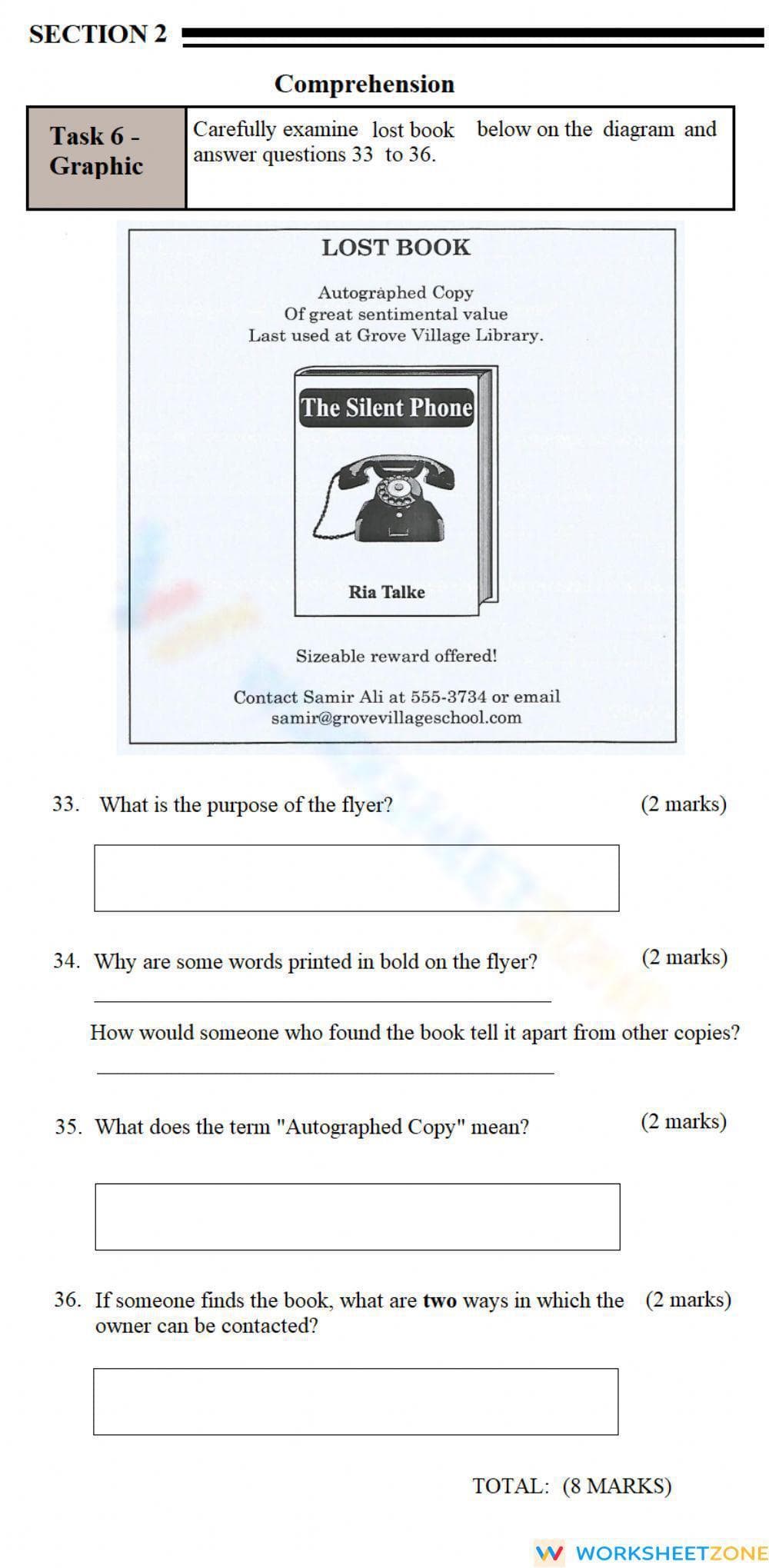
This Grade 5-8 ELA worksheet focuses on the critical skill of interpreting informational graphics. Students analyze a lost-book flyer to extract key details, determine purpose, and define vocabulary in context. This resource ensures students can navigate real-world documents with precision and efficiency while building essential media literacy skills for academic success.
At a Glance
- Grade: 5-8 · Subject: ELA
- Standard:
RI.5.7— Draw on information from multiple print or digital sources to solve problems- Skill Focus: Analyzing informational graphics and flyers
- Format: 1 page · 4 problems · Answer key included · PDF
- Best For: Test prep and informational text practice
- Time: 10–15 minutes
This single-page resource features "Task 6 - Graphic," which presents a realistic flyer for a lost book titled "The Silent Phone." It includes 4 multi-part questions totaling 8 marks. The questions challenge students to identify the flyer's purpose, interpret formatting choices like bold text, define specific vocabulary, and locate contact information. A complete answer key is provided for easy grading and immediate feedback.
Each of the 4 tasks is meticulously mapped to sub-skills within the RI.5.7 and RI.6.7 standards, focusing on evidence extraction and inference from non-prose text. The point-based system (2 marks per question) allows teachers to categorize student performance into Approaching, Meeting, or Exceeding mastery levels. These scores can be entered directly into gradebooks or used to monitor IEP progress for students working on specific informational text goals.
This worksheet aligns with CCSS.ELA-LITERACY.RI.5.7, which requires students to draw on information from multiple print or digital sources, demonstrating the ability to locate an answer to a question quickly or to solve a problem efficiently. Additionally, it supports RI.6.7 by integrating information presented in different media or formats. Both standard codes can be copied directly into lesson plans, IEP goals, or district curriculum mapping tools.
Use this worksheet as a quick formative assessment during a unit on informational text or as a bell ringer to build visual literacy. Teachers should observe whether students can distinguish between factual details and structural intent, such as the purpose of bold text. It is an ideal tool for checking student ability to synthesize information from graphics in under 15 minutes of instructional time.
This resource is designed for middle-grade students (Grades 5-8) who need practice with visual-verbal integration. It is particularly effective for students who benefit from analyzing concise graphics rather than traditional long-form reading passages. Pair this with a short informational passage or an anchor chart on text features for a comprehensive lesson on how information is organized in non-traditional formats.
Research by EdReports (2024) emphasizes that integrating graphics into ELA instruction is essential for developing the multi-modal literacy skills required in modern assessment environments. This worksheet addresses standard RI.5.7 by requiring students to locate answers quickly within a non-prose graphic. By analyzing the "Lost Book" flyer, students practice identifying purpose and interpreting text features, a skill that NAEP data suggests is a strong predictor of overall informational text comprehension. The 4-task structure provides a concise yet rigorous check for understanding, ensuring students can effectively navigate real-world documents. This alignment with rigorous standards ensures that educators are providing evidence-based practice that bridges the gap between classroom learning and practical application, fostering student independence in information retrieval tasks.


