


























Views
Downloads


2.OA.A.1 Worksheet: Word Problems — Grade 2 Aligned
Paste this activity's link or code into your existing LMS (Google Classroom, Canvas, Teams, Schoology, Moodle, etc.).
Students can open and work on the activity right away, with no student login required.
You'll still be able to track student progress and results from your teacher account.
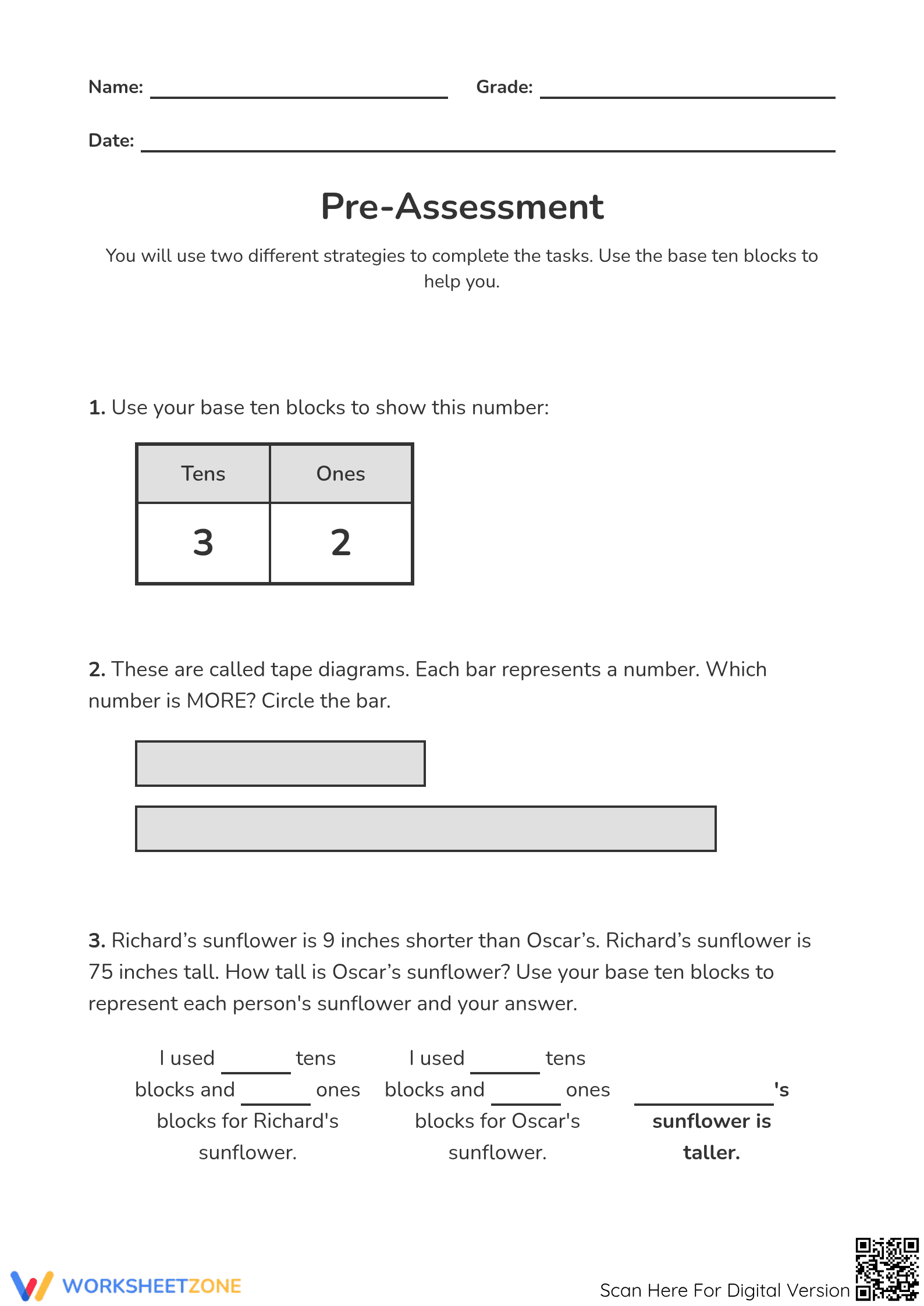
This Grade 2 math pre-assessment evaluates student readiness for solving one- and two-step word problems. By using base ten blocks and tape diagrams, students visualize quantities and compare lengths. This diagnostic tool helps teachers identify exactly where students need support before beginning a new unit on measurement and addition.
At a Glance
- Grade: 2 · Subject: Math
- Standard:
CCSS.MATH.CONTENT.2.OA.A.1— Solve word problems involving addition and subtraction within 100.- Skill Focus: Word Problems & Tape Diagrams
- Format: 3 pages · 6 problems · Answer key included · PDF
- Best For: Pre-assessment and diagnostic testing
- Time: 15–20 minutes
This comprehensive diagnostic includes three pages of carefully sequenced tasks. Students will encounter six multi-part problems requiring them to represent numbers with base ten blocks, interpret tape diagrams, and solve comparison word problems. The layout provides ample workspace for drawing models. A complete three-page answer key is included to ensure quick grading for educators.
To effectively measure student understanding, this assessment can be evaluated using a three-tier mastery rubric. Approaching Mastery: Students can identify the correct operation but struggle to draw accurate tape diagrams or base ten blocks. Meeting Mastery: Students successfully model the problem using the provided visual strategies and calculate the correct answer. Exceeding Mastery: Students clearly label all parts of their tape diagrams and write corresponding equations without prompting. Each task maps directly to a core sub-skill of the standard, and scores can be entered directly into gradebooks or IEP progress notes to track baseline data.
This resource is strictly aligned to CCSS.MATH.CONTENT.2.OA.A.1, requiring students to use addition and subtraction within 100 to solve one- and two-step word problems involving situations of adding to, taking from, putting together, taking apart, and comparing. It also supports CCSS.MATH.CONTENT.2.MD.B.5 by incorporating word problems that involve lengths given in the same units. Both standard codes can be copied directly into lesson plans, IEP goals, or district curriculum mapping tools.
Administer this worksheet before starting a new instructional module on measurement or advanced addition. It serves as an excellent baseline diagnostic to group students for targeted instruction. During the assessment, observe whether students rely heavily on counting individual blocks or if they efficiently identify tens and ones. Expect completion in 15 to 20 minutes.
This assessment is designed for second-grade students preparing to tackle complex word problems. It is particularly useful for inclusive classrooms, as the visual scaffolds—like tape diagrams and base ten blocks—support diverse learners and those with math-related IEP goals. Pair this diagnostic with a hands-on lesson using physical base ten manipulatives to bridge the gap between concrete and representational math concepts.
Effectively evaluating baseline knowledge is a critical component of evidence-based math instruction. This resource aligns with CCSS.MATH.CONTENT.2.OA.A.1, focusing on the ability to solve word problems involving addition and subtraction within 100. According to EdReports 2024, high-quality instructional materials must include diagnostic assessments that accurately measure prerequisite skills before introducing new concepts. By requiring students to use visual models like tape diagrams and base ten blocks, this assessment provides actionable data on student conceptual understanding rather than just procedural fluency. Identifying these gaps early allows educators to tailor their instruction, ensuring that all learners have the foundational skills necessary to succeed in subsequent measurement and algebraic thinking units. Utilizing structured pre-assessments directly correlates with improved student outcomes and more efficient use of instructional time throughout the school year.


