




























Views
Downloads

Halloween Word Search | Grade 3-5 Essential Activity

Paste this activity's link or code into your existing LMS (Google Classroom, Canvas, Teams, Schoology, Moodle, etc.).
Students can open and work on the activity right away, with no student login required.
You'll still be able to track student progress and results from your teacher account.
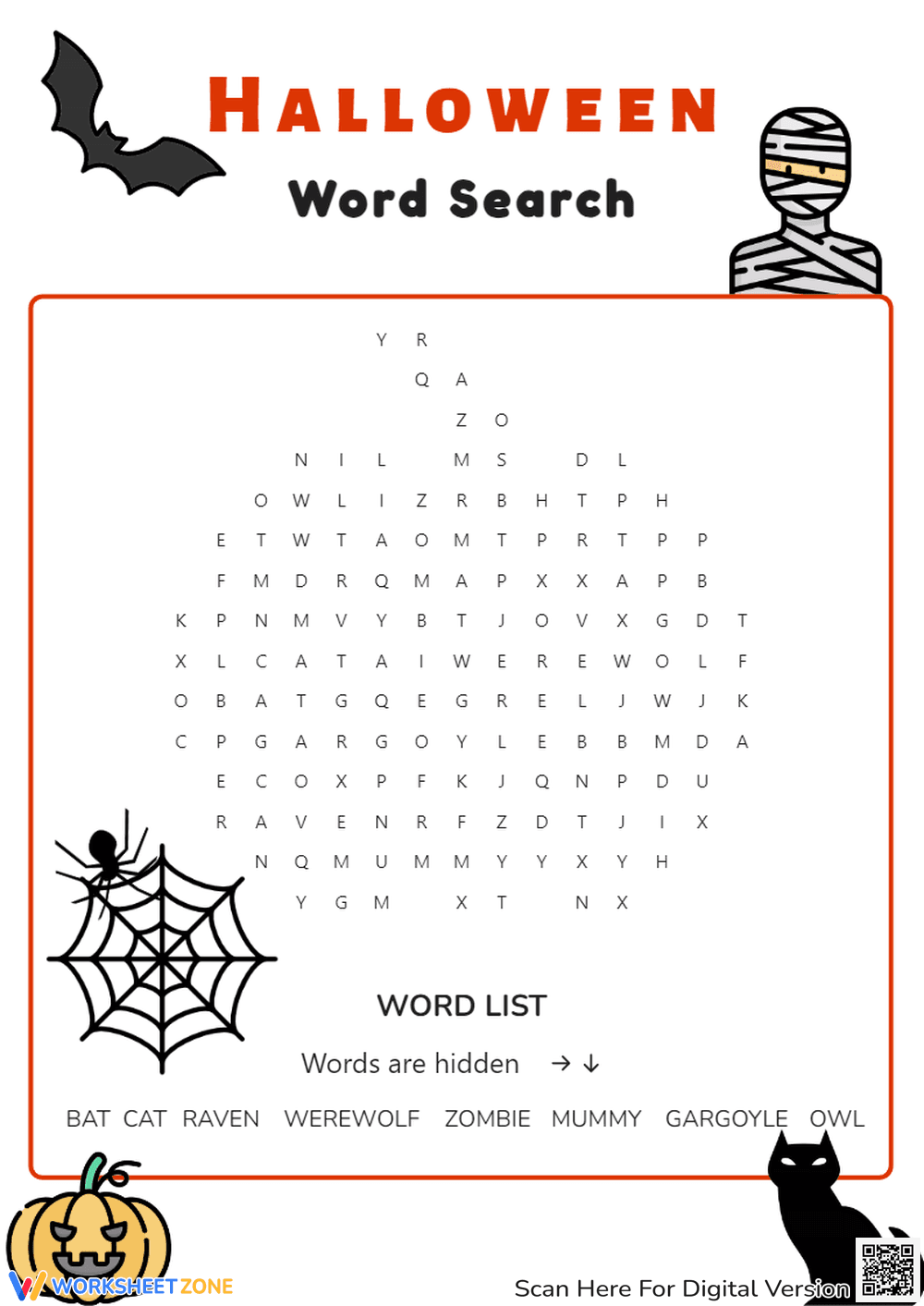
This Halloween-themed word search helps Grade 3 students master spooky vocabulary through visual pattern recognition. By identifying specific letter sequences for words like werewolf and gargoyle, learners strengthen their orthographic processing while celebrating the holiday season. It provides a high-engagement way to reinforce spelling and word recognition in a festive context.
At a Glance
- Grade: 3 · Subject: ELA
- Standard:
CCSS.ELA-LITERACY.L.3.2.F— Use spelling patterns and generalizations in writing words- Skill Focus: Vocabulary & Spelling
- Format: 1 page · 8 problems · Answer key included · PDF
- Best For: Holiday morning work or early finishers
- Time: 10–15 minutes
The worksheet features a clean, Halloween-themed layout with a central word grid. It includes a word list of 8 eerie creatures, including multi-syllabic terms like gargoyle and werewolf. The design includes festive illustrations of bats, mummies, and spiders to maintain student interest. A clear directional key indicates that words are hidden horizontally and vertically, providing a structured challenge for elementary learners.
This resource is designed for a zero-prep classroom workflow. Teachers can print the single-page PDF in less than 30 seconds. Distribution takes approximately 1 minute during a transition period. Reviewing the answers as a whole group or via a displayed key takes 2 minutes, making the total teacher time investment under 5 minutes. It is an ideal emergency sub plan or festive filler for the busy October season.
This activity aligns with CCSS.ELA-LITERACY.L.3.2.F, which requires students to use spelling patterns and generalizations. By searching for specific letter clusters, students reinforce their internal dictionary of common and irregular spelling structures. It also supports CCSS.ELA-LITERACY.L.2.2 for younger learners. Both standard codes can be copied directly into lesson plans, IEP goals, or district curriculum mapping tools.
Use this worksheet as a bell-ringer during the week of Halloween to settle the class immediately upon arrival. It also serves as an effective formative assessment for visual scanning skills. Observe which students struggle to track vertical letter sequences to identify those who may need additional support with spatial orientation in reading. Completion typically takes 12 minutes for the average third-grade student.
This resource is intended for students in Grades 2 through 5, particularly those who benefit from gamified ELA practice. It is highly effective for English Language Learners (ELLs) to build seasonal vocabulary in a low-stress format. Pair this activity with a short informational text about nocturnal animals or a creative writing prompt involving one of the creatures found in the grid to extend the learning.
According to Fisher & Frey (2014), word-level activities like word searches contribute to word consciousness, where students become more aware of and interested in the building blocks of language. This worksheet targets CCSS.ELA-LITERACY.L.3.2.F by requiring students to isolate and identify specific spelling patterns within a complex visual field. Research from the NAEP suggests that frequent exposure to varied vocabulary in different formats improves overall reading fluency and comprehension. By engaging with 8 distinct holiday-themed terms, students build the orthographic mapping necessary for rapid word recognition. This printable resource provides a structured yet low-stakes environment for students to practice these essential literacy skills during high-energy holiday periods. The inclusion of multi-syllabic words ensures that even upper-elementary students find the task appropriately challenging while maintaining a high success rate for younger learners.


