




























Views
Downloads

Hispanic Heritage Achievements Worksheet | Grade 5-7 Ready

Paste this activity's link or code into your existing LMS (Google Classroom, Canvas, Teams, Schoology, Moodle, etc.).
Students can open and work on the activity right away, with no student login required.
You'll still be able to track student progress and results from your teacher account.
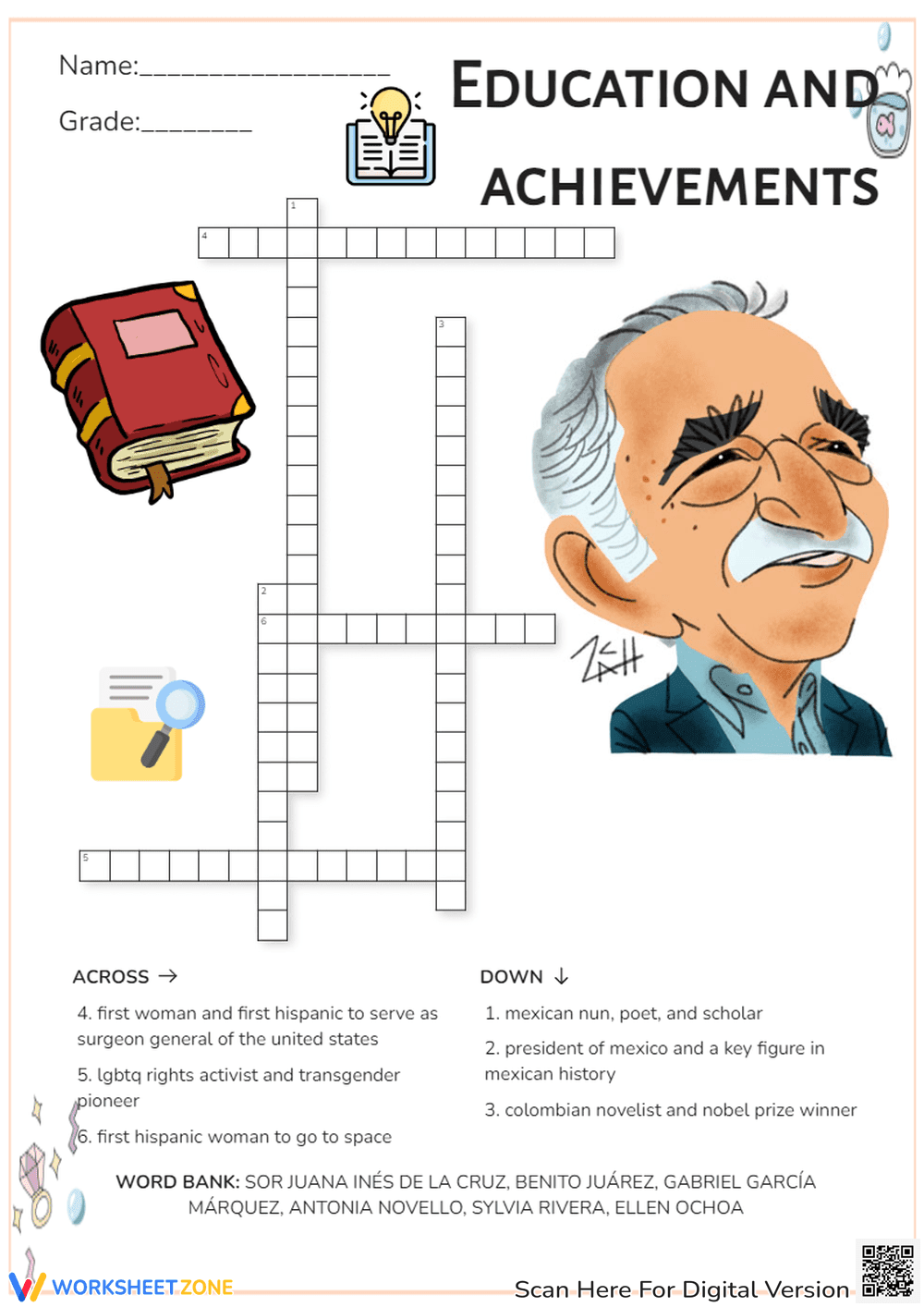
This Grade 5-7 Social Studies worksheet helps students recognize the significant contributions of influential Hispanic leaders through an interactive crossword format. By matching biographical clues to specific names, learners reinforce their understanding of historical figures in science, literature, and civil rights. It is an effective tool for building cultural literacy and vocabulary during Hispanic Heritage Month.
At a Glance
- Grade: 5-7 · Subject: Social Studies
- Standard:
CCSS.ELA-LITERACY.RI.5.1— Quote accurately from a text when explaining what the text says explicitly- Skill Focus: Biographical identification
- Format: 1 page · 6 problems · Answer key included · PDF
- Best For: Hispanic Heritage Month bell-ringers
- Time: 10–15 minutes
What's Inside
The worksheet features a professionally designed crossword puzzle centered on the theme of "Education and Achievements." It includes 6 detailed clues covering diverse fields such as medicine, space exploration, and literature. A clear word bank is provided at the bottom to support student recall, ensuring the activity remains accessible while still challenging their knowledge of historical facts. The layout is clean and student-friendly.
Zero-Prep Workflow
This resource follows a zero-prep workflow designed for busy educators. First, print the single-page PDF for your entire class (30 seconds). Second, distribute the sheets to students as a warm-up or transition activity (1 minute). Third, review the answers using the included key to facilitate a brief class discussion on each figure's legacy (5 minutes). Total teacher preparation time is under 2 minutes, making it an ideal sub-plan.
Standards Alignment
This activity aligns with `CCSS.ELA-LITERACY.RI.5.1`, requiring students to use specific details to identify individuals and their roles. It also supports middle school history standards regarding the contributions of diverse populations to American and global society. Both standard codes can be copied directly into lesson plans, IEP goals, or district curriculum mapping tools for easy documentation.
How to Use It
Use this worksheet as a formative assessment after a lesson on Hispanic Heritage Month to gauge student retention of key biographies. Alternatively, assign it as a fast-finisher task or a sub-plan component. Teachers should observe if students can correctly match the "firsts" (e.g., first Hispanic woman in space) to the correct name. Completion typically takes 10-15 minutes depending on student familiarity.
Who It's For
This resource is designed for students in grades 5, 6, and 7, particularly those studying American history or world literature. It is highly effective for inclusive classrooms where visual aids and word banks provide necessary scaffolding for diverse learners. Pair this crossword with a short reading passage or a classroom anchor chart featuring the six highlighted individuals for a complete lesson.
Research from Fisher & Frey (2014) emphasizes that vocabulary acquisition and factual recall are significantly enhanced when students engage with content through varied formats, such as puzzles and word banks. This worksheet applies these principles by requiring students to synthesize biographical data into a crossword structure, reinforcing the standard CCSS.ELA-LITERACY.RI.5.1. By focusing on 6 specific figures like Ellen Ochoa and Gabriel García Márquez, the activity provides a manageable yet rigorous cognitive load for middle-grade learners. The inclusion of a word bank serves as a critical scaffold, allowing students to focus on the historical "why" and "who" rather than just spelling. This approach aligns with modern pedagogical strategies that prioritize cultural relevance and active engagement. Educators can use this tool to meet diversity requirements while maintaining high academic expectations for evidence-based identification of historical achievements.


