


























Views
Plays
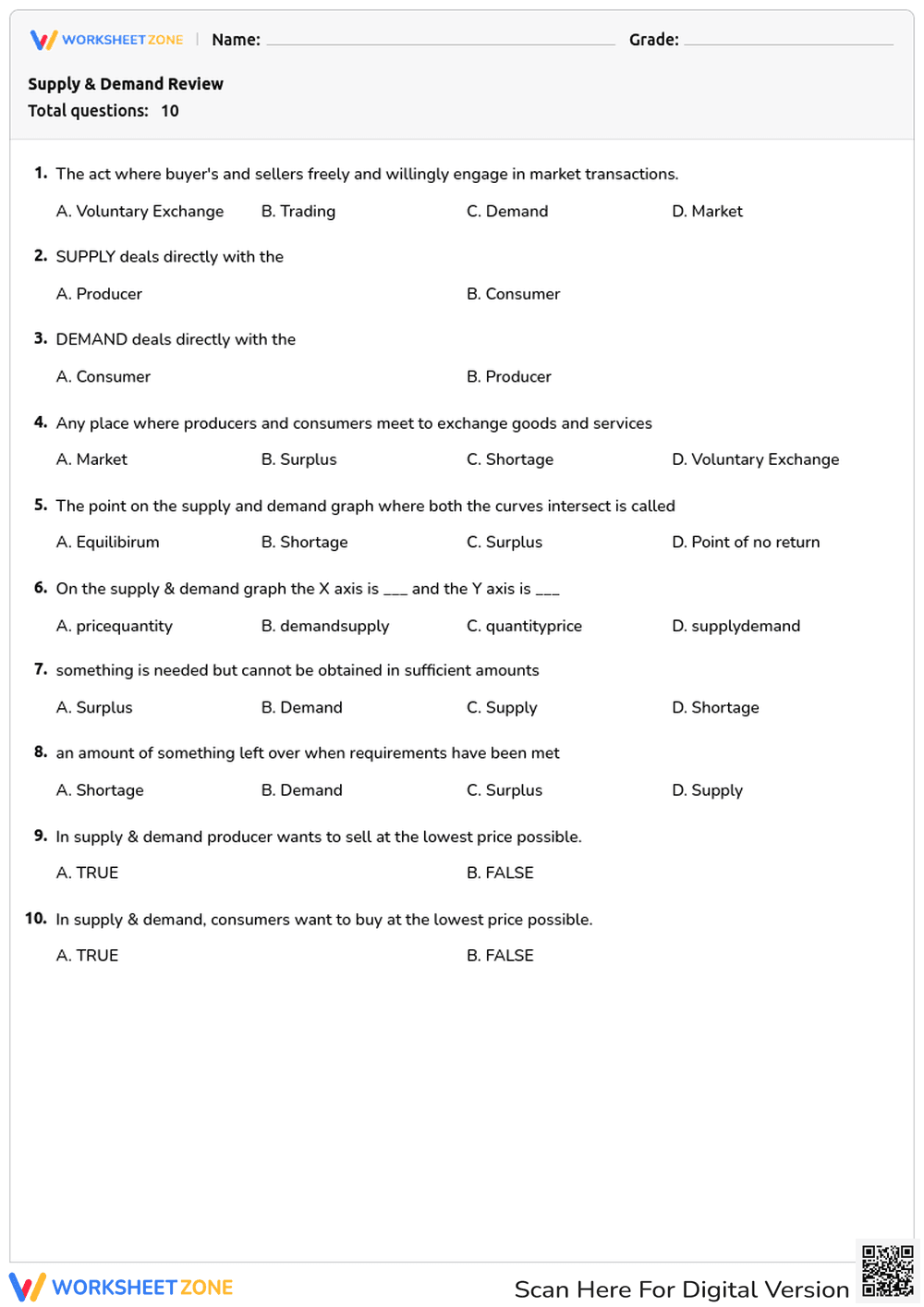

Supply and Demand Worksheet | Grade 11-12 Printable
Paste this activity's link or code into your existing LMS (Google Classroom, Canvas, Teams, Schoology, Moodle, etc.).
Students can open and work on the activity right away, with no student login required.
You'll still be able to track student progress and results from your teacher account.
This high school economics worksheet provides students with targeted practice on supply and demand fundamentals. By evaluating market scenarios, learners solidify their understanding of equilibrium, surpluses, and shortages. The straightforward multiple-choice format allows students to quickly demonstrate their grasp of core economic vocabulary and market behaviors.
At a Glance
- Grade: 11-12 · Subject: Economics
- Standard:
D2.Eco.4.9-12— Evaluate how competition among buyers and sellers impacts markets.- Skill Focus: Supply and demand fundamentals
- Format: 1 page · 10 problems · Answer key included · PDF
- Best For: Quick formative assessment
- Time: 10–15 minutes
This single-page resource features 10 carefully structured questions designed to assess foundational economic knowledge. The task set includes eight multiple-choice questions covering key terms like voluntary exchange, market equilibrium, and the specific roles of producers and consumers. Additionally, two true-or-false statements challenge students to identify the primary motivations of buyers and sellers regarding price points. A complete answer key is provided to ensure accurate and efficient grading.
Zero-Prep Workflow
This resource requires minimal teacher setup.
- Print (1 minute): The single-page layout minimizes copy time and saves paper, making it an ideal quick-print solution.
- Distribute (1 minute): Hand out the assessment as a bell-ringer, exit ticket, or independent practice activity.
- Review (3 minutes): Use the included answer key to rapidly score student responses or facilitate a whole-class review session.
With a total teacher prep time of under two minutes, this worksheet serves as an excellent emergency sub plan or a reliable filler activity for unexpected schedule changes.
Standards Alignment
This activity aligns with D2.Eco.4.9-12, requiring students to evaluate the extent to which competition among sellers and among buyers exists in specific markets. By identifying how surpluses and shortages occur, learners demonstrate comprehension of market forces. Both standard codes can be copied directly into lesson plans, IEP goals, or district curriculum mapping tools.
How to Use It
Deploy this worksheet after direct instruction on market equilibrium to gauge comprehension. It functions perfectly as a 10-minute formative assessment, allowing educators to identify which students struggle with the distinction between a surplus and a shortage. Alternatively, assign it as a brief homework task to reinforce vocabulary before a major unit exam. While monitoring independent work, observe whether students correctly associate the x-axis and y-axis with quantity and price, as this visual mapping is critical for future graphing exercises.
Who It's For
This resource is optimized for 11th and 12th-grade economics students encountering market theory for the first time. The clear, concise question formatting provides built-in differentiation for English Language Learners and students requiring modified assessments, as it avoids overly complex phrasing. Pair this quiz with a visual anchor chart displaying a standard supply and demand curve to support visual learners.
Mastering basic economic vocabulary is a critical stepping stone for advanced financial literacy and comprehensive market analysis. This resource directly targets D2.Eco.4.9-12, prompting students to evaluate how competition among buyers and sellers impacts markets in real-world scenarios. According to EdReports 2024, instructional materials that isolate foundational vocabulary before introducing complex graphical analysis significantly improve long-term retention in high school social studies courses. By breaking down the mechanics of supply and demand into distinct, manageable questions, educators can effectively prevent cognitive overload. This targeted approach ensures that learners build a robust conceptual framework regarding market equilibrium, voluntary exchange, and price motivations. Consequently, students are better prepared to tackle subsequent units on macroeconomic shifts and global trade policies, establishing a strong foundation for college-level coursework and informed civic participation.


