




























Views
Downloads

Kindergarten Easter Counting — Printable No-Prep Worksheet

Paste this activity's link or code into your existing LMS (Google Classroom, Canvas, Teams, Schoology, Moodle, etc.).
Students can open and work on the activity right away, with no student login required.
You'll still be able to track student progress and results from your teacher account.
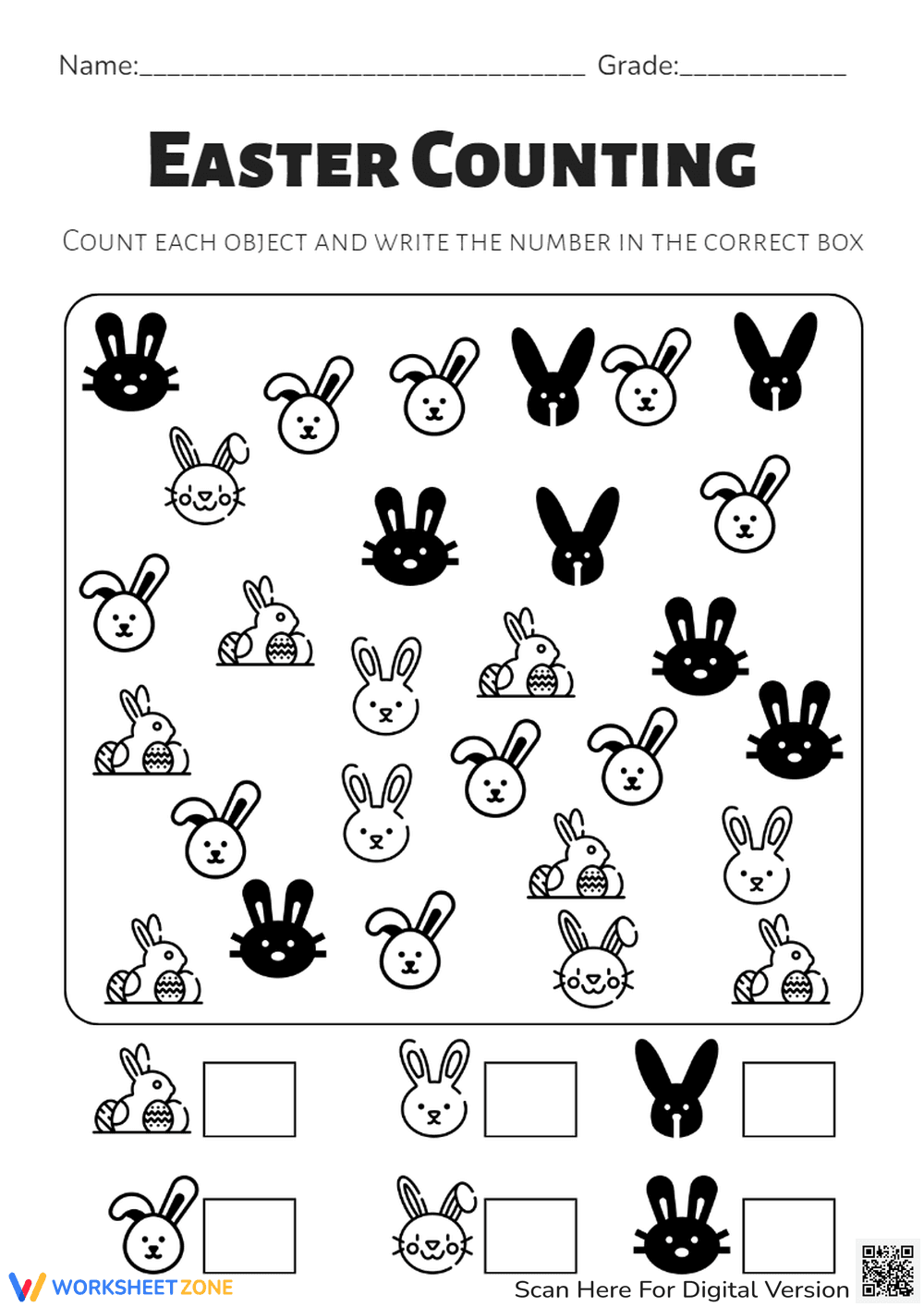
This Easter counting worksheet helps early learners master counting and sorting skills by finding and tallying themed holiday objects. Students count six distinct types of bunny graphics scattered across the page, writing the correct total for each. This activity builds visual discrimination and one-to-one correspondence in a fun, seasonal format.
At a Glance
- Grade: Kindergarten · Subject: Math
- Standard:
K.CC.B.5— Count scattered objects up to 10 to answer how many- Skill Focus: Visual discrimination, sorting, and counting objects
- Format: 1 page · 6 tasks · Answer key included · PDF
- Best For: Independent morning work, math centers, or homework
- Time: 10–15 minutes
The worksheet features a single page filled with a variety of cute Easter bunny illustrations. There are six different styles of bunnies, including bunnies holding eggs, solid black silhouettes, and simple line drawings. Below the main activity box, students find six corresponding answer boxes where they write the final count for each specific bunny type. This layout encourages organized scanning and systematic counting.
Zero-Prep Workflow
Deploy this resource immediately with under two minutes of prep time:
- Print (1 minute): Copy the clean black-and-white page to save ink.
- Distribute (30 seconds): Hand out sheets. Visual cues let students start without explanation.
- Review (30 seconds): Grade quickly with the answer key or project for group review.
This self-explanatory sheet is perfect for emergency sub plans.
Standards Alignment
This activity aligns with standard K.CC.B.5 to count scattered objects up to 20. Students practice organizing chaotic visual fields. It also supports standard K.CC.B.4 by reinforcing the relationship between numbers and quantities. Both standard codes can be copied directly into lesson plans, IEP goals, or district curriculum mapping tools.
How to Use It
Use this worksheet during your morning routine or as a transition activity after direct instruction on counting. It works well as a quick formative assessment to observe how students track objects they have already counted. For example, teachers can watch if students cross out the bunnies as they count them to avoid double-counting. Expect students to complete the page in 10 to 15 minutes.
Who It's For
This resource is tailored for kindergarteners and first graders developing early numeracy skills. It provides excellent practice for students who need extra support with visual tracking or one-to-one correspondence. Pair this worksheet with concrete manipulatives, like plastic Easter eggs or counters, to help struggling learners bridge the gap between physical objects and paper-and-pencil tasks.
According to the ScienceDirect TpT Analysis, structured thematic worksheets that combine visual discrimination with counting tasks significantly enhance early math engagement and retention. This worksheet directly targets the standard K.CC.B.5, helping young learners develop the ability to count scattered objects up to 10. By requiring students to distinguish between six highly similar bunny graphics, the activity strengthens executive functioning and visual scanning skills. Research shows that integrating seasonal themes into math practice helps sustain attention in early childhood classrooms. Teachers can confidently use this resource to assess one-to-one correspondence and cardinality. The structured layout ensures that students practice systematic counting strategies, which are foundational for future addition and subtraction concepts. This printable worksheet serves as an effective tool for both formative assessment and independent practice in early childhood math curricula.


