


























Views
Downloads

Easter Reading Comprehension | Grade 4-6 Essential
Paste this activity's link or code into your existing LMS (Google Classroom, Canvas, Teams, Schoology, Moodle, etc.).
Students can open and work on the activity right away, with no student login required.
You'll still be able to track student progress and results from your teacher account.
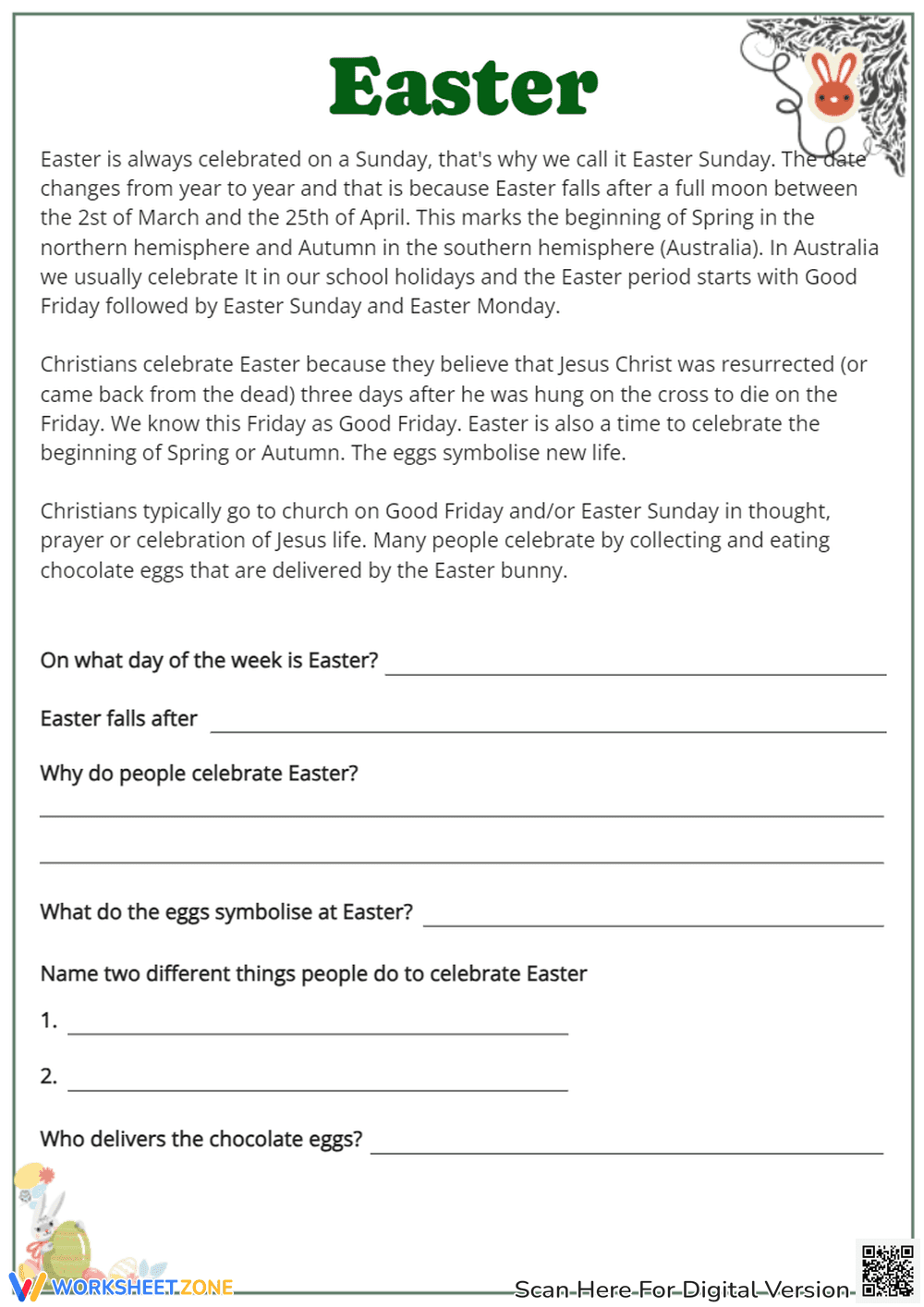
This Grade 4-6 Easter reading comprehension worksheet helps students understand the cultural and religious traditions of the holiday. By engaging with an informational passage, learners practice extracting specific details to answer literal and inferential questions. It is designed to strengthen reading stamina while exploring seasonal themes in a structured, academic format.
At a Glance
- Grade: 4-6 · Subject: ELA
- Standard:
CCSS.ELA-LITERACY.RI.4.1— Refer to details and examples in a text when explaining explicit information- Skill Focus: Informational Text Comprehension
- Format: 1 page · 6 problems · Answer key included · PDF
- Best For: Holiday literacy centers or morning work
- Time: 15–20 minutes
This resource features a concise three-paragraph informational text covering the timing of Easter, religious significance, and common symbols like eggs and the Easter bunny. Following the text, students encounter 6 targeted questions, including fill-in-the-blank and short-answer formats. The single-page layout ensures all necessary information is visible at once, reducing cognitive load for intermediate readers.
The zero-prep workflow is designed for maximum efficiency. First, print the single-page PDF (30 seconds). Next, distribute the sheets to students as a warm-up or independent reading task (1 minute). Finally, review the answers using the included key to provide immediate feedback (5 minutes). This makes it an ideal resource for substitute folders or busy holiday weeks.
This worksheet aligns primarily with `CCSS.ELA-LITERACY.RI.4.1`, which requires students to refer to details and examples in a text when explaining what the text says explicitly. It also supports RI.5.1 and RI.6.1 by encouraging evidence-based responses. Both standard codes can be copied directly into lesson plans, IEP goals, or district curriculum mapping tools.
Use this worksheet during a literacy block as a formative assessment of reading comprehension. It works well as a "Do Now" activity to settle the class or as a quiet independent task following a group discussion about spring holidays. Teachers can observe if students are looking back at the text to find specific dates and symbols, providing a quick check on active reading strategies.
This resource is tailored for students in grades 4 through 6 who are developing their ability to synthesize informational text. It is particularly useful for English Language Learners (ELLs) due to its clear vocabulary and direct question-to-text mapping. Pair this worksheet with a holiday-themed anchor chart or a short video about global spring traditions for a comprehensive lesson.
According to the RAND AIRS 2024 report, high-quality informational text sets are critical for developing the background knowledge necessary for long-term reading proficiency. This worksheet addresses that need by providing a focused look at the cultural and historical context of Easter. By requiring students to locate specific evidence within the text—such as the symbolic meaning of eggs or the specific days of the Easter period—the resource reinforces the close reading habits championed by Fisher & Frey (2014). Research indicates that short, high-interest passages with direct comprehension checks significantly improve retention in middle-grade learners. This 1-page tool provides 6 distinct opportunities for students to practice these essential literacy skills, ensuring they meet the rigorous demands of CCSS.ELA-LITERACY.RI.4.1 while engaging with seasonal content that maintains classroom interest during holiday transitions.


