


























Views
Downloads

Grade 9 Earthworm Anatomy — Printable No-Prep Worksheet
Paste this activity's link or code into your existing LMS (Google Classroom, Canvas, Teams, Schoology, Moodle, etc.).
Students can open and work on the activity right away, with no student login required.
You'll still be able to track student progress and results from your teacher account.
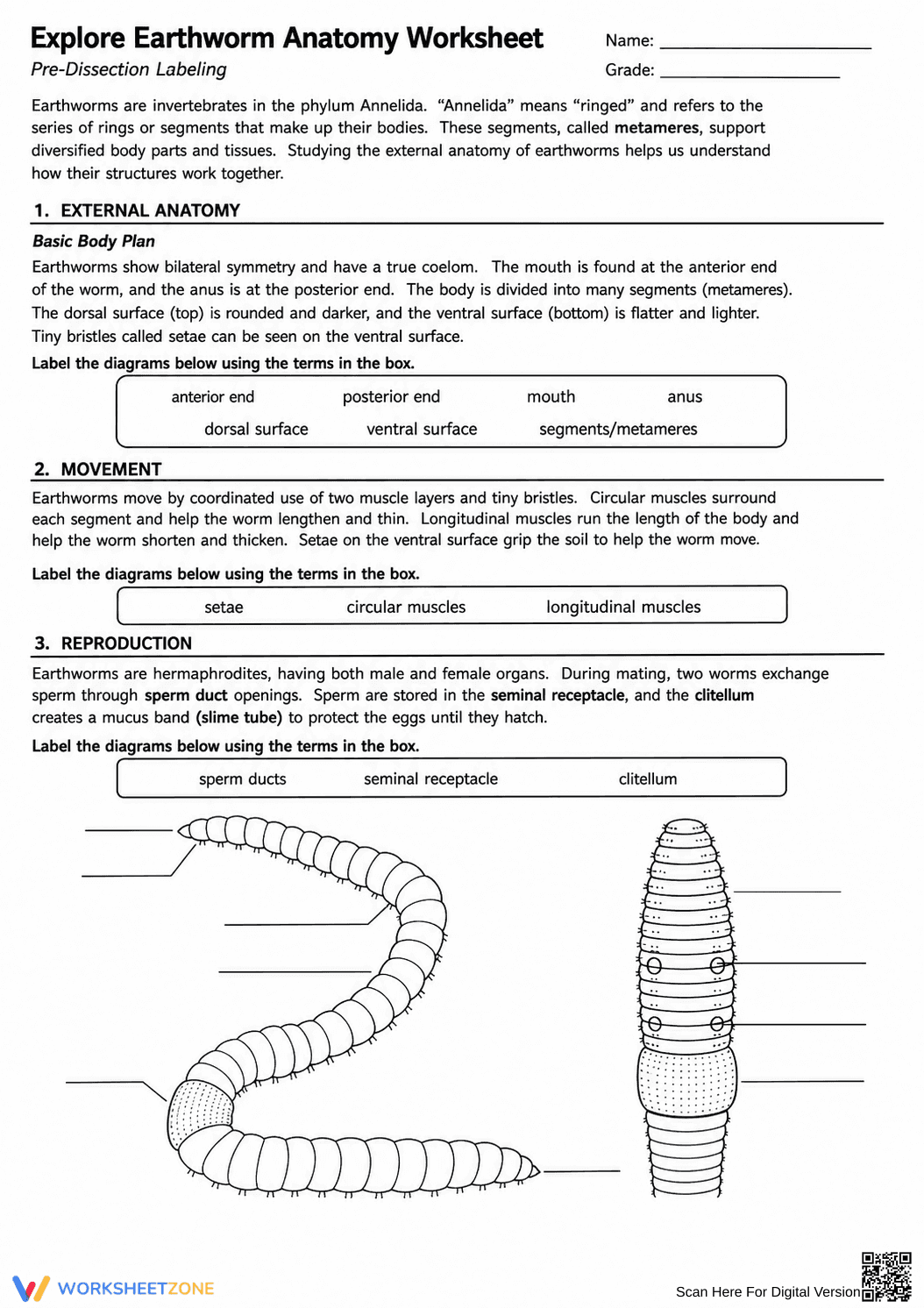
This pre-dissection biology worksheet prepares students for lab work by focusing on earthworm anatomy and physiological structures. Students read introductory text about the Annelida phylum and apply that knowledge to label diagrams of external and internal systems, ensuring they understand how specific structures support biological functions before beginning their dissection.
At a Glance
- Grade: 9 · Subject: Biology
- Standard:
HS-LS1-2— Illustrate interacting systems providing specific functions in organisms- Skill Focus: Anatomy identification and labeling
- Format: 2 pages · 35 problems · Answer key included · PDF
- Best For: Pre-lab preparation
- Time: 20–30 minutes
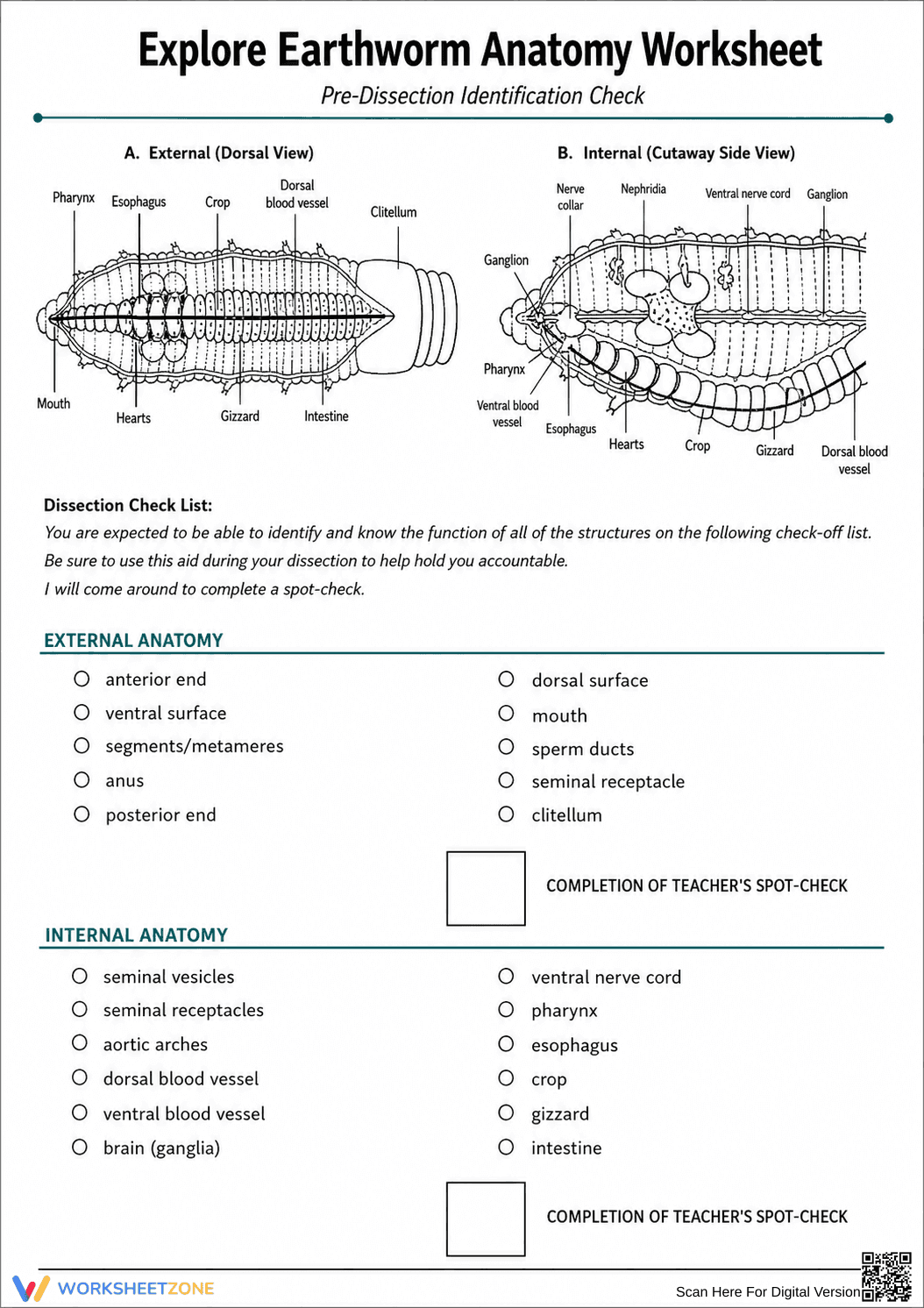
This two-page resource features comprehensive reading sections covering basic body plans, movement, and reproduction, paired with 13 diagram labeling tasks using provided word banks. The second page includes detailed reference diagrams of both dorsal and cutaway side views, alongside a 22-item dissection checklist. This checklist serves as a built-in accountability tool, complete with designated spaces for a teacher's spot-check signature during the actual lab.
Zero-Prep Workflow
- Print (1 minute): Generate copies of the two-page PDF for each student. No special materials or prior setup are required for this phase of the lab.
- Distribute (1 minute): Hand out the worksheets as a bell-ringer or independent assignment before moving to the lab stations.
- Review (3 minutes): Quickly verify student labels using the reference diagrams on page two, then use the checklist to conduct rapid spot-checks during the dissection.
Total teacher prep time is under two minutes, making this an excellent emergency sub plan for science classes.
Standards Alignment
This resource is aligned to HS-LS1-2: Develop and use a model to illustrate the hierarchical organization of interacting systems that provide specific functions within multicellular organisms. By identifying structures like setae, aortic arches, and the clitellum, students connect specific anatomical features to movement, circulation, and reproduction. Both standard codes can be copied directly into lesson plans, IEP goals, or district curriculum mapping tools.
How to Use It
Deploy this worksheet immediately before direct instruction on invertebrate anatomy or as a mandatory pre-requisite activity before handing out dissection tools. For formative assessment, observe students as they complete the labeling section; if they struggle to differentiate between circular and longitudinal muscles, pause for a brief class clarification. Expected completion time is 20 to 30 minutes, depending on reading speed.
Who It's For
This activity is designed for high school biology and life science students preparing for hands-on laboratory work. The embedded reading passages and word banks provide natural differentiation for students who need vocabulary support. It pairs perfectly with physical earthworm specimens or virtual dissection software.
Effective laboratory preparation requires students to build a strong conceptual model of organism anatomy before engaging in physical dissection. Aligned with HS-LS1-2, this resource requires students to illustrate interacting systems providing specific functions in organisms by mapping vocabulary directly onto anatomical diagrams. According to a ScienceDirect TpT Analysis, structured pre-lab activities that combine reading comprehension with visual labeling significantly reduce cognitive overload during complex hands-on procedures. By familiarizing themselves with terms like metameres, seminal receptacles, and ganglia prior to the lab, students can focus their working memory on the physical skills of dissection rather than basic identification. This dual-page approach ensures that learners transition smoothly from theoretical understanding to practical application, maximizing the instructional value of the laboratory period while providing teachers with a reliable framework for assessing student readiness.


