


























Views
Downloads

Earthworm Dissection Guide | Essential Biology Worksheet
Paste this activity's link or code into your existing LMS (Google Classroom, Canvas, Teams, Schoology, Moodle, etc.).
Students can open and work on the activity right away, with no student login required.
You'll still be able to track student progress and results from your teacher account.
This Earthworm Dissection: Biology Exploration worksheet provides a structured framework for students to investigate annelid anatomy. By following a systematic procedural checklist, learners identify key external features and internal organ systems. This resource ensures students maintain focus during laboratory sessions, leading to higher retention of biological structures and their physiological functions.
At a Glance
- Grade: 7-12 · Subject: Biology
- Standard:
MS-LS1-3— Evidence that the body is a system of interacting subsystems- Skill Focus: Anatomical Identification
- Format: 1 page · 12 tasks · Answer key included · PDF
- Best For: Laboratory procedural guidance and observation
- Time: 45–60 minutes
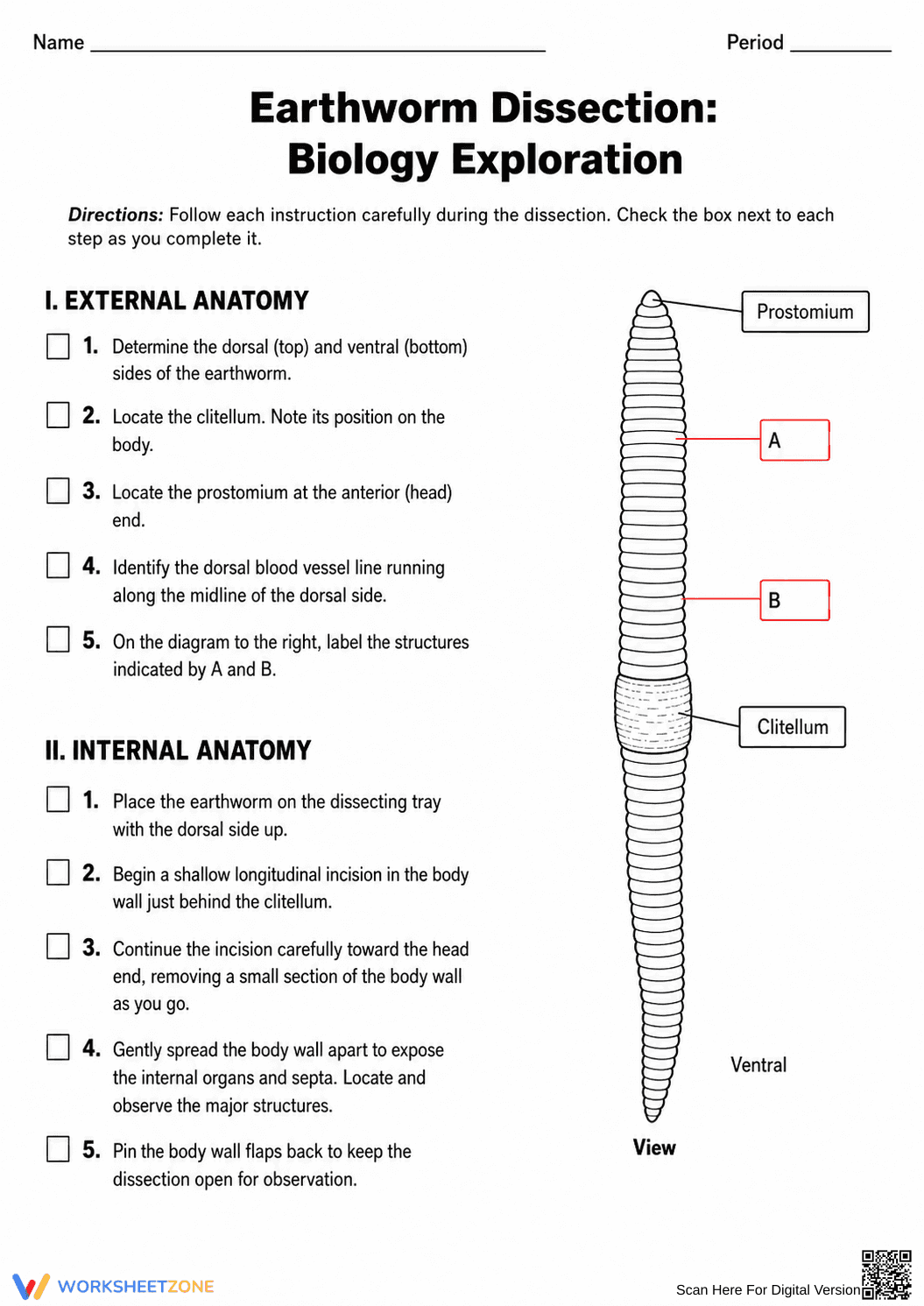
The worksheet features a comprehensive two-part guide covering external and internal anatomy. It includes 10 specific procedural steps with integrated checkboxes for student accountability. A detailed anatomical diagram of an earthworm is provided, featuring labeling callouts for the prostomium, clitellum, and specific segments. The layout is designed for high visibility in a laboratory environment.
Zero-Prep Workflow
- Print: Select the single-page PDF and print enough copies for your lab groups (1 minute).
- Distribute: Hand out the guides alongside dissection kits and specimens (1 minute).
- Review: Use the integrated checklist to monitor student progress in real-time as they move from external observation to internal incision.
Total teacher prep time is under 2 minutes, making this an ideal resource for busy lab days or as a detailed sub plan for science departments.
Standards Alignment
Primary standard: MS-LS1-3 — "Use argument supported by evidence for how the body is a system of interacting subsystems composed of groups of cells." This worksheet allows students to physically observe these interacting systems, such as the dorsal blood vessel and digestive tract. Both standard codes can be copied directly into lesson plans, IEP goals, or district curriculum mapping tools.
How to Use It
Assign this worksheet during the active laboratory phase of a biology unit on invertebrates. It serves as a primary procedural guide that prevents students from rushing through the dissection process. For formative assessment, walk around the lab and check that students have correctly labeled structures A and B on their diagrams before they proceed to the internal anatomy section. Expected completion time is approximately 45–60 minutes.
Who It's For
This resource is designed for middle and high school science students (Grades 7-12) studying life science or zoology. It is particularly effective for visual learners who benefit from seeing a diagram alongside written instructions. Pair this worksheet with a pre-lab video or an anatomical anchor chart to provide additional scaffolding for students new to dissection techniques.
The Earthworm Dissection: Biology Exploration worksheet aligns with the MS-LS1-3 standard by facilitating direct observation of biological subsystems. Research from the RAND AIRS 2024 report indicates that structured laboratory guides significantly reduce cognitive load during complex manual tasks, allowing students to focus on conceptual connections rather than just procedural execution. By requiring students to check off steps and label diagrams, the worksheet reinforces the "I Do, We Do, You Do" model of gradual release within a lab setting. Fisher & Frey (2014) emphasize that such scaffolds are vital for developing technical literacy in secondary science environments. This 1-page PDF provides the necessary structure for a 50-minute lab period, ensuring that anatomical identification of the prostomium and clitellum is accurate. The inclusion of specific checkboxes promotes student agency and self-regulation during scientific inquiry.


