


























Views
Downloads


Grade 3 Earth Day Reading Comprehension | Printable
Paste this activity's link or code into your existing LMS (Google Classroom, Canvas, Teams, Schoology, Moodle, etc.).
Students can open and work on the activity right away, with no student login required.
You'll still be able to track student progress and results from your teacher account.
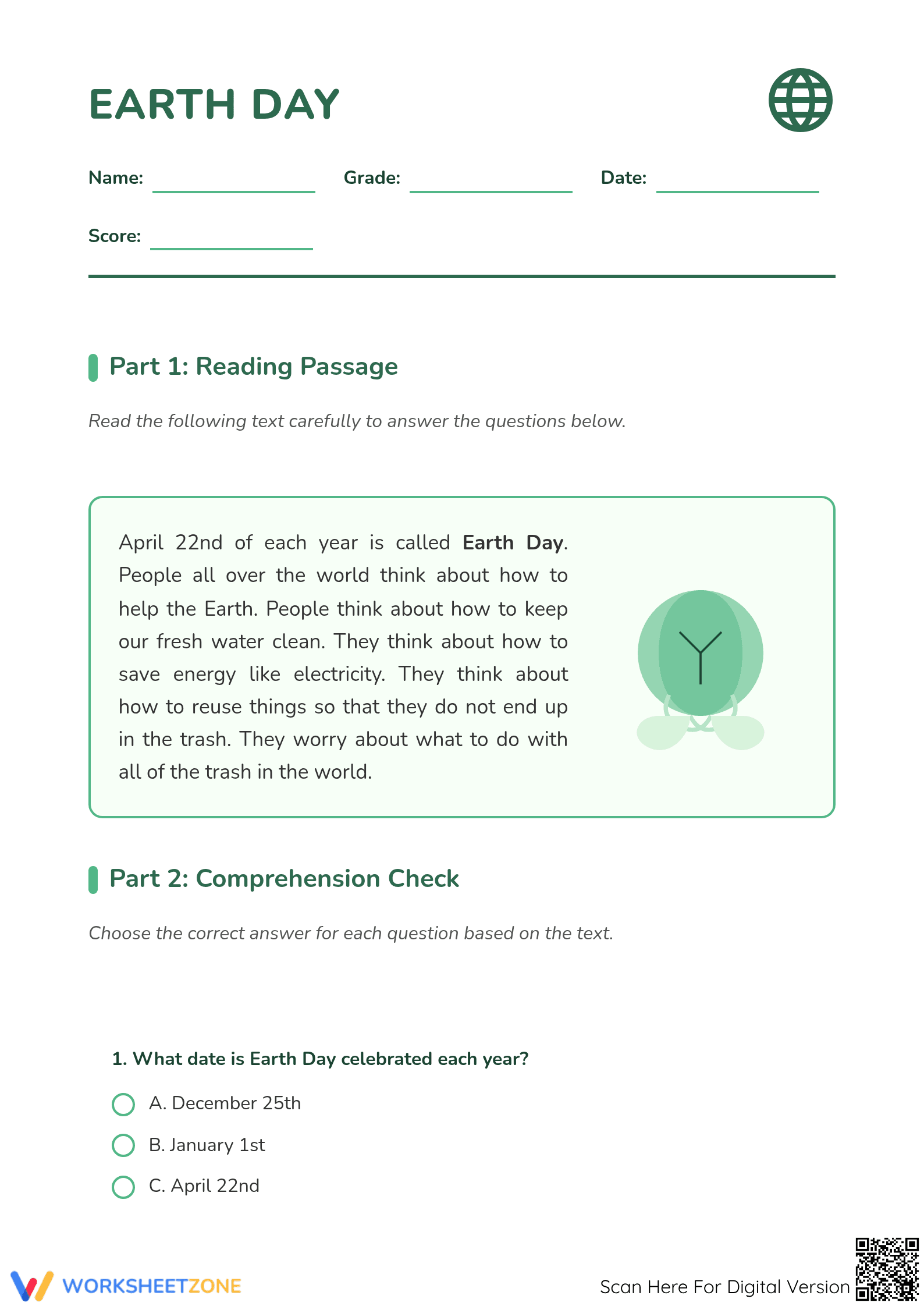
This ready-to-use Earth Day reading comprehension worksheet helps third and fourth-grade students build essential informational text skills. By reading a short, engaging passage and answering targeted questions, learners practice locating text evidence, synthesizing information, and understanding environmental vocabulary while celebrating our planet.
At a Glance
- Grade: 3 · Subject: ELA
- Standard:
CCSS.ELA-LITERACY.RI.3.1— Ask and answer questions using text evidence- Skill Focus: Reading Comprehension
- Format: 3 pages · 7 problems · Answer key included · PDF
- Best For: Independent practice and holiday activities
- Time: 15–20 minutes
This comprehensive three-page packet includes a short informational reading passage about Earth Day, followed by three distinct activity sections. Students will complete three multiple-choice comprehension questions, one short-answer critical thinking prompt, and a three-part vocabulary matching activity focusing on the concepts of reduce, reuse, and recycle. A complete answer key is provided for quick and accurate grading.
Zero-Prep Workflow
This resource requires under two minutes of total teacher prep time:
- Print (1 minute): Print the three-page PDF student packet.
- Distribute (1 minute): Hand out during your literacy block or morning work.
- Review (3 minutes): Use the included answer key to quickly check student responses or guide a whole-class discussion on environmental awareness.
The self-explanatory instructions make this packet perfect for emergency sub plans.
Standards Alignment
This worksheet is directly aligned to CCSS.ELA-LITERACY.RI.3.1, requiring students to ask and answer questions to demonstrate understanding of a text, referring explicitly to the text as the basis for the answers. It also supports vocabulary acquisition by having students determine the meaning of domain-specific words related to Earth Day. Both standard codes can be copied directly into lesson plans, IEP goals, or district curriculum mapping tools.
How to Use It
This resource fits perfectly into April lesson plans. Use it as an independent reading activity after a brief whole-class discussion about environmental conservation. Alternatively, assign it as meaningful morning work on Earth Day to set a thematic tone for the morning. As a formative assessment tip, observe how students approach the short-answer question; check if they are pulling specific details from the passage or relying solely on prior knowledge. Students can complete the packet in 15 to 20 minutes.
Who It's For
This worksheet is primarily designed for third and fourth-grade students developing their informational reading skills. The straightforward text and clear question formats make it accessible for on-level readers, while the critical thinking prompt provides a slight challenge for advanced students. For students needing extra support, teachers can read the passage aloud before having them tackle the questions independently. It pairs naturally with an anchor chart on the "Three Rs" (Reduce, Reuse, Recycle) or a broader science lesson on natural resources.
Integrating thematic reading passages into daily literacy instruction significantly boosts student engagement and comprehension retention. According to a recent ScienceDirect TpT Analysis, connecting core reading skills to real-world events or holidays increases task persistence and motivation in elementary learners. This specific worksheet targets CCSS.ELA-LITERACY.RI.3.1, explicitly helping students ask and answer questions using text evidence. By combining a high-interest topic like Earth Day with structured comprehension tasks, educators can effectively assess both reading fluency and analytical thinking in a single session. The strategic inclusion of multiple-choice, short-answer, and vocabulary matching formats ensures a comprehensive evaluation of the student's ability to process and apply informational text. Providing targeted practice with domain-specific environmental vocabulary further strengthens overall reading proficiency, making this an evidence-based tool for spring literacy blocks and cross-curricular science integration.


