


























Views
Downloads

Printable Earth Day Word Search | Grade 3
Paste this activity's link or code into your existing LMS (Google Classroom, Canvas, Teams, Schoology, Moodle, etc.).
Students can open and work on the activity right away, with no student login required.
You'll still be able to track student progress and results from your teacher account.
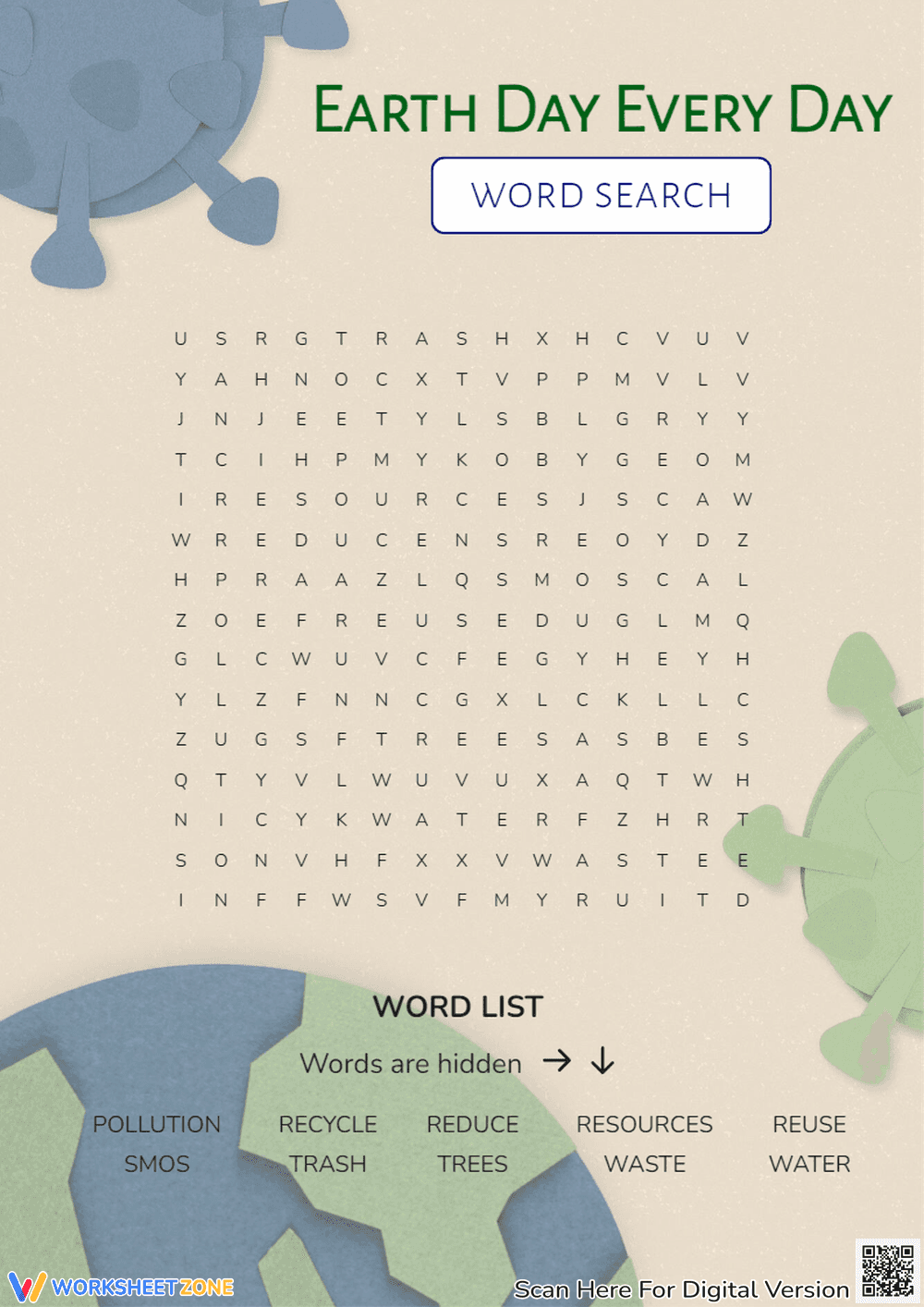
This Earth Day word search worksheet builds essential environmental vocabulary while keeping students engaged. By hunting for ten thematic words, learners reinforce spelling patterns and domain-specific language related to conservation. It provides a focused, independent activity that supports holiday themes without requiring extensive instructional setup.
At a Glance
- Grade: 3 · Subject: ELA
- Standard:
CCSS.ELA-LITERACY.L.3.6— Acquire and use domain-specific words- Skill Focus: Vocabulary Recognition
- Format: 1 page · 10 problems · Answer key included · PDF
- Best For: Independent practice and morning work
- Time: 10–15 minutes
Inside this single-page resource, educators will find a clearly formatted letter grid featuring ten hidden words related to environmental awareness, such as pollution, recycle, and resources. The bottom of the page includes a straightforward word bank with directional arrows indicating that words are hidden horizontally and vertically. The clean, visually appealing design minimizes distractions, allowing students to focus entirely on the vocabulary task at hand.
This resource offers a zero-prep workflow:
- Print (1 minute): Download the PDF and print. The design ensures crisp reproduction.
- Distribute (1 minute): Hand out during transitions. No teacher setup required.
- Review (3 minutes): Quickly check progress by scanning completed grids.
With total prep time under two minutes, it is perfect for sub plans.
This activity aligns directly with CCSS.ELA-LITERACY.L.3.6, which requires students to acquire and use accurately grade-appropriate conversational, general academic, and domain-specific words and phrases. By interacting repeatedly with terms like "reduce" and "reuse," students solidify their grasp of environmental science vocabulary within an ELA context. It also supports CCSS.ELA-LITERACY.RF.3.3 by reinforcing phonics and word analysis skills in decoding. Both standard codes can be copied directly into lesson plans, IEP goals, or district curriculum mapping tools.
Teachers can deploy this word search as an effective morning work assignment on Earth Day, giving students a quiet, focused task while attendance is taken. Alternatively, it serves as an excellent transition activity after a direct instruction lesson on recycling and conservation. As a formative assessment observation tip, educators can monitor which students struggle to locate words horizontally versus vertically, providing quick insight into visual tracking skills. The expected completion time ranges from 10 to 15 minutes.
This worksheet is primarily designed for second, third, and fourth-grade students developing their domain-specific vocabulary. For differentiation, teachers can highlight the first letter of each hidden word for students who need visual accommodations, or challenge advanced learners to write a short paragraph using five of the vocabulary words on the back of the page. It pairs naturally with an anchor chart detailing the three R's (Reduce, Reuse, Recycle) or a short informational passage about Earth Day.
Integrating thematic vocabulary exercises into the classroom routine supports broader literacy goals. According to a RAND AIRS 2024 report, students who engage with domain-specific terminology in varied, low-stakes formats demonstrate higher retention rates of academic language. This worksheet targets CCSS.ELA-LITERACY.L.3.6, helping learners acquire and use domain-specific words effectively. By searching for terms related to environmental conservation, students practice visual scanning and spelling reinforcement simultaneously. The structured nature of a word search provides a predictable framework that reduces cognitive load, allowing learners to focus entirely on word recognition. This approach not only builds essential vocabulary but also fosters independent problem-solving skills. Regular exposure to targeted terminology through engaging formats ensures that students can confidently apply these words in both conversational and academic contexts, strengthening their overall communication abilities.


