


























Views
Downloads



Essential Counting Objects Worksheet | K-Grade Math Ready
Paste this activity's link or code into your existing LMS (Google Classroom, Canvas, Teams, Schoology, Moodle, etc.).
Students can open and work on the activity right away, with no student login required.
You'll still be able to track student progress and results from your teacher account.
This Kindergarten counting objects worksheet provides a comprehensive path for early learners to master 1-to-1 correspondence. By engaging with vibrant visuals like flowers and ladybugs, students build a concrete understanding of how numbers represent quantities. It ensures young mathematicians move beyond rote counting to true conceptual mastery of sets and numerals.
At a Glance
- Grade: Kindergarten · Subject: Math
- Standard:
CCSS.MATH.CONTENT.K.CC.B.5— Count to answer "how many?" questions about things arranged in a line or array- Skill Focus: 1-to-1 Correspondence and Numeral Writing
- Format: 3 pages · 17 problems · Answer key included · PDF
- Best For: Kindergarten daily math practice and classroom centers
- Time: 15–20 minutes
What's Inside
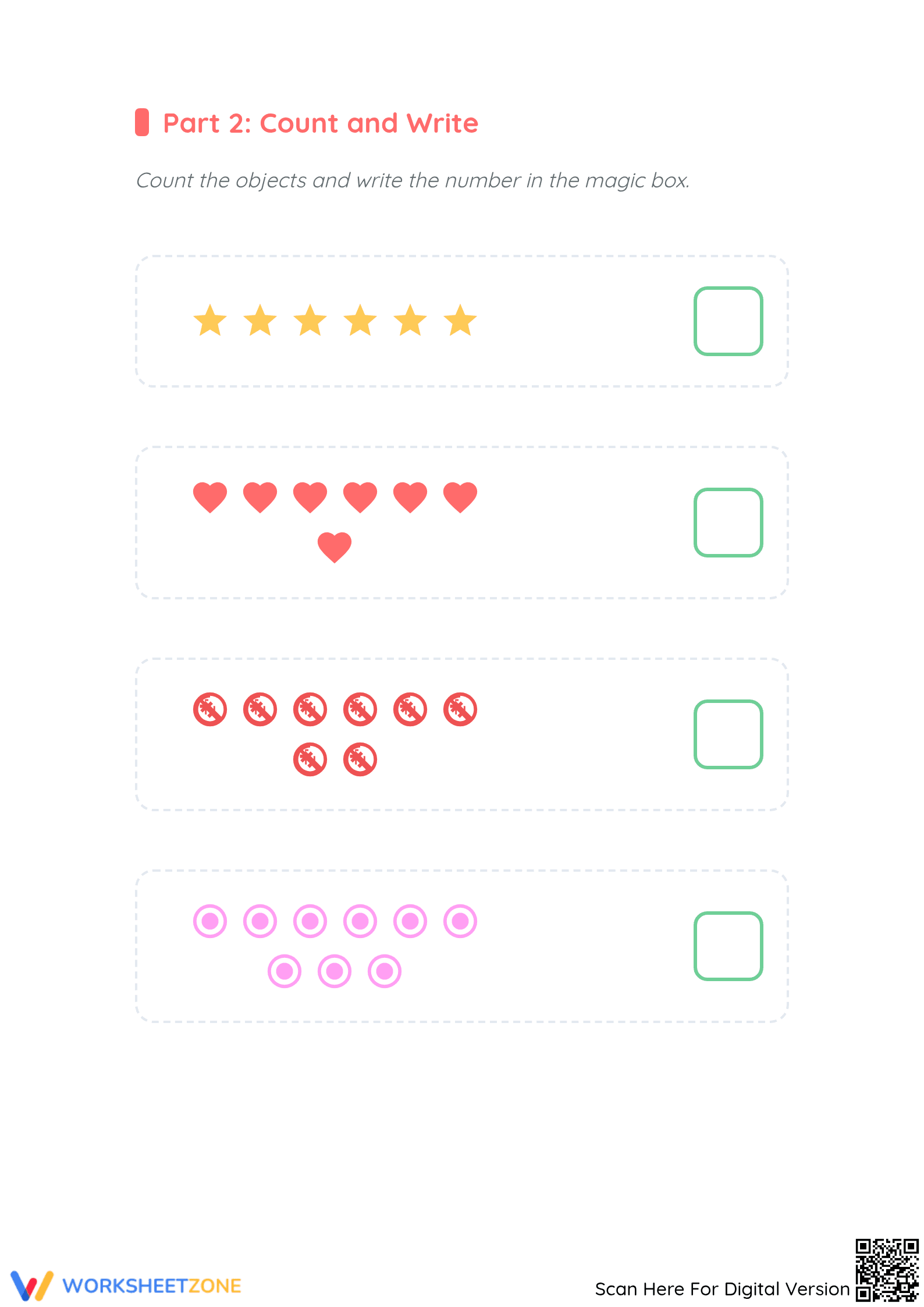
This 3-page resource offers 17 diverse problems designed to reinforce number sense. Page one focuses on matching groups to numerals, page two requires circling the correct value from a choice of three, and page three challenges students to write the numeral independently. A full answer key is provided for all pages to facilitate quick grading.
Zero-Prep Workflow
This resource is designed for immediate classroom implementation with a three-step workflow: Print (30 seconds), Distribute (1 minute), and Review (5 minutes). The total teacher prep time is under 2 minutes, making it an ideal choice for busy mornings or as a high-quality addition to emergency sub plans. The clear visual layout ensures students can begin working with minimal verbal instructions.
Standards Alignment
The primary alignment is to `CCSS.MATH.CONTENT.K.CC.B.5`: "Count to answer 'how many?' questions about as many as 20 things arranged in a line, a rectangular array, or a circle, or as many as 10 things in a scattered configuration." It also supports `CCSS.MATH.CONTENT.K.CC.B.4` regarding the relationship between numbers and quantities. Both standard codes can be copied directly into lesson plans, IEP goals, or district curriculum mapping tools.
How to Use It
Use this packet during independent work time after a whole-group lesson on counting to 10. Teachers can observe if students are touching each object as they count, which is a key formative assessment tip for identifying 1-to-1 correspondence accuracy. Expect completion in about 18 minutes depending on the student's fine motor skills for writing numerals during the final assessment phase.
Who It's For
This worksheet is ideal for Kindergarten and early Grade 1 students. It pairs naturally with physical manipulatives or a classroom number line to support students who need concrete reinforcement before transitioning to the abstract representations on the page. It is also suitable for special education settings focusing on foundational math goals.
Research from RAND AIRS 2024 emphasizes that visual-spatial representations of number sets are critical for early numeracy development. By using objects like flowers and ladybugs, this worksheet leverages familiar imagery to lower the cognitive load during the abstraction of quantity. Fisher & Frey (2014) highlight the importance of the gradual release of responsibility, which is mirrored here through the transition from matching to circling to writing numerals. This scaffolding helps prevent math anxiety by providing safety nets in the early stages of practice. According to NAEP data, students who master 1-to-1 correspondence by mid-kindergarten show significantly higher achievement in elementary addition and subtraction. This resource provides the high-repetition, low-stress environment required for this cognitive leap. Aligned to CCSS.MATH.CONTENT.K.CC.B.5, it ensures that student practice remains focused on high-utility early learning standards.


