


























Views
Downloads


Printable Letter E Tracing Worksheet | Preschool & K
Paste this activity's link or code into your existing LMS (Google Classroom, Canvas, Teams, Schoology, Moodle, etc.).
Students can open and work on the activity right away, with no student login required.
You'll still be able to track student progress and results from your teacher account.
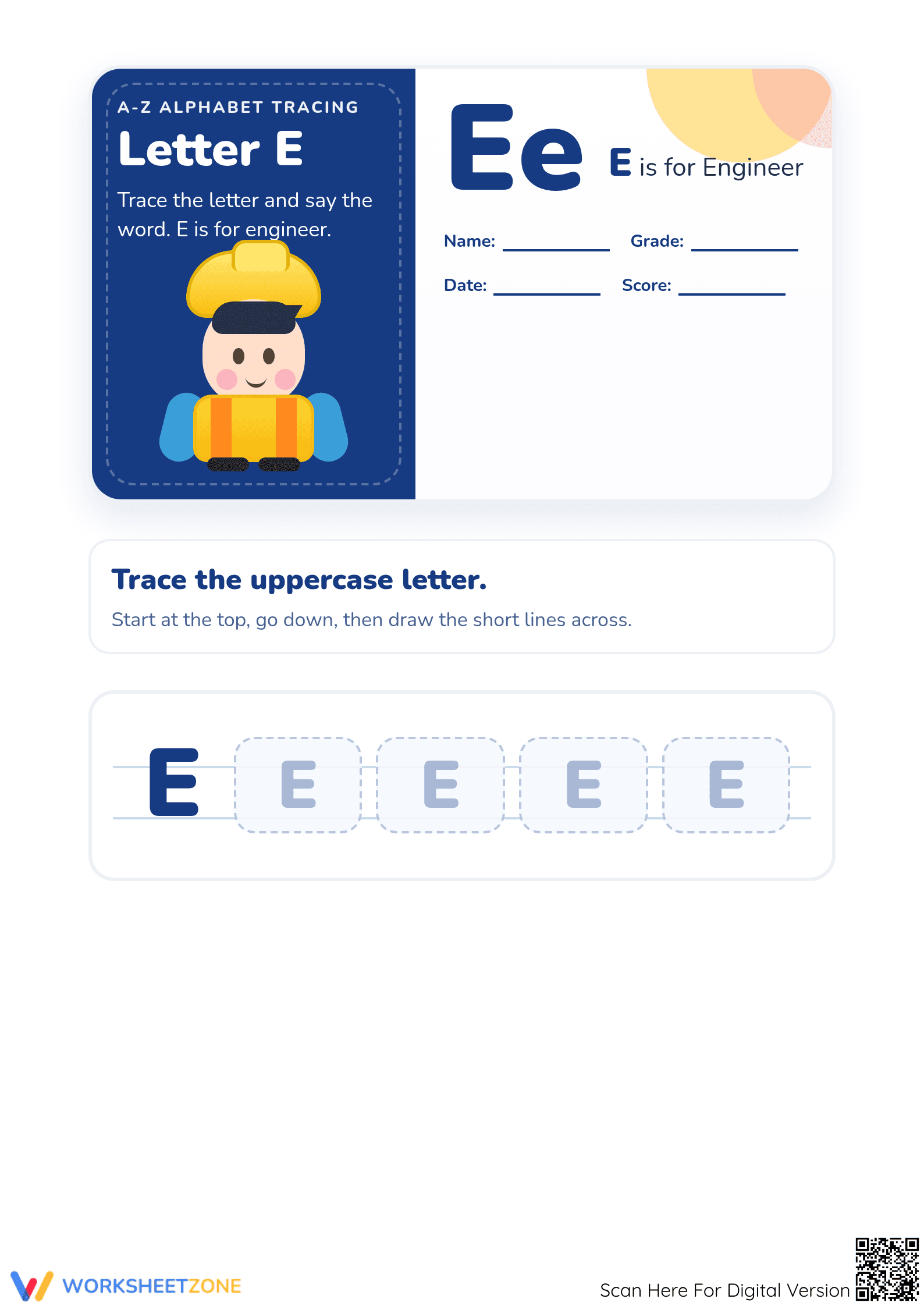
This preschool and kindergarten alphabet worksheet helps students master the letter E through structured tracing and vocabulary associations. By focusing on both uppercase and lowercase letter formation, this resource ensures students build the fine motor control and phonemic awareness necessary for early literacy success. Students will trace, say, and write the letter E effectively.
At a Glance
- Grade: K · Subject: ELA
- Standard:
CCSS.ELA-LITERACY.L.K.1.A— Print many upper- and lowercase letters correctly and legibly- Skill Focus: Alphabet Tracing (Letter E)
- Format: 2 pages · 9 problems · Answer key included · PDF
- Best For: Early literacy centers and handwriting practice
- Time: 15–20 minutes
What's Inside
This comprehensive 2-page PDF provides a dual-focus approach to alphabet mastery. The first page features uppercase tracing with directional prompts to guide penmanship. The second page introduces lowercase tracing and a vocabulary writing task centered on the word "Engineer." Each page includes clear instructional cues to support independent student work and ensure proper stroke order from the start.
Zero-Prep Workflow
This resource is designed for immediate classroom implementation with minimal teacher intervention required. Follow these three simple steps to integrate it into your morning routine or literacy block. First, print the 2-page PDF (30 seconds). Second, distribute the worksheets along with pencils and crayons (1 minute). Third, review student letter formation using the provided visual guides (30 seconds). Total prep time is under two minutes.
Standards Alignment
This worksheet is primarily aligned with `CCSS.ELA-LITERACY.L.K.1.A`, which requires students to "Print many upper- and lowercase letters." It also supports `CCSS.ELA-LITERACY.RF.K.1.D` by encouraging students to recognize and name all upper- and lowercase letters of the alphabet. Both standard codes can be copied directly into lesson plans, IEP goals, or district curriculum mapping tools.
How to Use It
Use this worksheet during the "You Do" phase of a gradual release model following a direct instruction lesson on the letter E. It works exceptionally well as a quiet-time activity or a substitute teacher sub plan due to its self-explanatory nature. Teachers should observe students during the initial tracing tasks to ensure they are following the directional arrows correctly to prevent bad habits.
Who It's For
This resource is specifically crafted for preschool and kindergarten students who are transitioning from basic line tracing to formal alphabet formation. It provides the necessary scaffolds for early learners while offering a vocabulary extension for advanced students. Pair this with a high-interest picture book about engineers to create a cross-curricular literacy and career-exploration lesson.
The mastery of letter formation is a foundational predictor of future reading fluency and written expression. According to the RAND AIRS 2024 report, early exposure to structured handwriting practice significantly correlates with cognitive development in literacy-rich environments. This worksheet addresses the specific mechanical demands of the letter E, providing nine distinct tasks that reinforce muscle memory and letter-name recognition. By integrating visual cues with repetitive motor tasks, the resource aligns with evidence-based instructional practices for early childhood education. Research indicates that students who master lowercase and uppercase letter distinctions before the end of kindergarten demonstrate higher rates of comprehension in later elementary grades. This standard-aligned tool serves as a reliable instrument for both formative assessment and skill reinforcement. Educators can use the results to identify students needing additional fine motor support or those ready for complex sentence-writing tasks. The standard CCSS.ELA-LITERACY.L.K.1.A remains a critical benchmark for early grade success.


