


























Views
Downloads
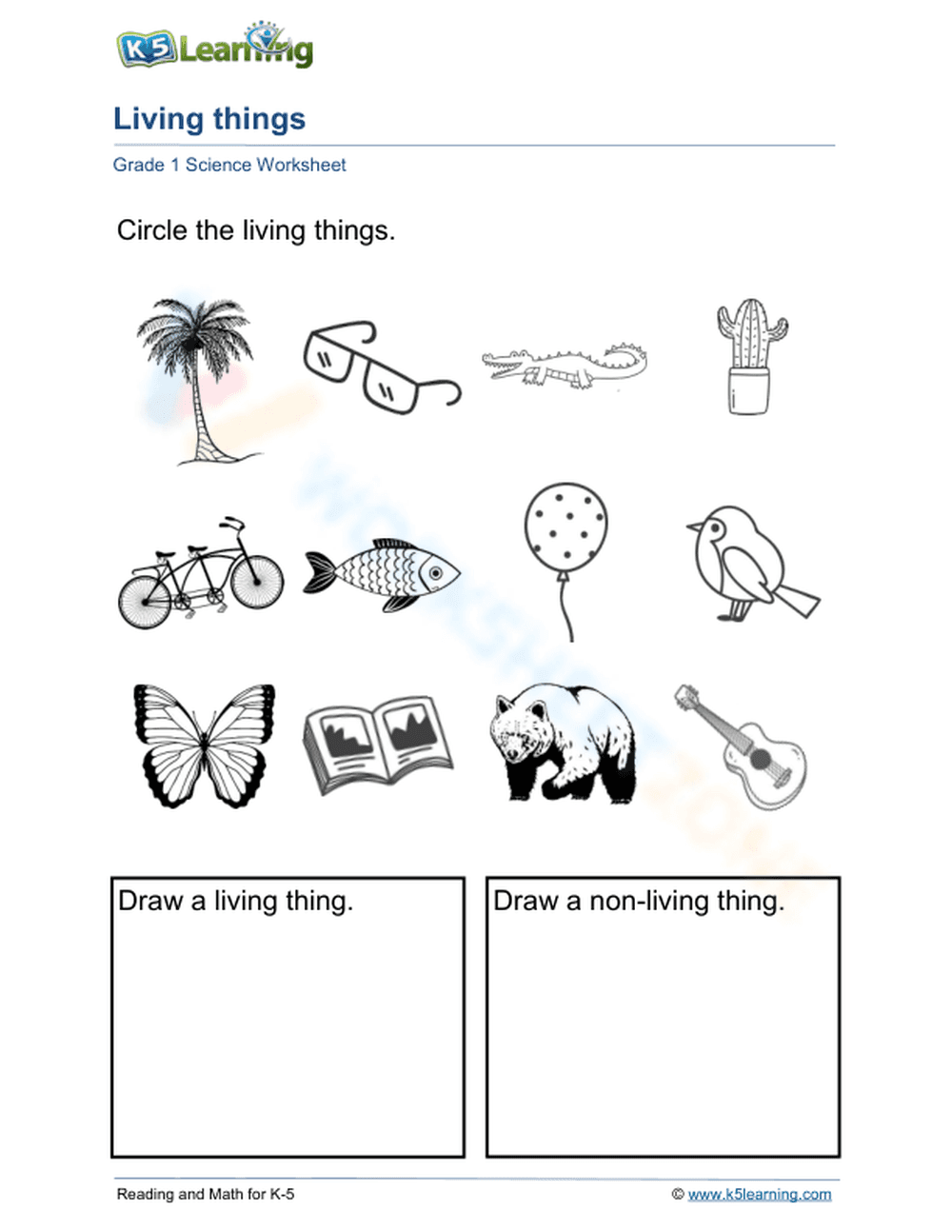

Grade 1 Living Things — Printable No-Prep Worksheet
Paste this activity's link or code into your existing LMS (Google Classroom, Canvas, Teams, Schoology, Moodle, etc.).
Students can open and work on the activity right away, with no student login required.
You'll still be able to track student progress and results from your teacher account.
This Grade 1 science worksheet helps young learners master the fundamental distinction between living and non-living things. Students engage in visual identification and creative application to solidify their understanding of biological characteristics. By the end of this activity, students will confidently categorize organisms based on observable traits like growth and movement.
At a Glance
- Grade: 1 · Subject: Science
- Standard:
1-LS1-1— Use observations to identify and describe characteristics of living organisms- Skill Focus: Living vs. Non-Living Classification
- Format: 1 page · 14 problems · Answer key included · PDF
- Best For: Introduction to life science units
- Time: 15–20 minutes
What's Inside
This single-page PDF features a two-part instructional design. The first section presents 12 clear illustrations—including animals, plants, and inanimate objects—where students must circle the living entities. The second section provides two dedicated drawing boxes for students to illustrate their own examples of a living and non-living thing, encouraging higher-order synthesis of the concept.
Zero-Prep Workflow
The "print-and-go" design ensures this resource fits perfectly into any busy classroom schedule, making it an ideal candidate for emergency sub-plans. Total teacher prep time is under 2 minutes:
- Print (30 seconds): Simply open the PDF and print enough copies for your class.
- Distribute (1 minute): Pass out sheets and a pencil; no extra materials are required.
- Review (30 seconds): Use the provided answer key to facilitate a quick review session.
This workflow minimizes teacher preparation while maximizing student engagement.
Standards Alignment
This resource is directly aligned with 1-LS1-1. It requires students to use observations to identify the external parts of living things and distinguish them from non-living objects. Supporting concepts include understanding that living things grow and respond to their environment. Both standard codes can be copied directly into lesson plans, IEP goals, or district curriculum mapping tools.
How to Use It
Use this worksheet as a formative assessment during the "Explore" or "Explain" phase of a 5E lesson model. Alternatively, it serves as an excellent independent practice activity following a direct instruction session on the needs of plants and animals. Teachers can observe students during the drawing phase to check for misconceptions regarding inanimate objects that "move," like cars or clouds.
Who It's For
Designed for Grade 1 students, this worksheet is also highly effective for Kindergarten enrichment or Grade 2 review. The visual-heavy layout supports English Language Learners and students with IEP accommodations by reducing reading load while maintaining cognitive rigor. It pairs naturally with a classroom "living vs. non-living" anchor chart or a short walk around the school garden.
According to the NAEP Science Framework, classifying objects based on observable biological properties is a foundational skill for mastery of ecosystems and heredity. This Grade 1 worksheet facilitates that progression by requiring students to apply categorization criteria to diverse examples. Research by Fisher & Frey (2014) emphasizes that combining visual identification with generative tasks significantly improves retention and conceptual depth in early elementary learners. The structured layout of the 14 tasks provides a low-floor, high-ceiling environment where students can demonstrate their understanding of 1-LS1-1. By transitioning from recognition to production, students move beyond simple recall toward a durable mental model of life. This resource aligns with pedagogical standards for life science, ensuring students build the necessary vocabulary and observational habits required for future academic success in the biological sciences.


