




























Views
Downloads

Printable Grade 1 Animal Movement Science Worksheet

Paste this activity's link or code into your existing LMS (Google Classroom, Canvas, Teams, Schoology, Moodle, etc.).
Students can open and work on the activity right away, with no student login required.
You'll still be able to track student progress and results from your teacher account.
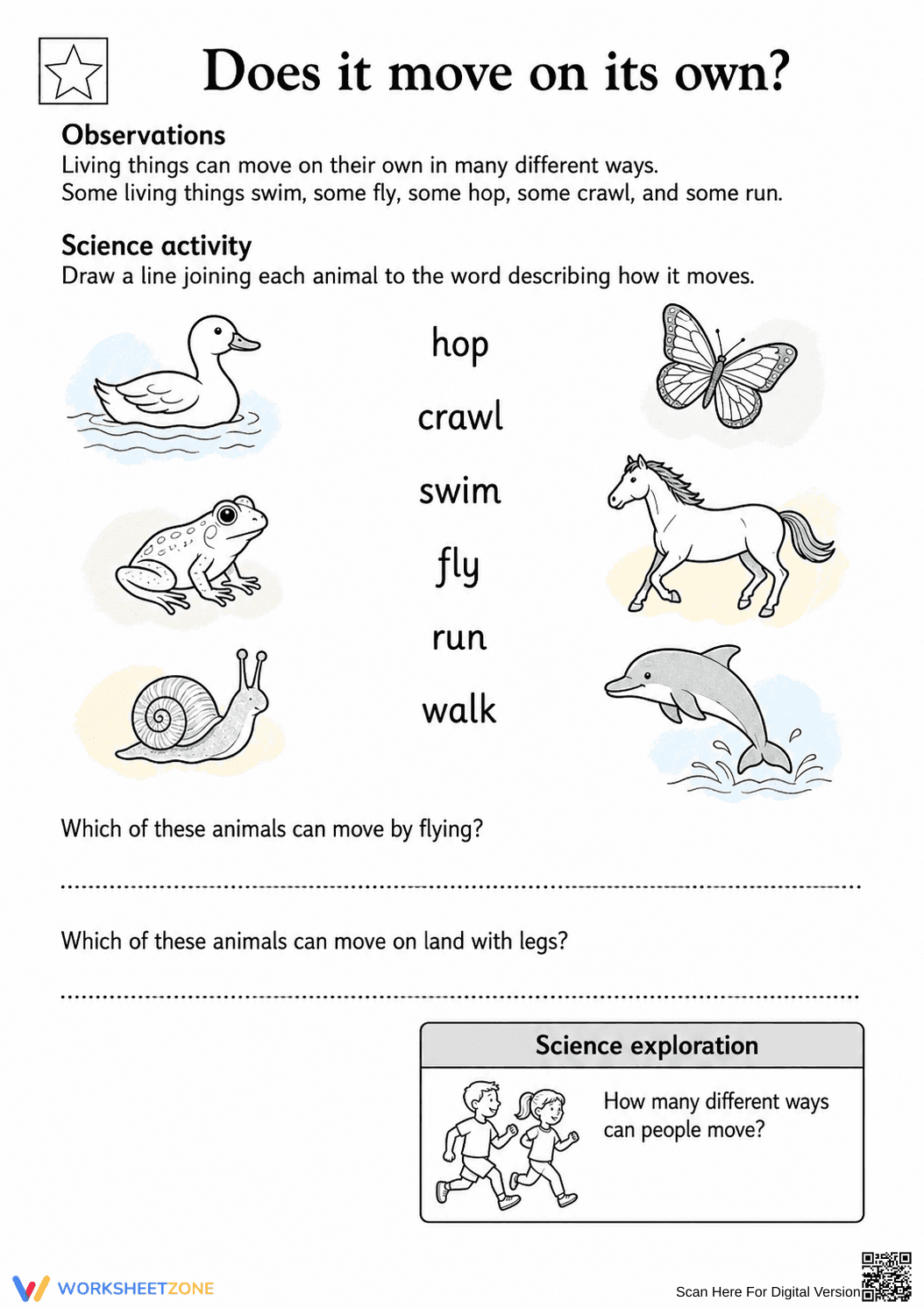
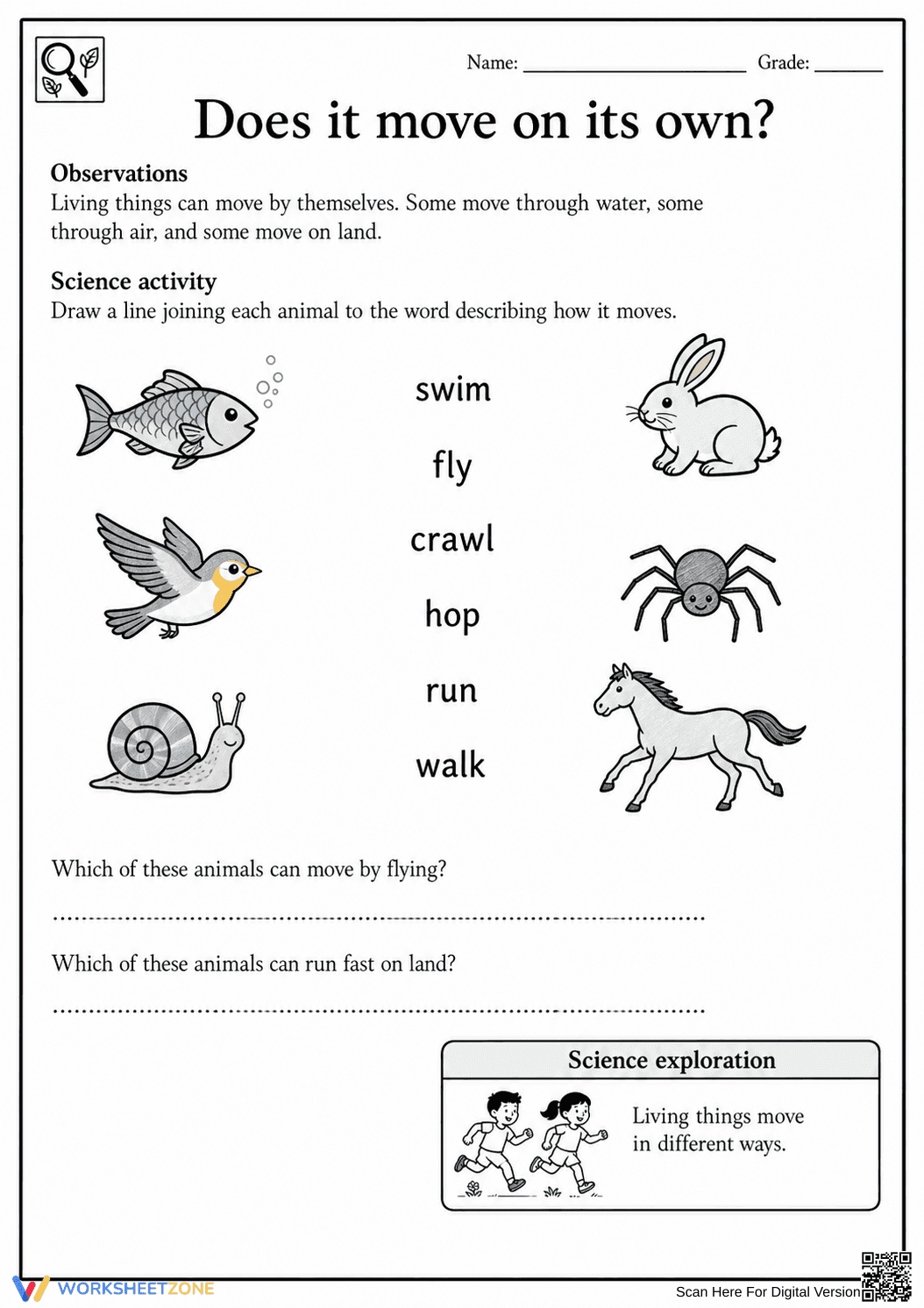
This introductory Grade 1 science worksheet helps students observe and classify how different living things move. By identifying specific methods of locomotion like swimming, hopping, and flying, children develop essential biological observation skills. The activity ensures learners can distinguish between various animal behaviors while building categorical thinking.
At a Glance
- Grade: 1 · Subject: Science
- Standard:
1-LS1-1— Identify how animals use body parts to move- Skill Focus: Animal Locomotion
- Format: 2 pages · 16 problems · Answer key included · PDF
- Best For: Independent practice or science centers
- Time: 10–15 minutes
What's Inside
This two-page PDF features a primary matching activity where students draw lines to connect twelve different animals—including a frog, dolphin, and rabbit—to their primary movement descriptors. Four additional short-answer questions challenge students to apply their knowledge by identifying specific animals that fly or run on land. A complete answer key is included for effortless grading and immediate feedback.
Zero-Prep Workflow
- Step 1: Print (30 seconds). Simply download and print the two-page worksheet for your entire class.
- Step 2: Distribute (1 minute). Hand out the activity as a warm-up, independent science center task, or quick homework assignment requiring minimal teacher setup.
- Step 3: Review (2 minutes). Use the provided answer key to quickly check student work or project it for a whole-class self-correction session.
Standards Alignment
Aligned to 1-LS1-1: Use materials to design a solution to a human problem by mimicking how plants and/or animals use their external parts to help them survive, grow, and meet their needs. This worksheet focuses on the locomotion component, helping students recognize how animals use specialized body parts to move through their environment. Both standard codes can be copied directly into lesson plans, IEP goals, or district curriculum mapping tools.
How to Use It
Use this worksheet as a formative assessment after an introductory lesson on animal traits. Observe how students categorize the butterfly and spider to gauge their understanding of specialized movement. It also serves as an excellent sub-plan filler, as the instructions are self-explanatory and require zero teacher explanation. Expect students to complete the matching and questions within a 10 to 15-minute instructional block.
Who It's For
This resource is primarily designed for Grade 1 students but remains appropriate for Grade 2 learners needing a review of living things. It pairs naturally with animal-themed reading passages or a direct instruction lesson on habitat adaptations. The clear icons provide vital visual support for English Language Learners and emerging readers to succeed independently.
According to the RAND AIRS 2024 analysis of early elementary science curricula, explicit instruction in biological locomotion provides a foundational framework for understanding broader ecological relationships and physical adaptations. This worksheet targets the 1-LS1-1 standard, requiring students to identify how animals use body parts to move by categorizing various animal species by their primary mode of movement, such as swimming, flying, or crawling. By connecting observable physical traits to functional behaviors, learners build the schema necessary for complex classification tasks in later grades. Research emphasizes that combining visual matching with short-answer justification strengthens the retention of scientific vocabulary. This resource delivers essential practice in identifying how living things move on their own, ensuring students can differentiate between biological movement and external force. The inclusion of a clear answer key allows for immediate feedback, which is critical for correcting misconceptions about unique species.


