


























Views
Downloads


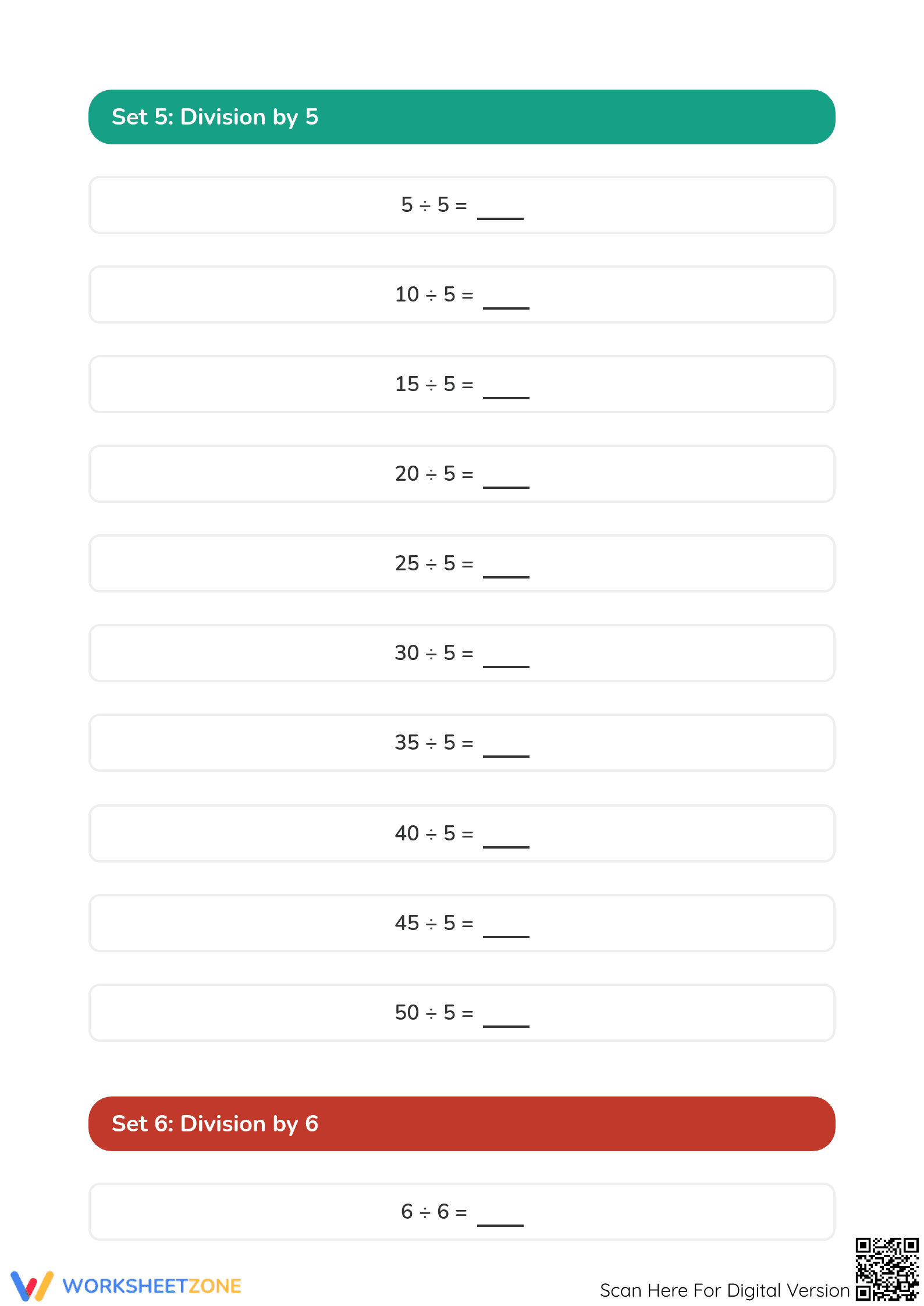

Printable Division Facts Worksheet | Grade 3 Math Mastery
Paste this activity's link or code into your existing LMS (Google Classroom, Canvas, Teams, Schoology, Moodle, etc.).
Students can open and work on the activity right away, with no student login required.
You'll still be able to track student progress and results from your teacher account.
This printable division facts worksheet provides Grade 3 students with intensive practice to build computational fluency with divisors 1 through 10. By systematically working through equations organized by divisor sets, learners develop the mental recall necessary for solving more complex multi-step math problems and real-world division scenarios effectively.
At a Glance
- Grade: 3 · Subject: Math
- Standard:
CCSS.MATH.CONTENT.3.OA.C.7— Fluently divide within 100 using the relationship between multiplication and division- Skill Focus: Division Facts
- Format: 10 pages · 100 problems · Answer key included · PDF
- Best For: Daily math drills and fluency checks
- Time: 15–20 minutes
The collection features a clean, high-contrast layout designed to minimize visual distraction for focused practice sessions. Each page focuses on a specific set of division facts, from division by 1 up to division by 10. The package includes multiple practice pages, clear section headers, and a comprehensive answer key for immediate student feedback or teacher grading.
Skill Progression
- Guided Practice: Students start with division by 1 and 2 (20 problems), focusing on the foundational concept that any number divided by 1 remains unchanged.
- Supported Practice: Facts for divisors 3 through 6 (40 problems) introduce greater variety, requiring students to use inverse multiplication facts as scaffolds.
- Independent Practice: The final sets for divisors 7 through 10 (40 problems) demand high-level automaticity and rapid mental recall for mastery.
This structured progression follows the gradual-release model, moving from simple modeling to independent student execution across all core fact families.
Standards Alignment
Primary standard: `CCSS.MATH.CONTENT.3.OA.C.7`. Students will fluently divide within 100, using strategies such as the relationship between multiplication and division or properties of operations. By the end of Grade 3, students should know from memory all products of two one-digit numbers. Both standard codes can be copied directly into lesson plans, IEP goals, or district curriculum mapping tools.
How to Use It
Use this resource as a timed drill to assess automaticity after direct instruction on division concepts. Alternatively, assign individual sets as morning work to reinforce the relationship between multiplication and division. During use, observe if students are skip-counting or using mental recall; this formative data helps identify which fact families require additional intervention. Expected completion time is 2 minutes per set.
Who It's For
This resource is ideal for third-grade students working toward mastery and fourth-graders needing remedial fluency support. It serves as an excellent companion to physical manipulatives like arrays or counters for tactile learners. For differentiation, provide a multiplication chart to students who are still bridging between inverse operations while they work through the advanced divisor sets.
Building automaticity with division facts is vital for success in mathematics. Research from Fisher & Frey (2014) indicates that structured repetition allows students to offload basic computation to long-term memory, freeing cognitive resources for higher-order tasks. This worksheet addresses `CCSS.MATH.CONTENT.3.OA.C.7` by providing high-volume practice for transitioning from strategies to recall. By isolating divisors 1-10, the curriculum ensures learners encounter frequent facts in a sequence promoting mastery. NAEP data highlights that students achieving early operational fluency demonstrate higher proficiency in fractional reasoning and algebraic thinking in middle school. These drills are essential for Grade 3 students to build the math muscles required for future academic challenges.


