


























Views
Downloads
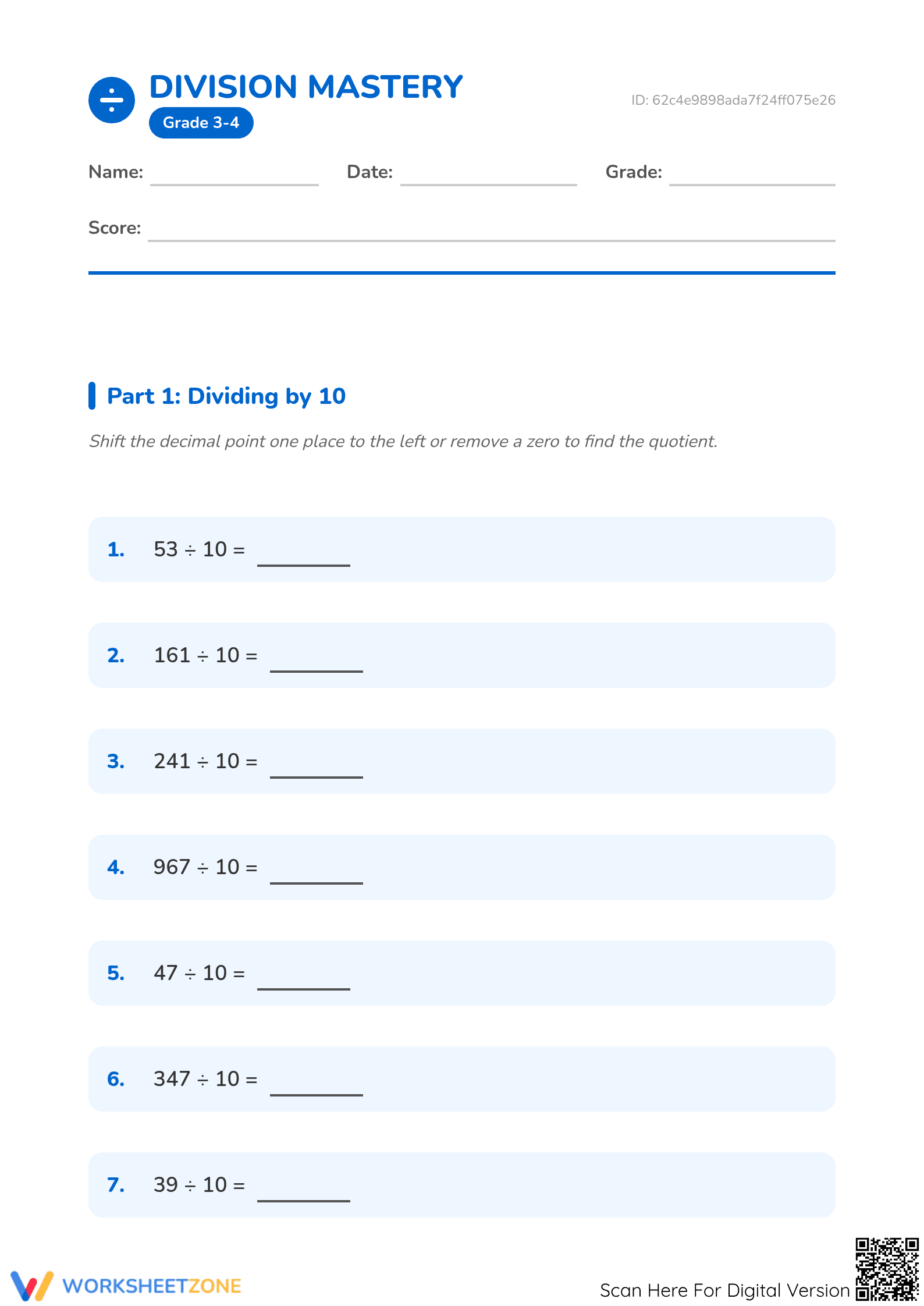
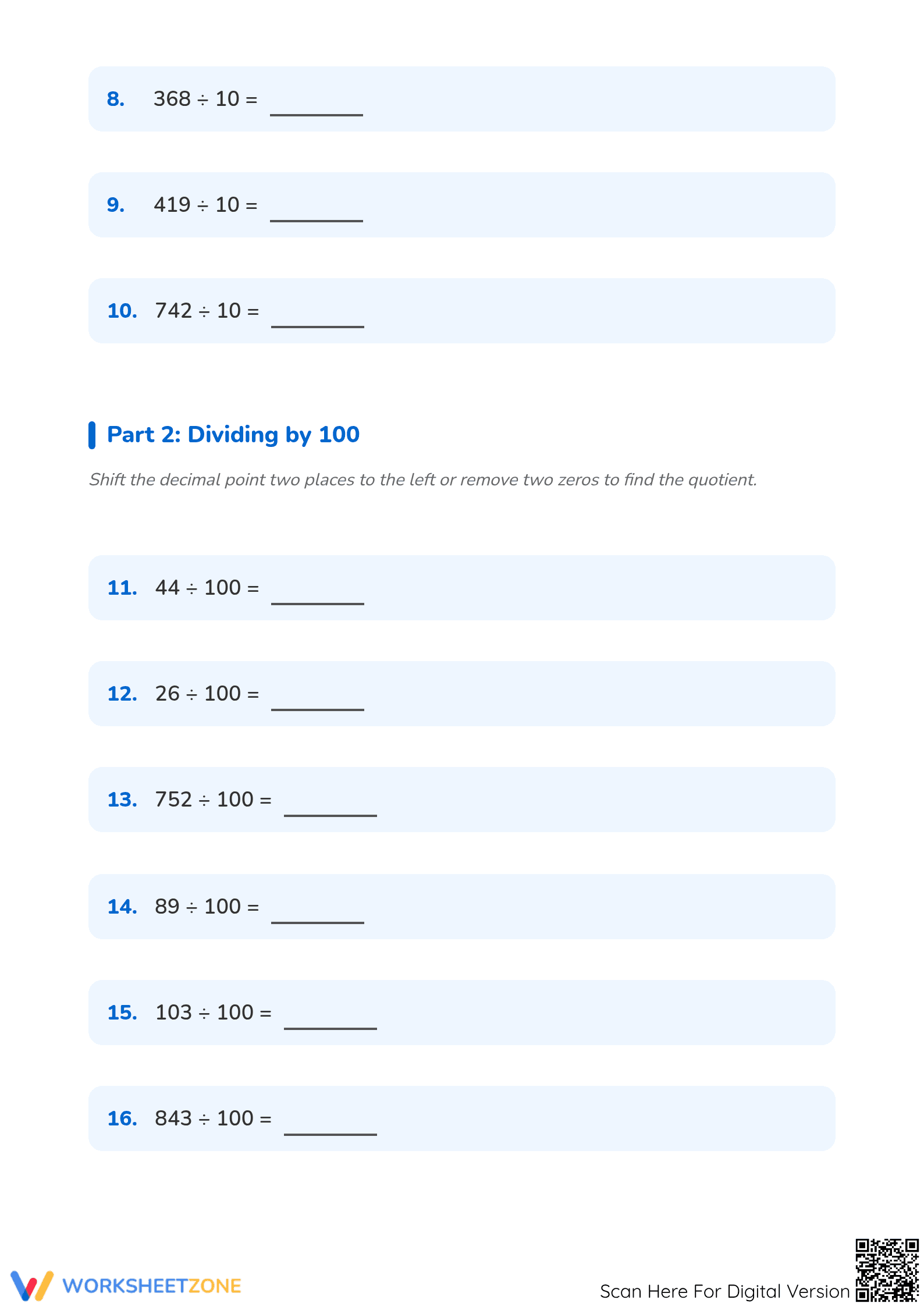
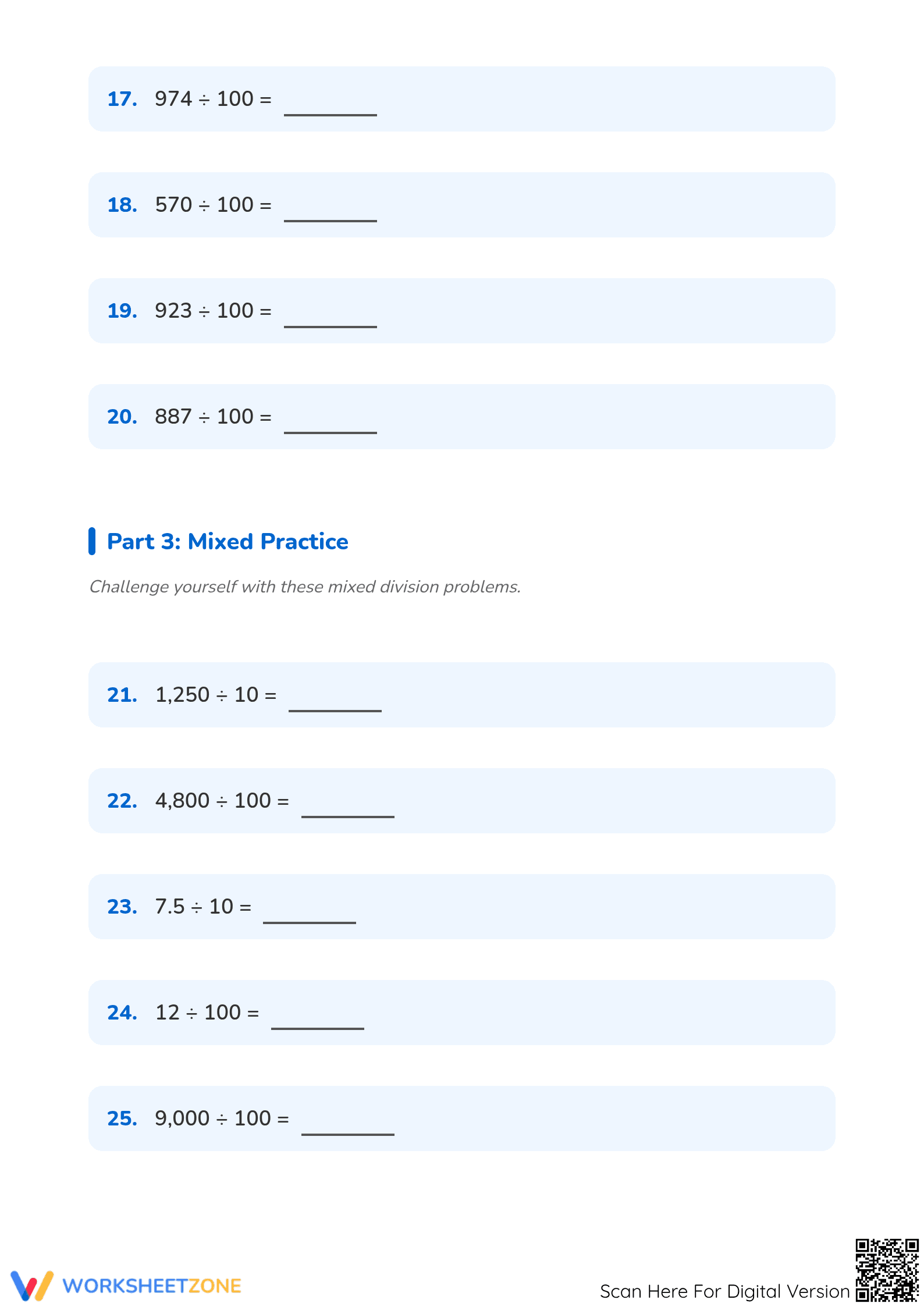
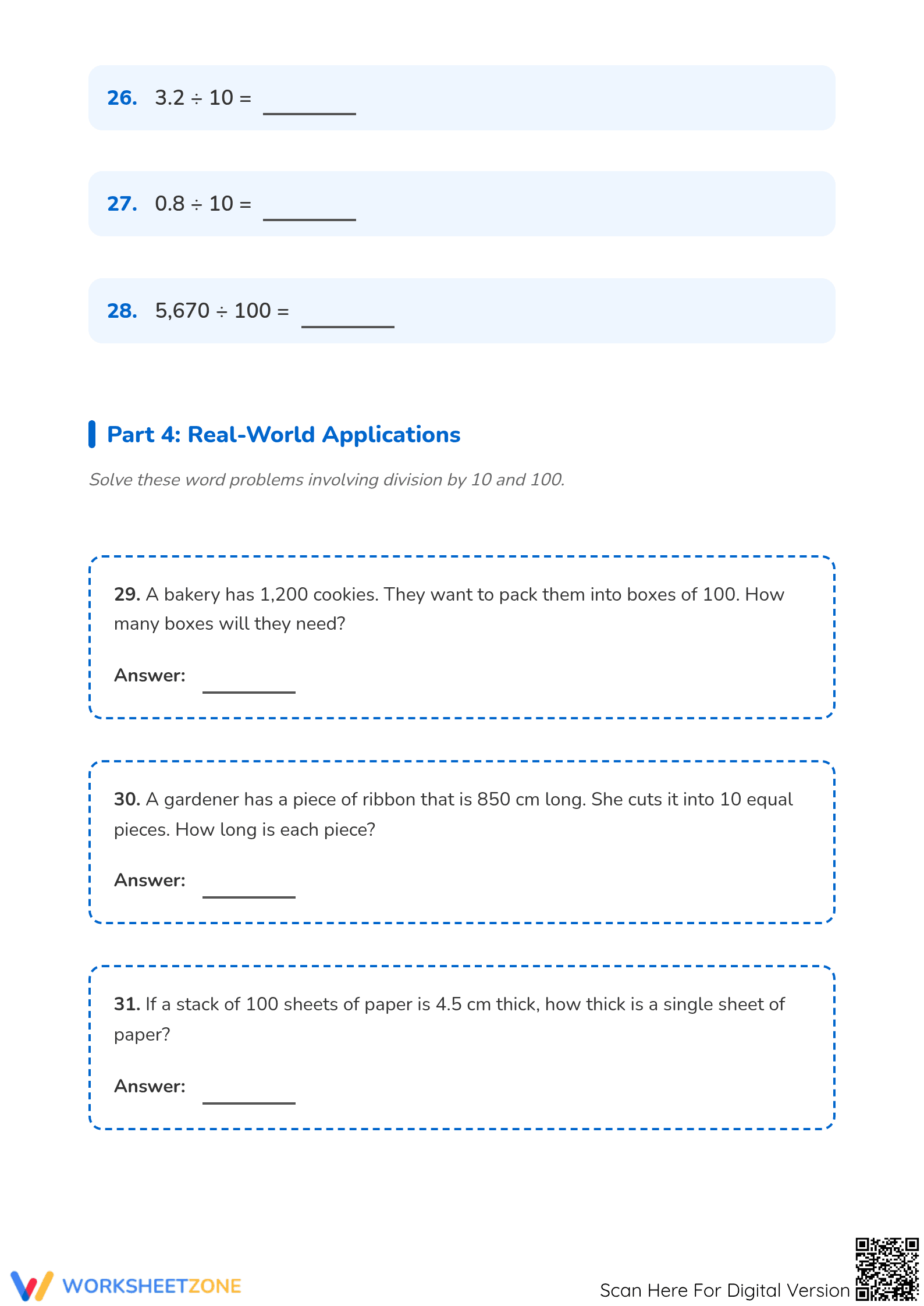

Essential Dividing by 10 and 100 Practice | Grade 4-5
Paste this activity's link or code into your existing LMS (Google Classroom, Canvas, Teams, Schoology, Moodle, etc.).
Students can open and work on the activity right away, with no student login required.
You'll still be able to track student progress and results from your teacher account.
Build mental math fluency and decimal mastery with this comprehensive multi-page division worksheet. Students move beyond basic calculations to understand the underlying patterns of base-ten division, specifically focusing on how to shift decimal points and manage zeros in quotients. This resource provides the rigorous practice needed to bridge the gap between simple division and advanced decimal operations.
At a Glance
- Grade: 4–5 · Subject: Math
- Standard:
5.NBT.A.2— Explain patterns in decimal point placement when dividing by powers of 10- Skill Focus: Dividing by 10 and 100
- Format: 5 pages · 36 problems · Answer key included · PDF
- Best For: Mental math fluency and decimal mastery
- Time: 30–45 minutes
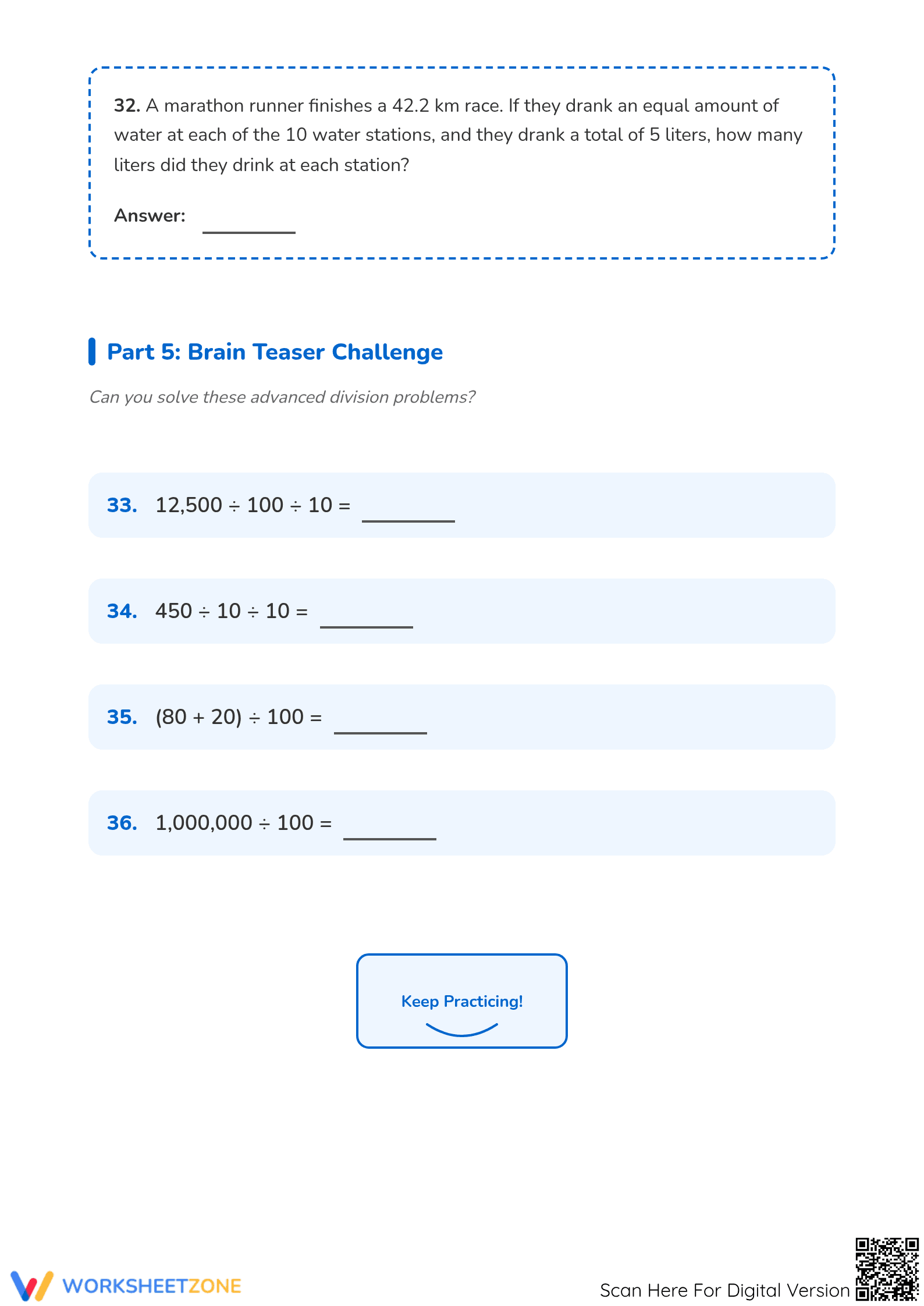
This 5-page PDF set contains 36 carefully sequenced problems designed to build confidence and accuracy. The packet begins with clear instructional cues and transitions from simple whole-number division to complex decimal problems and multi-step brain teasers. A full answer key is included to facilitate quick grading or student self-correction, making it ideal for both classroom use and independent practice.
- Guided Practice: The first 20 problems provide focused repetitions for dividing whole numbers and basic decimals by 10 and 100, allowing students to internalize the decimal-shifting rule through consistent application.
- Supported Practice: Mixed sets and real-world word problems challenge students to identify the correct divisor and apply their skills to situational contexts like measurements and money.
- Independent Practice: The final section features advanced brain teasers that require multi-step reasoning, ensuring students can apply division patterns even when faced with unfamiliar or complex numeric sequences.
This resource is strictly aligned to 5.NBT.A.2: "Explain patterns in the number of zeros of the product when multiplying a number by powers of 10, and explain patterns in the placement of the decimal point when a decimal is multiplied or divided by a power of 10." It also supports 4th-grade standards regarding base-ten patterns.
Integrate this worksheet into your curriculum during independent work blocks or as a targeted homework assignment following a lesson on place value. For a formative assessment, observe if students are manually performing long division or correctly utilizing the "shift" pattern; those who still rely on vertical division may need additional modeling of the decimal movement rule. Most students complete the full set in 40 minutes.
This practice set is designed for upper elementary students who have a basic grasp of division but need to develop speed and conceptual depth with powers of ten. It is particularly effective for students requiring extra support with decimal placement. For best results, pair this worksheet with a place value anchor chart or a decimal point slide tool to provide a visual anchor for the shifting process.
Understanding patterns in base-ten division is fundamental to algebraic thinking and scientific notation. Students who master mental division by powers of ten demonstrate significantly higher proficiency in multi-step problem solving and decimal operations. This worksheet aligns with CCSS.MATH.CONTENT.5.NBT.A.2 by requiring students to move beyond rote procedures and recognize the predictable shift of decimal points. Engaging with 36 targeted problems across diverse sections, from mental math to complex word problems, helps students internalize place value relationships. This structural understanding reduces cognitive load during advanced calculations, fostering greater focus on conceptual reasoning in middle school. The inclusion of decimals and multi-step challenges prepares learners for state assessments and future quantitative coursework in STEM fields.


