


























0
Views
0
Downloads

Save
0 Likes
Share
Distinguishing Natural and Man-Made Objects
0 Views
0 Downloads
Paste this activity's link or code into your existing LMS (Google Classroom, Canvas, Teams, Schoology, Moodle, etc.).
Students can open and work on the activity right away, with no student login required.
You'll still be able to track student progress and results from your teacher account.
Information
Description
What It Is:
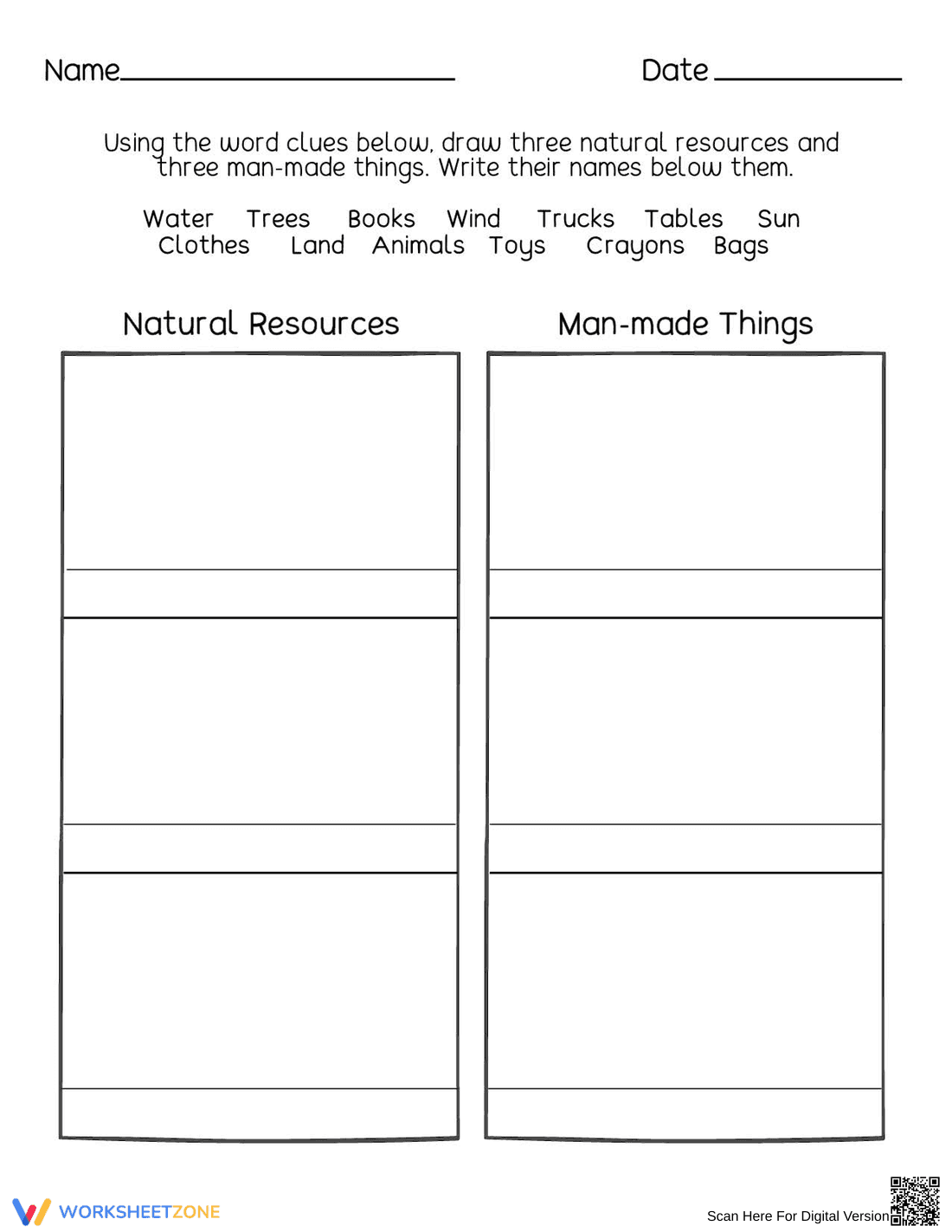
This is an educational worksheet designed to teach the difference between natural resources and man-made things. The worksheet provides a list of words including 'Water,' 'Trees,' 'Books,' 'Wind,' 'Trucks,' 'Tables,' 'Sun,' 'Clothes,' 'Land,' 'Animals,' 'Toys,' 'Crayons,' and 'Bags.' Students are instructed to draw three natural resources and three man-made things from the word list in the provided boxes, and then write the names of the items they drew. The worksheet is divided into two columns, one labeled 'Natural Resources' and the other 'Man-made Things,' each containing three blank boxes for drawing and writing.
Grade Level Suitability:
This worksheet is suitable for grades 1-3. The activity involves basic recognition of objects and their origins, simple drawing, and writing, which are skills typically developed in these grade levels. The concepts of natural resources and man-made things are also introduced at this level.
Why Use It:
This worksheet helps students learn to differentiate between natural resources and man-made objects. It encourages critical thinking and observation skills. It also reinforces vocabulary related to the environment and everyday objects, while improving drawing and writing skills.
How to Use It:
Provide the worksheet to students along with crayons or pencils. Instruct them to read the list of words provided. They should then choose three natural resources from the list and draw them in the boxes under the 'Natural Resources' column, writing the name of each item below the drawing. Next, they should choose three man-made things from the list and draw them in the boxes under the 'Man-made Things' column, writing the name of each item below the drawing.
Target Users:
This worksheet is designed for elementary school students, particularly those in grades 1-3, who are learning about natural resources, man-made objects, and basic classification skills. It can also be used for homeschooling or as a supplementary activity in a science or social studies lesson.
This is an educational worksheet designed to teach the difference between natural resources and man-made things. The worksheet provides a list of words including 'Water,' 'Trees,' 'Books,' 'Wind,' 'Trucks,' 'Tables,' 'Sun,' 'Clothes,' 'Land,' 'Animals,' 'Toys,' 'Crayons,' and 'Bags.' Students are instructed to draw three natural resources and three man-made things from the word list in the provided boxes, and then write the names of the items they drew. The worksheet is divided into two columns, one labeled 'Natural Resources' and the other 'Man-made Things,' each containing three blank boxes for drawing and writing.
Grade Level Suitability:
This worksheet is suitable for grades 1-3. The activity involves basic recognition of objects and their origins, simple drawing, and writing, which are skills typically developed in these grade levels. The concepts of natural resources and man-made things are also introduced at this level.
Why Use It:
This worksheet helps students learn to differentiate between natural resources and man-made objects. It encourages critical thinking and observation skills. It also reinforces vocabulary related to the environment and everyday objects, while improving drawing and writing skills.
How to Use It:
Provide the worksheet to students along with crayons or pencils. Instruct them to read the list of words provided. They should then choose three natural resources from the list and draw them in the boxes under the 'Natural Resources' column, writing the name of each item below the drawing. Next, they should choose three man-made things from the list and draw them in the boxes under the 'Man-made Things' column, writing the name of each item below the drawing.
Target Users:
This worksheet is designed for elementary school students, particularly those in grades 1-3, who are learning about natural resources, man-made objects, and basic classification skills. It can also be used for homeschooling or as a supplementary activity in a science or social studies lesson.


