


























Views
Downloads

Counting Coins & Money Word Problems | Grade 3 Ready
Paste this activity's link or code into your existing LMS (Google Classroom, Canvas, Teams, Schoology, Moodle, etc.).
Students can open and work on the activity right away, with no student login required.
You'll still be able to track student progress and results from your teacher account.
This Grade 3 currency worksheet provides students with practical experience identifying and summing mixed coin values. By combining visual identification with contextual word problems, learners develop the fluency needed to manage real-world transactions. Students will calculate totals for quarters, dimes, nickels, and pennies to reach accurate mathematical conclusions.
At a Glance
- Grade: 3 · Subject: Math
- Standard:
CCSS.MATH.CONTENT.2.MD.C.8— Solve word problems involving quarters, dimes, nickels, and pennies using symbols correctly- Skill Focus: Mixed coin counting and word problems
- Format: 2 pages · 7 problems · Answer key included · PDF
- Best For: Independent practice or formative assessment
- Time: 15–20 minutes
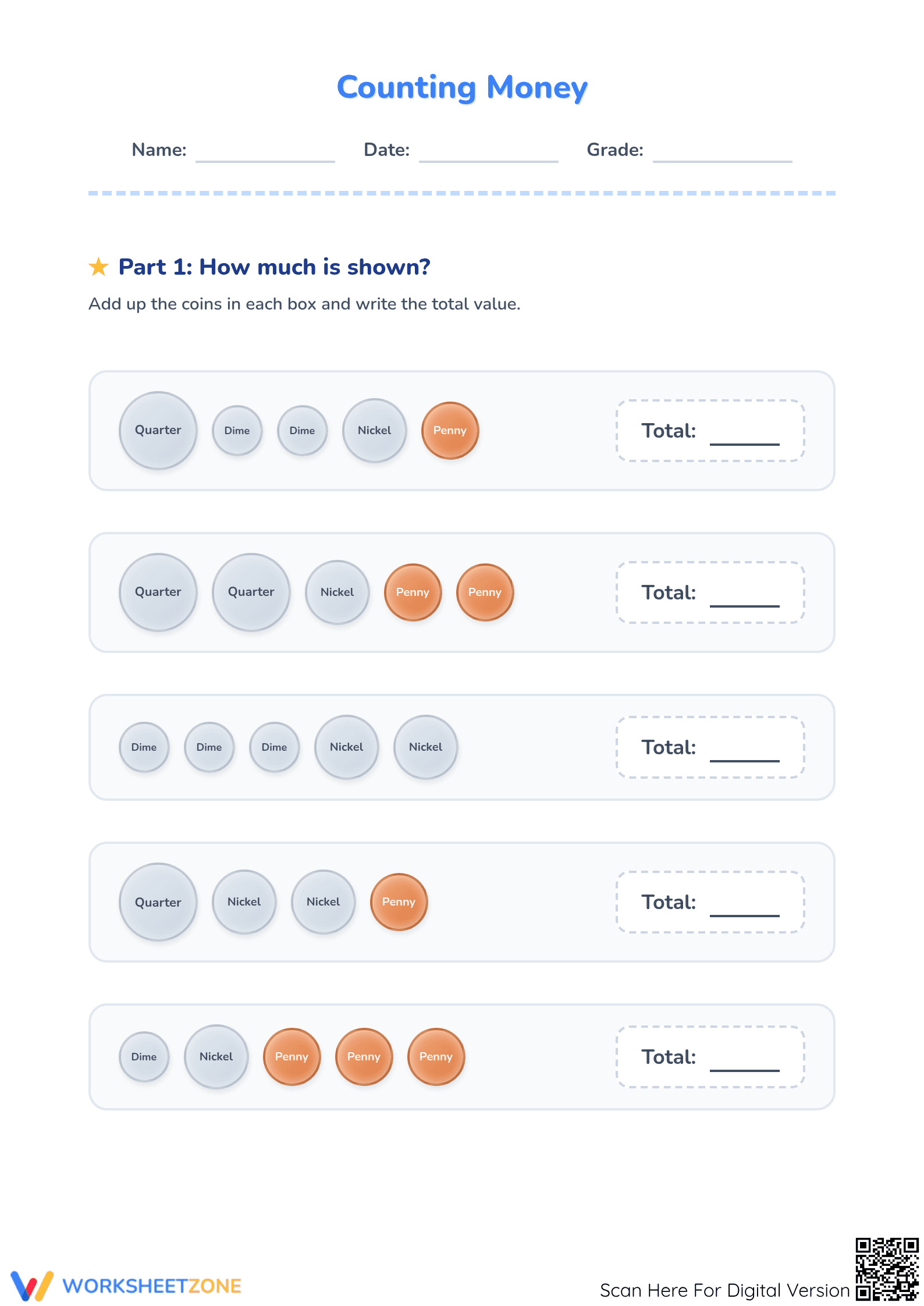
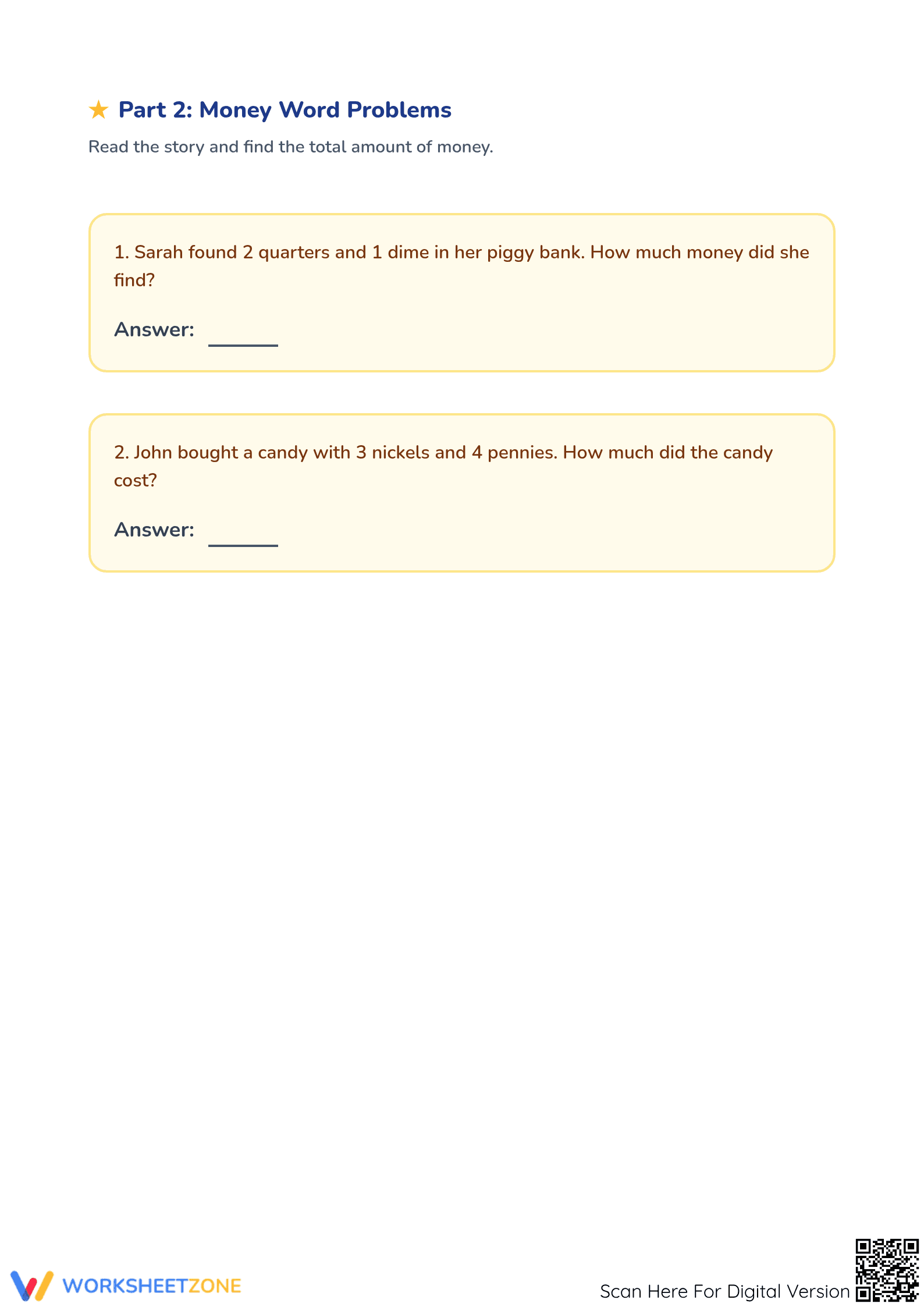
The resource is structured across two comprehensive pages. The first page features five visual clusters where students must identify and add various combinations of silver and copper coins. The second page transitions to higher-order thinking with two narrative word problems. A full answer key is provided, allowing for immediate feedback or self-grading during classroom rotations.
This resource follows a zero-prep workflow designed for busy educators. First, print the two-page PDF (30 seconds). Second, distribute the sheets to students for independent or small-group work (1 minute). Finally, review the answers using the included key to identify common calculation errors (5 minutes). Total teacher preparation time is under 2 minutes, making it an ideal sub plan or morning work activity.
This worksheet aligns with CCSS.MATH.CONTENT.2.MD.C.8, which requires students to solve word problems involving dollar bills, quarters, dimes, nickels, and pennies. While introduced in earlier grades, mastery of these combinations is essential for Grade 3 fluency in measurement and data. Both standard codes can be copied directly into lesson plans, IEP goals, or district curriculum mapping tools.
Use this worksheet during the independent practice phase of a gradual release lesson on money. It serves as an excellent bridge between concrete coin manipulation and abstract word problem solving. For a formative assessment, observe if students group coins by value (e.g., counting quarters first) or if they struggle with the transition between 10-cent and 5-cent increments. Completion typically takes 15 to 20 minutes.
This resource is designed for Grade 3 students but remains highly effective for Grade 4-6 learners requiring remedial support or Life Skills instruction. It pairs naturally with physical plastic coin manipulatives or an anchor chart displaying coin faces and values. It is particularly useful for students who have mastered single-coin counting but need practice with mixed sets.
According to the RAND AIRS 2024 report, frequent exposure to mixed-representation math tasks significantly improves long-term retention of financial literacy concepts. This worksheet targets CCSS.MATH.CONTENT.2.MD.C.8 by requiring students to perform multi-step addition within a currency context. By moving from visual coin clusters to text-based word problems, the material supports the cognitive shift from concrete to representational math. Research from Fisher & Frey (2014) emphasizes that scaffolded practice, such as the transition from Page 1 to Page 2 in this resource, ensures students build the necessary stamina for standardized testing environments. Educators can utilize the 7 included tasks to gather data on student accuracy and speed, which are critical indicators of mathematical fluency. This structured approach ensures that learners do not just memorize coin values but apply them to solve practical, everyday problems effectively.


