


























Views
Downloads

Counting Dimes and Pennies Worksheet | Grade 3 Essential
Paste this activity's link or code into your existing LMS (Google Classroom, Canvas, Teams, Schoology, Moodle, etc.).
Students can open and work on the activity right away, with no student login required.
You'll still be able to track student progress and results from your teacher account.
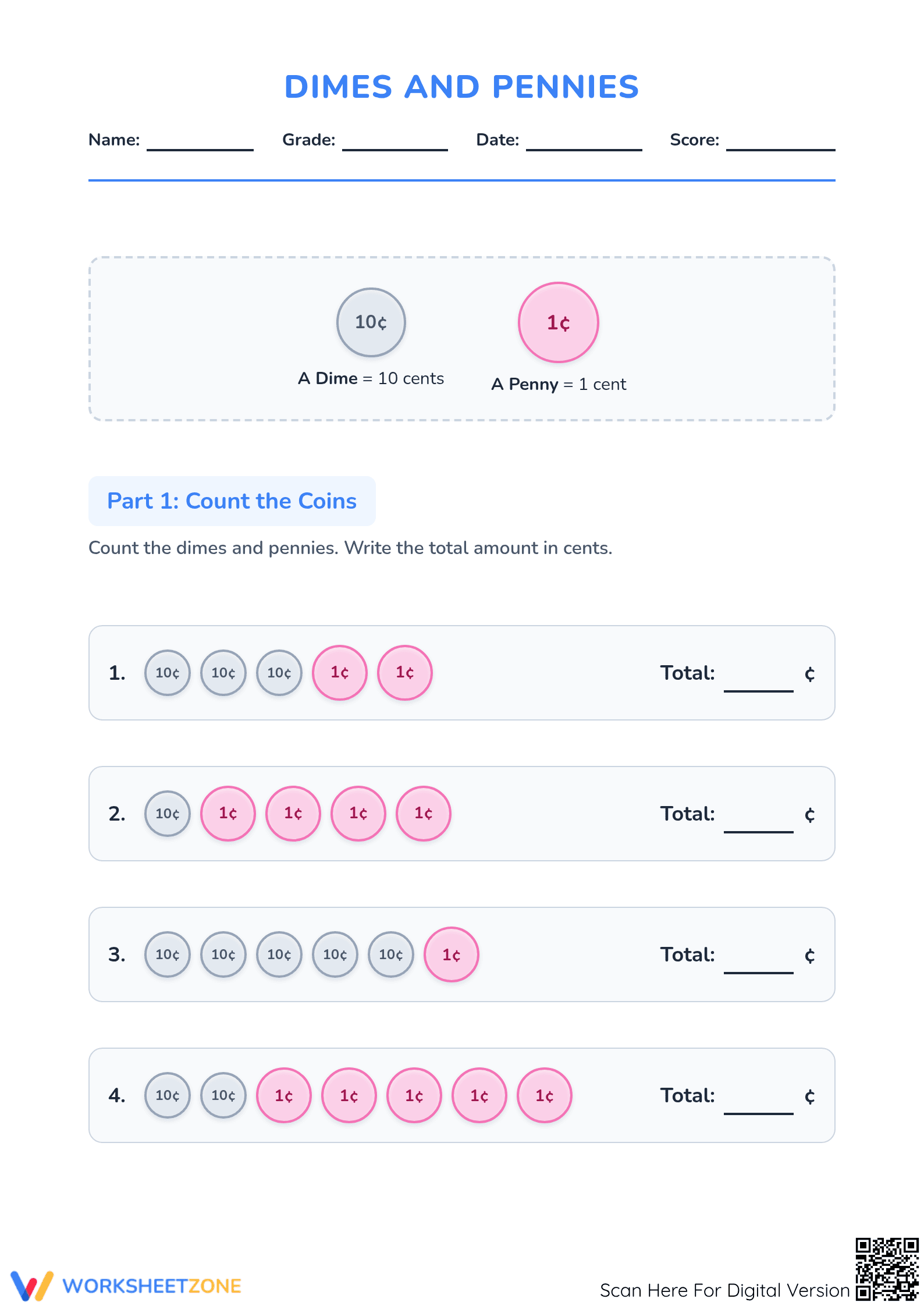
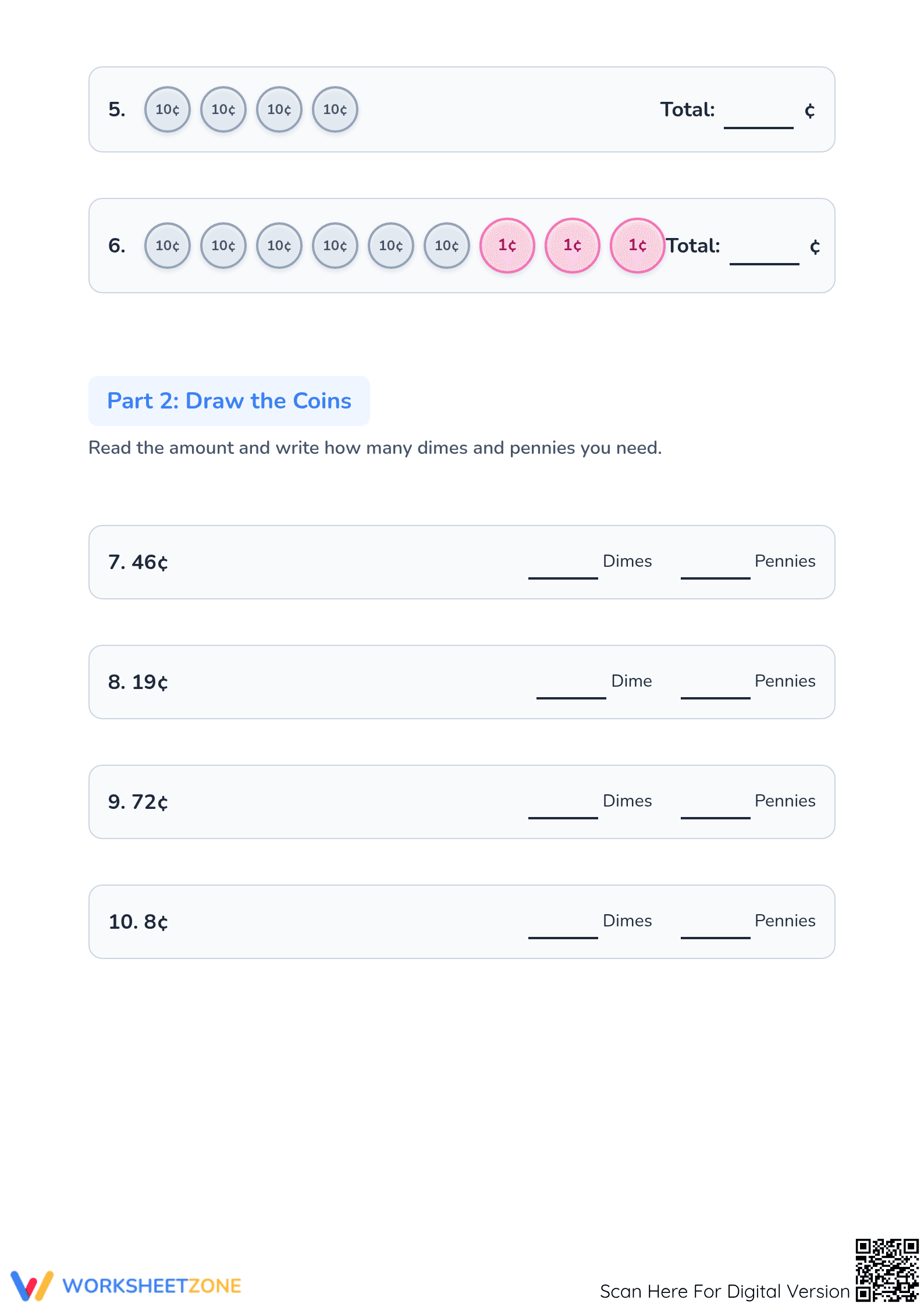
This Grade 3 currency worksheet provides students with targeted practice in identifying and totaling dimes and pennies. By focusing on the base-ten relationship between these two specific coins, learners build a foundation for more complex financial literacy and decimal place value. Students will calculate totals from visual coin sets and decompose numerical values into specific coin counts.
At a Glance
- Grade: 3 · Subject: Math
- Standard:
CCSS.MATH.CONTENT.2.MD.C.8— Solve word problems involving dollar bills, quarters, dimes, nickels, and pennies- Skill Focus: Counting and decomposing dimes and pennies
- Format: 2 pages · 10 problems · Answer key included · PDF
- Best For: Independent practice or morning work
- Time: 15–20 minutes
The resource consists of two distinct pages. Part 1 features 6 problems where students observe groups of dimes and pennies to determine the total cent value. Part 2 includes 4 problems requiring students to read a cent value and determine the exact number of dimes and pennies needed to reach that sum. A clear visual reference at the top of page one defines the value of each coin to support student independence.
This resource is designed for a zero-prep classroom environment. First, print the two-page PDF (30 seconds). Next, distribute the sheets to students for independent work or as a quick assessment (1 minute). Finally, use the included answer key to review student work or allow for self-correction (30 seconds). Total teacher preparation time is under two minutes, making it an ideal choice for substitute folders or emergency lesson plans.
This worksheet aligns with CCSS.MATH.CONTENT.2.MD.C.8. While labeled for Grade 3 and above to support remediation and life skills, it directly addresses the requirement for students to solve problems involving dimes and pennies. The tasks reinforce the concept that ten pennies equal one dime, mirroring the base-ten structure found in CCSS.MATH.CONTENT.3.NBT.A.2. Both standard codes can be copied directly into lesson plans, IEP goals, or district curriculum mapping tools.
Use this worksheet during the "You Do" phase of a gradual release lesson on money. It serves as an excellent formative assessment after a whole-group lesson using physical manipulatives. Teachers should observe if students are counting by tens first before adding the ones (pennies). Completion typically takes 15 to 20 minutes depending on student fluency with skip-counting and basic addition.
This resource is tailored for Grade 3 students but is highly effective for Grade 4-6 learners requiring life skills support or intervention. It pairs naturally with a classroom store activity or a digital coin-counting game. The clear, uncluttered layout supports students with executive functioning challenges who benefit from structured, predictable task formats and limited visual distractions.
According to Fisher & Frey (2014), the gradual release of responsibility is most effective when students are provided with clear, scaffolded independent practice that mirrors direct instruction. This worksheet facilitates that transition by providing a visual reference before moving into abstract decomposition tasks. By isolating just two coin types, the cognitive load is reduced, allowing students to master the base-ten logic of currency before introducing nickels or quarters. Research from the NAEP indicates that early mastery of coin values is a significant predictor of later success with decimal operations and real-world financial problem-solving. This 10-problem set provides the necessary repetition to move these skills from short-term memory to long-term fluency. The inclusion of both counting and drawing tasks ensures that students engage with the material through both recognition and production, a key component of mathematical proficiency.


