


























Views
Downloads

Counting Dimes, Nickels, and Pennies | Essential Grade 3
Paste this activity's link or code into your existing LMS (Google Classroom, Canvas, Teams, Schoology, Moodle, etc.).
Students can open and work on the activity right away, with no student login required.
You'll still be able to track student progress and results from your teacher account.
This currency worksheet helps students master the fundamental skill of counting mixed coin sets. By focusing specifically on dimes, nickels, and pennies, learners build the skip-counting fluency required for real-world financial literacy. Students will calculate total values from visual representations and solve a concluding word problem to demonstrate practical application.
At a Glance
- Grade: 3 · Subject: Math
- Standard:
CCSS.MATH.CONTENT.2.MD.C.8— Solve word problems involving dimes, nickels, and pennies using symbols correctly- Skill Focus: Mixed coin counting
- Format: 3 pages · 9 problems · Answer key included · PDF
- Best For: Remedial practice or life skills instruction
- Time: 15–20 minutes
What's Inside
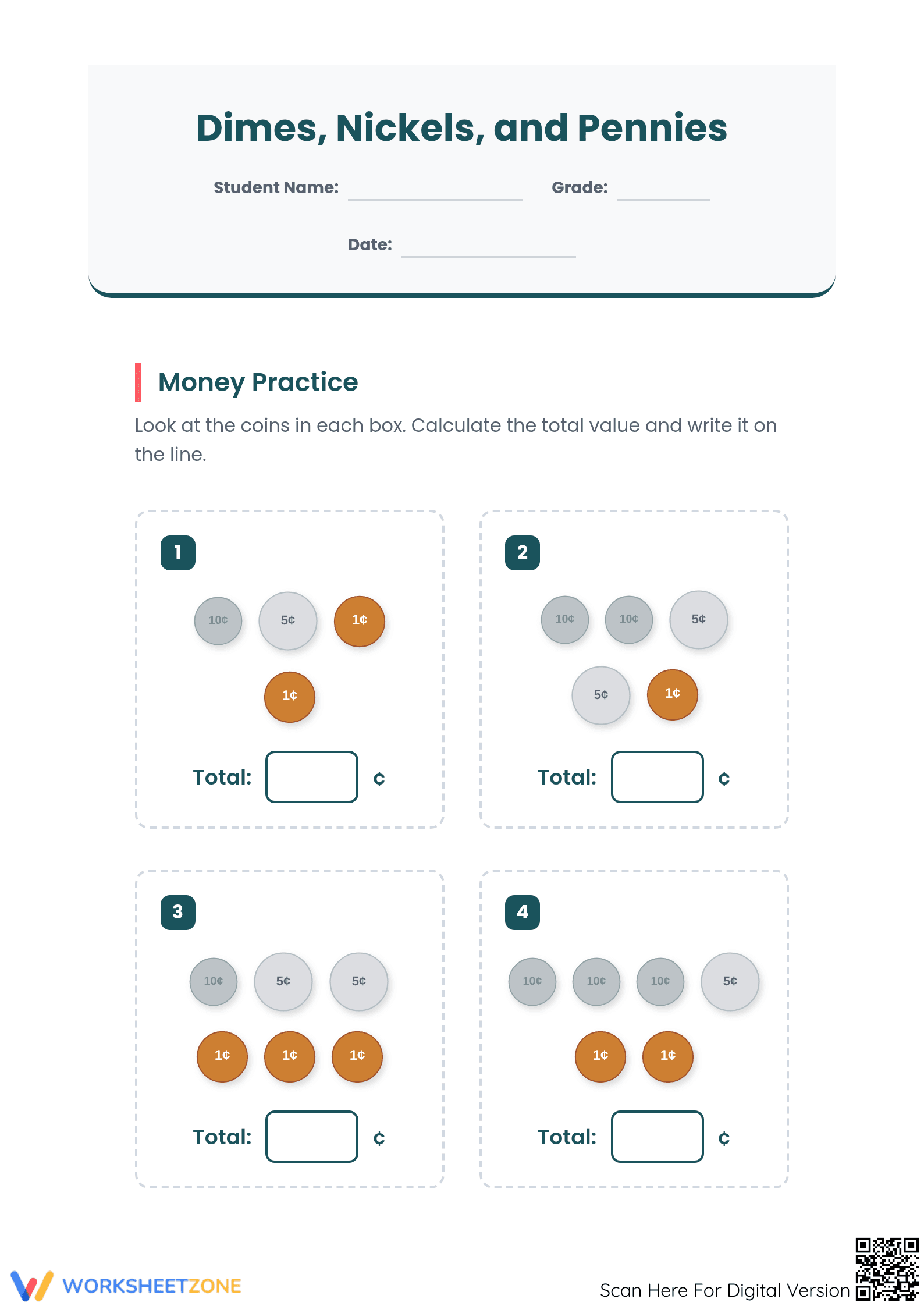
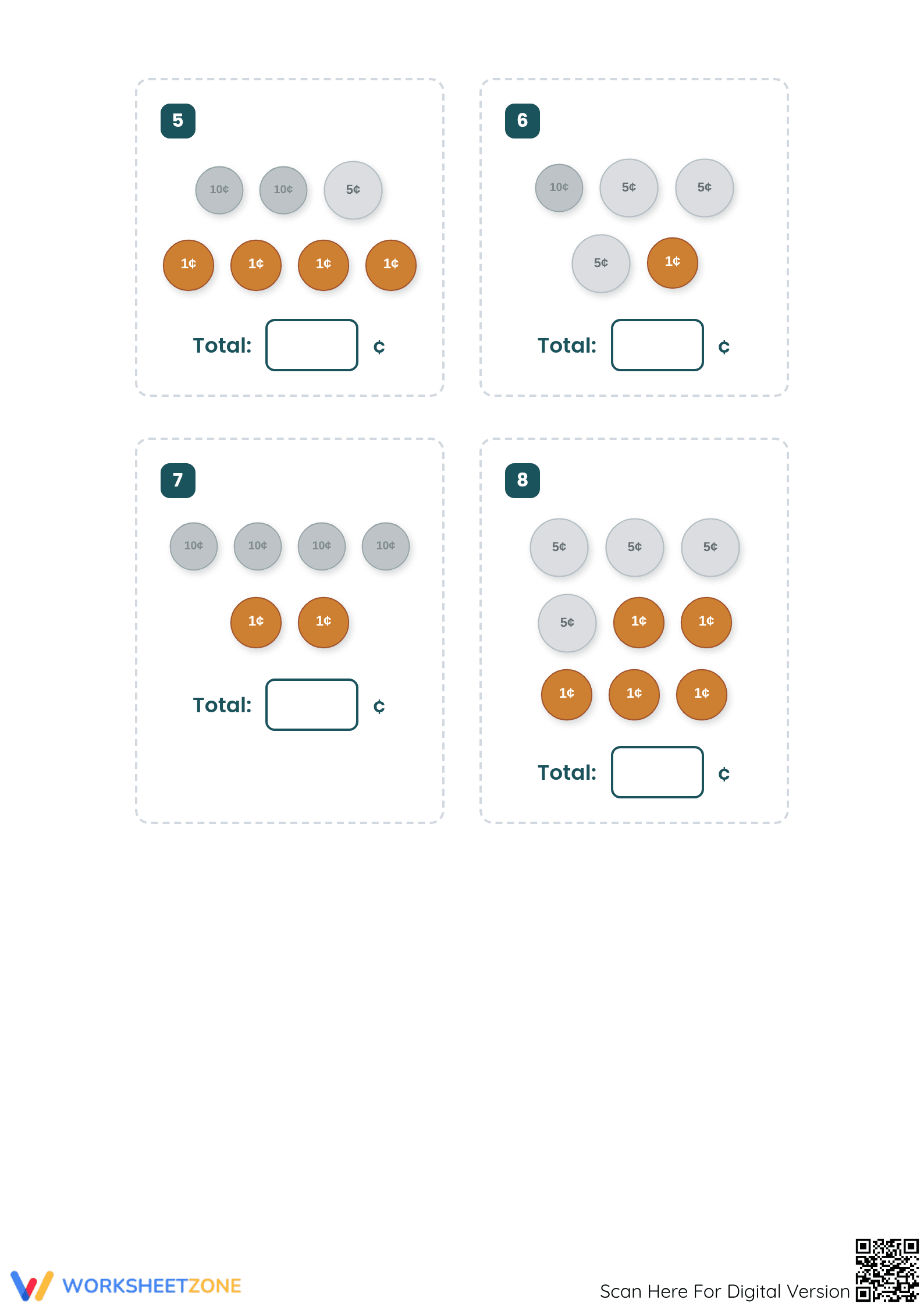
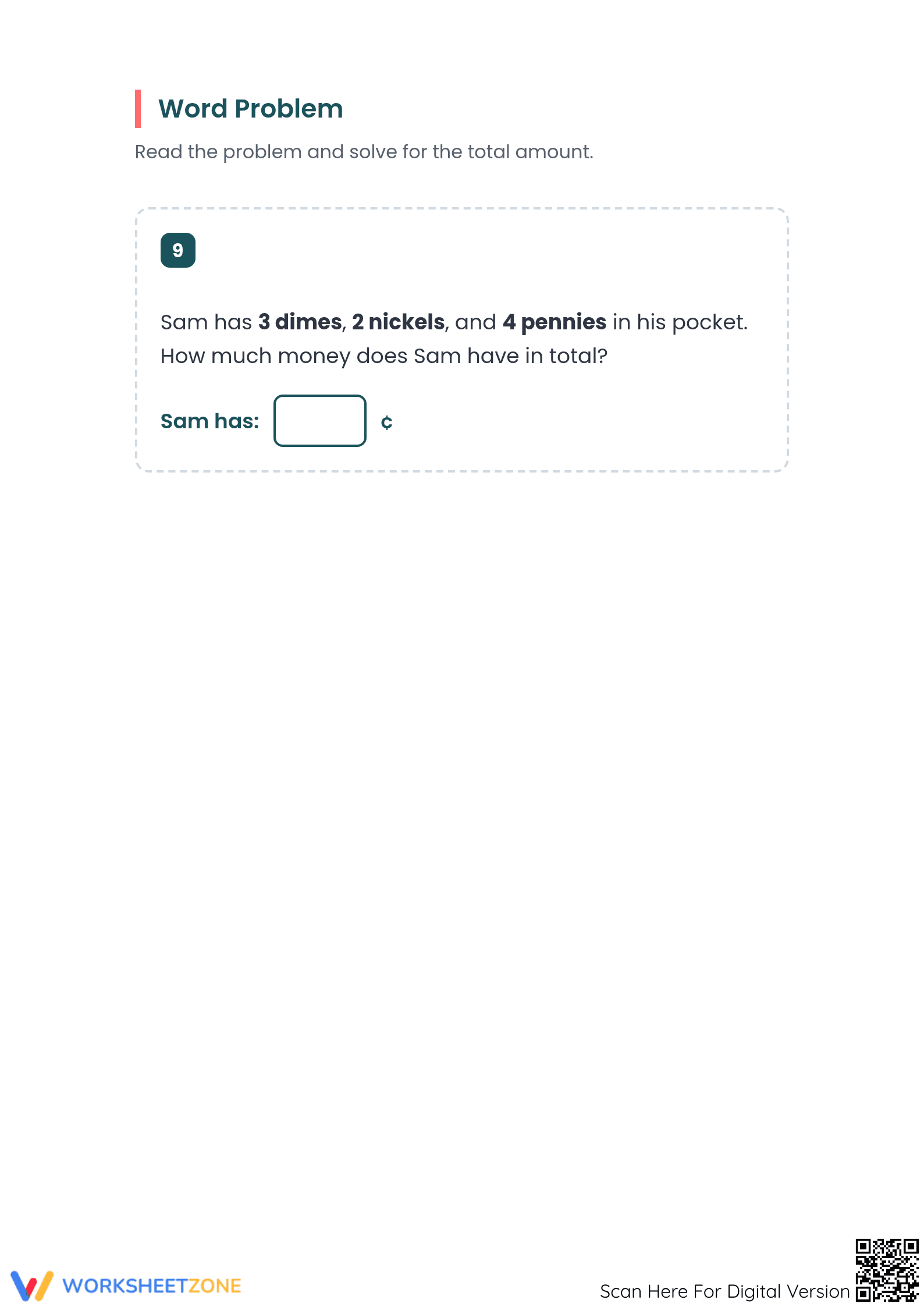
The resource consists of three pages designed for clarity. The first two pages feature eight distinct boxes containing high-quality illustrations of dimes, nickels, and pennies. Each box includes a dedicated "Total" field for student responses. The final page transitions to a text-based word problem, challenging students to translate written quantities into numerical sums without visual aids.
Skill Progression
- Guided Practice: The initial four problems use small coin clusters (3-5 coins) to establish the rhythm of skip-counting by tens, fives, and ones.
- Supported Practice: Problems five through eight increase the complexity by adding more pennies and nickels, requiring students to maintain accuracy across larger sets.
- Independent Practice: The final word problem removes visual scaffolding entirely, forcing students to mentally model the coins or draw their own representations.
This gradual-release model ensures students move from concrete visual recognition to abstract mathematical reasoning.
Standards Alignment
The primary focus is `CCSS.MATH.CONTENT.2.MD.C.8`, which requires students to solve word problems involving dollar bills, quarters, dimes, nickels, and pennies. While this worksheet focuses on a subset of these coins, it provides the necessary scaffolding for students in higher grades who require additional support with base-ten concepts. Both standard codes can be copied directly into lesson plans, IEP goals, or district curriculum mapping tools.
How to Use It
Use this worksheet during a small-group rotation after a direct instruction lesson on coin values. It serves as an excellent formative assessment tool; observe if students are physically marking the coins as they count or if they struggle with the transition from counting by fives to counting by ones. Expect completion within 15 to 20 minutes depending on student proficiency.
Who It's For
This resource is ideal for Grade 3-6 students who need remedial support, as well as Special Education classrooms focusing on functional life skills. It pairs naturally with physical plastic coins or a digital interactive whiteboard display to provide a multi-sensory learning experience.
According to the RAND AIRS 2024 report on elementary mathematics, visual scaffolding in early currency instruction significantly reduces cognitive load for students struggling with multi-step addition. This worksheet implements these findings by providing clear, isolated coin sets that allow students to focus on the transition between different denominations. By aligning with CCSS.MATH.CONTENT.2.MD.C.8, the material ensures that even remedial practice remains tethered to rigorous academic expectations. Research from Fisher & Frey (2014) emphasizes that the gradual release of responsibility—moving from the visual prompts on pages one and two to the text-only word problem on page three—is essential for long-term retention of mathematical procedures. This structured approach helps bridge the gap between classroom exercises and real-world financial interactions, providing a reliable foundation for more complex money management skills in later grades.


