


























Views
Downloads

Essential Digestive System Anatomy Worksheet | Grade 7-12
Paste this activity's link or code into your existing LMS (Google Classroom, Canvas, Teams, Schoology, Moodle, etc.).
Students can open and work on the activity right away, with no student login required.
You'll still be able to track student progress and results from your teacher account.
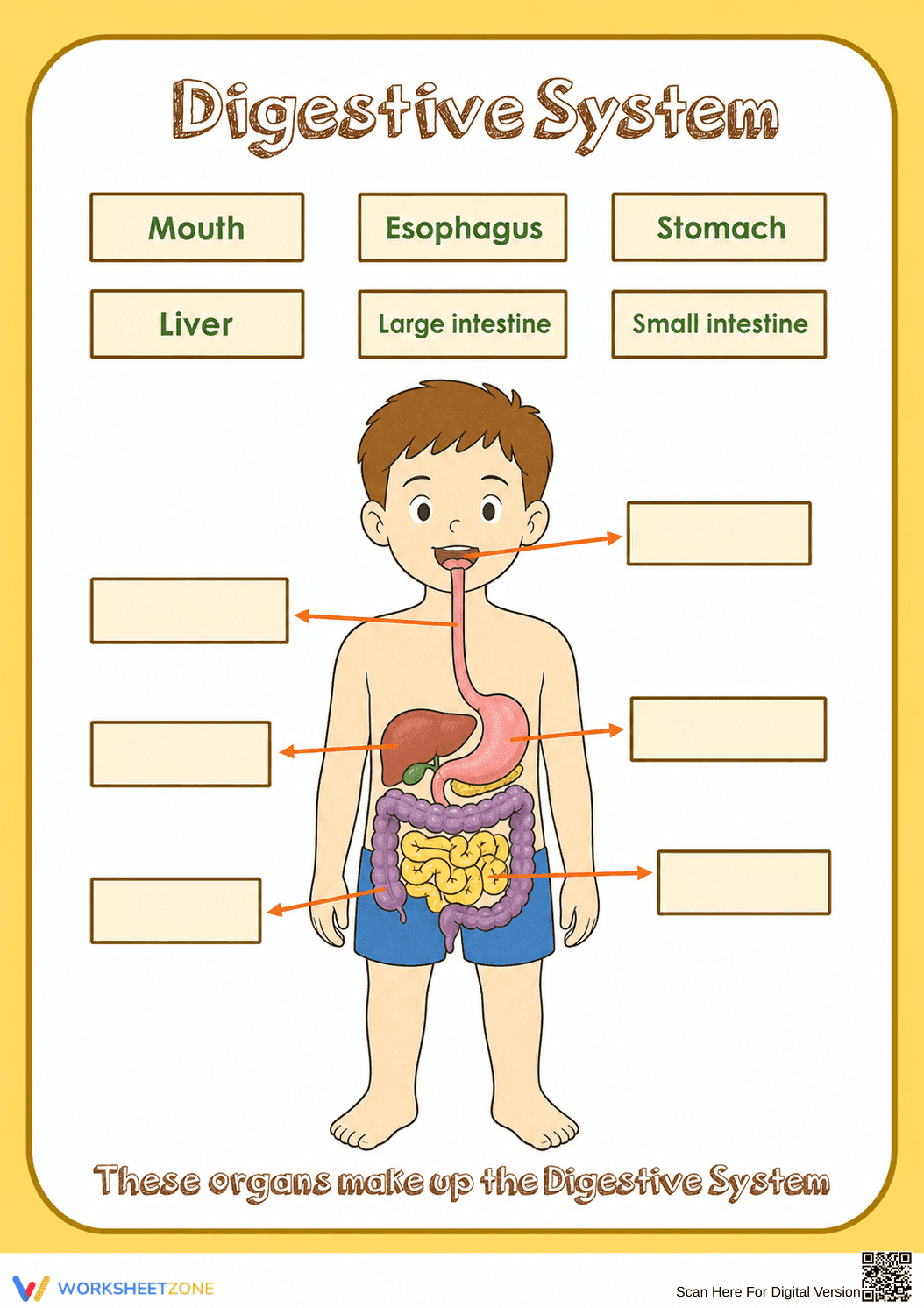
This anatomy worksheet provides a clear visual guide for students to identify and label the primary organs of the human digestive system. By connecting anatomical terms to their physical locations, learners develop a concrete understanding of how the body is organized to process nutrients. It serves as a foundational tool for biology and life science units.
At a Glance
- Grade: 7-12 · Subject: Biology
- Standard:
MS-LS1-3— Use evidence to support how body systems interact to maintain life- Skill Focus: Anatomical identification
- Format: 1 page · 6 problems · Answer key included · PDF
- Best For: Quick review or formative assessment
- Time: 10–15 minutes
What's Inside
The worksheet features a high-quality anatomical illustration of the human torso with the digestive tract highlighted. Students are provided with a word bank containing six essential terms: Mouth, Esophagus, Stomach, Liver, Large Intestine, and Small Intestine. Clear directional arrows ensure students accurately map biological structures.
Zero-Prep Workflow
This resource is designed for a zero-prep classroom workflow. First, print the single-page PDF (30 seconds). Second, distribute the sheets to students as a bell-ringer or exit ticket (30 seconds). Third, review the correct labels using the included answer key to provide immediate feedback (2 minutes). Total teacher prep is under one minute, making it an ideal sub plan.
Standards Alignment
Aligned to `MS-LS1-3`, this activity supports the requirement that students describe how the body is a system of interacting subsystems composed of groups of cells. While focusing on the digestive system, it provides the necessary vocabulary for discussing how the body obtains energy. This standard code can be copied directly into lesson plans, IEP goals, or district curriculum mapping tools.
How to Use It
Use this worksheet as a "Do Now" activity at the start of a human body systems unit to gauge prior knowledge. Use it as a formative assessment after a lecture. Teachers should observe if students can distinguish between the small and large intestines, which is a common point of confusion. Completion typically takes 10 to 15 minutes.
Who It's For
This resource is tailored for middle and high school life science students. It is particularly effective for visual learners and English Language Learners (ELLs) who benefit from the direct pairing of vocabulary with imagery. It pairs naturally with a digestive system slide deck.
According to the RAND AIRS 2024 report, visual-spatial mapping in science education significantly improves long-term retention of anatomical structures compared to rote memorization of definitions. This worksheet leverages that principle by requiring students to physically locate organs within the context of the human body. By mastering the MS-LS1-3 standard through this labeling task, students build the cognitive framework necessary for more complex physiological concepts, such as enzyme interaction and nutrient absorption. The inclusion of a word bank provides a scaffold that reduces cognitive load, allowing students to focus on the spatial relationships between the liver, stomach, and intestines. Research from Fisher & Frey (2014) suggests that such guided practice is essential for moving students toward independent mastery of complex biological systems. This 1-page resource provides a reliable, evidence-based method for reinforcing essential biology curriculum.


