




























Views
Downloads
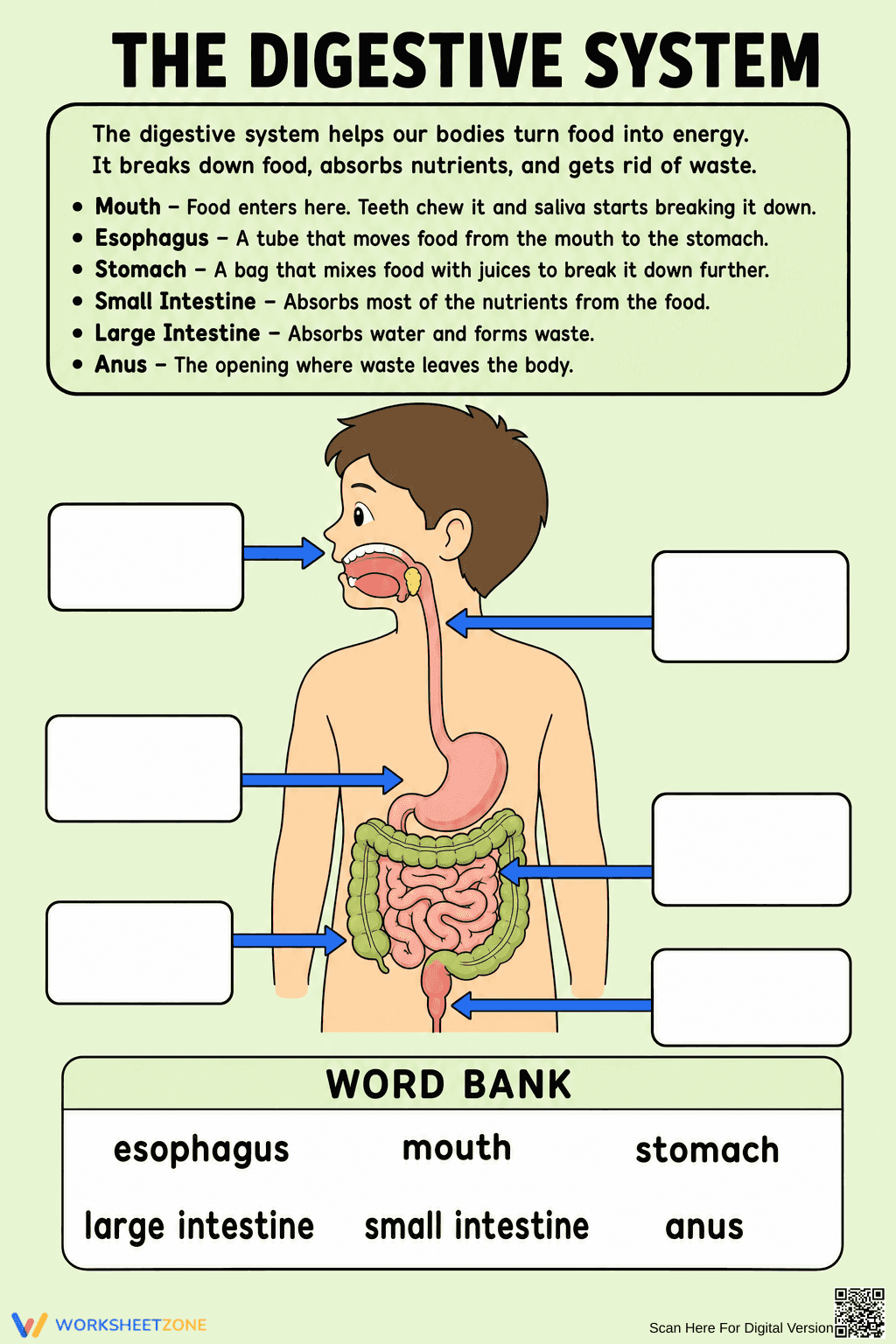

Digestive System Anatomy Printable Worksheet | Grade 7

Paste this activity's link or code into your existing LMS (Google Classroom, Canvas, Teams, Schoology, Moodle, etc.).
Students can open and work on the activity right away, with no student login required.
You'll still be able to track student progress and results from your teacher account.
This Grade 7 science worksheet helps students identify and label the major organs of the human digestive system. By reading brief functional descriptions and using a provided word bank, learners will accurately map the mouth, stomach, and intestines to reinforce their understanding of how the body processes food.
At a Glance
- Grade: 7 · Subject: Science
- Standard:
MS-LS1-3— Identify interacting body subsystems and their functions- Skill Focus: Digestive System Anatomy
- Format: 1 page · 6 problems · Answer key included · PDF
- Best For: Independent practice or sub plans
- Time: 10–15 minutes
This single-page resource features a clear, labeled diagram of the human digestive tract alongside a helpful reading section. The top section provides concise definitions for six key organs, explaining their roles in breaking down food. Students then apply this knowledge by matching terms from the bottom word bank to the correct blank boxes on the anatomical diagram. A complete answer key is included for fast grading.
Zero-Prep Workflow
This resource is designed for immediate classroom application with absolutely no teacher setup required.
- Print (1 minute): Simply print the single-page PDF and the accompanying answer key.
- Distribute (1 minute): Hand out the worksheet. The built-in reading passage and word bank mean students have everything they need on one page.
- Review (3 minutes): Quickly check student diagrams against the provided key or project the answers for self-correction.
With prep time under two minutes, this activity is an excellent option for emergency sub plans.
Standards Alignment
This activity aligns with MS-LS1-3, requiring students to use evidence to explain how the body is a system of interacting subsystems composed of groups of cells. By isolating the digestive tract, learners build foundational knowledge of one critical subsystem. Both standard codes can be copied directly into lesson plans, IEP goals, or district curriculum mapping tools.
How to Use It
Use this worksheet after direct instruction on body systems to solidify anatomical vocabulary. It also serves as an effective warm-up activity at the start of a biology unit. As a formative assessment tip, observe which students rely heavily on the reading passage versus those who can label the diagram from memory; this indicates their current level of vocabulary retention. Expect students to complete the labeling and reading within 10 to 15 minutes.
Who It's For
This resource is designed for middle school science students learning basic anatomy. The inclusion of a word bank and short, accessible reading descriptions provides built-in differentiation, making it highly suitable for English Language Learners or students requiring reading scaffolds. Pair this diagram with a larger anchor chart of the human body or a hands-on lab demonstrating chemical digestion for a comprehensive lesson.
Integrating visual diagrams with targeted vocabulary practice significantly improves student retention in middle school life sciences. This worksheet directly supports MS-LS1-3 by helping students identify interacting body subsystems and their functions, specifically focusing on the digestive tract. According to Fisher & Frey (2014), providing students with clear, structured visual scaffolds alongside text-based definitions enhances their ability to process and recall complex academic language. By combining a short reading passage, a visual diagram, and a targeted word bank on a single page, this resource reduces cognitive load and allows learners to focus directly on mastering anatomical relationships. The immediate application of reading comprehension to a labeling task ensures active engagement with the material, fostering a deeper understanding of how individual organs contribute to the broader digestive system and overall human health.


