




























Views
Downloads
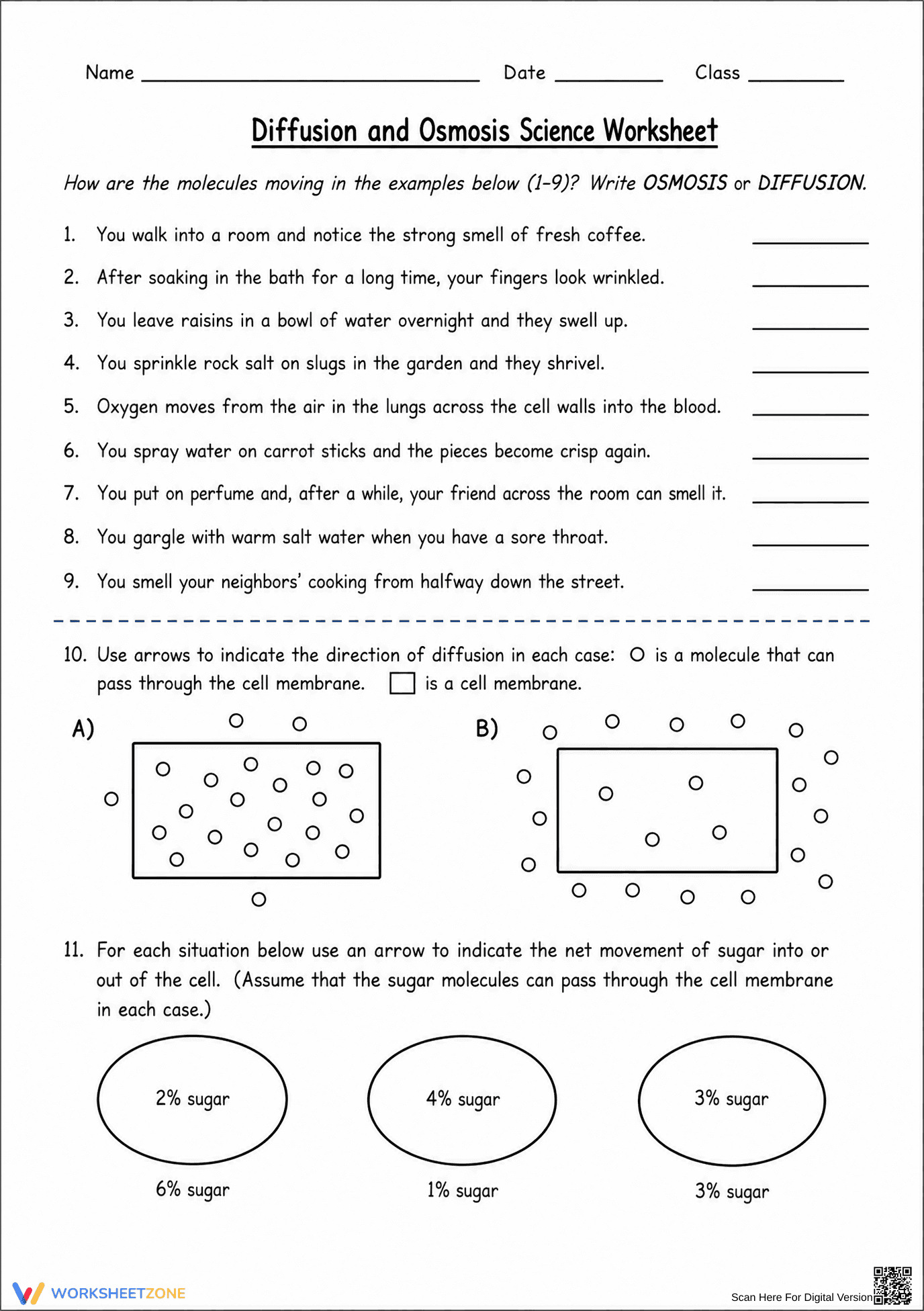

Grade 9 Diffusion and Osmosis — Printable No-Prep Worksheet

Paste this activity's link or code into your existing LMS (Google Classroom, Canvas, Teams, Schoology, Moodle, etc.).
Students can open and work on the activity right away, with no student login required.
You'll still be able to track student progress and results from your teacher account.
This Grade 9 biology worksheet provides targeted practice on cellular transport, helping students confidently distinguish between diffusion and osmosis. By analyzing real-world scenarios and concentration gradients, learners will predict the net movement of molecules across cell membranes, solidifying their understanding of how cells maintain homeostasis.
At a Glance
- Grade: 9 · Subject: Biology
- Standard:
HS-LS1-3— Predict molecular movement to maintain cellular homeostasis- Skill Focus: Differentiating diffusion and osmosis
- Format: 1 page · 14 problems · Answer key included · PDF
- Best For: Independent practice or review
- Time: 15–20 minutes
This single-page resource features 14 carefully structured tasks divided into two distinct sections. The first section includes nine real-world scenarios where students must identify the process at work as either osmosis or diffusion. The second section contains five visual diagrams of cells and concentration gradients, requiring students to draw arrows indicating the exact direction of molecular movement. A complete answer key is included to ensure accurate grading and immediate student feedback.
Designed for maximum efficiency, this worksheet requires minimal teacher preparation:
- Print (1 minute): The single-page layout is optimized for quick, high-contrast black-and-white copying.
- Distribute (1 minute): Hand out the sheets as a warm-up, exit ticket, or main practice activity.
- Review (3 minutes): Use the included answer key to quickly check student comprehension or facilitate a whole-class review.
With a total setup time of under two minutes, this resource is an excellent addition to any emergency sub plan or last-minute lesson adjustment.
This activity is aligned to HS-LS1-3, requiring students to plan and conduct an investigation to provide evidence that feedback mechanisms maintain homeostasis. By predicting how water and solutes move across a semipermeable membrane, students demonstrate their grasp of the passive transport mechanisms essential for cellular survival. Both standard codes can be copied directly into lesson plans, IEP goals, or district curriculum mapping tools.
Deploy this worksheet following direct instruction on passive transport to reinforce concepts. It serves perfectly as an independent practice assignment where students can apply theoretical knowledge to practical, everyday examples like smelling perfume or soaking raisins. As a formative assessment tip, observe how students draw their arrows in the diagram section; incorrect arrow direction quickly reveals misconceptions about concentration gradients. Most students will complete the entire page within 15 to 20 minutes.
This resource is ideal for high school biology students, particularly those in Grade 9 encountering cellular transport for the first time. The clear, relatable examples provide excellent scaffolding for English Language Learners and students who benefit from concrete applications of abstract scientific concepts. Pair this worksheet with a visual anchor chart detailing the cell membrane structure to provide additional support during independent work time.
Mastering the mechanics of cellular transport is a foundational requirement for advanced biological sciences and general life science curricula. This resource aligns directly with HS-LS1-3, focusing on the critical ability to predict molecular movement to maintain cellular homeostasis. According to a ScienceDirect TpT Analysis, integrating relatable real-world scenarios with explicit visual diagramming significantly improves student retention of abstract microscopic processes. By requiring learners to translate text-based scenarios into visual models of concentration gradients, this worksheet bridges the gap between rote memorization and true conceptual application. The dual-format approach ensures that students not only recognize the definitions of diffusion and osmosis but can also accurately map their physical trajectories across a semipermeable membrane. This targeted practice builds the analytical skills necessary for subsequent units on active transport, cellular respiration, and complex physiological feedback loops.


