




























Views
Downloads
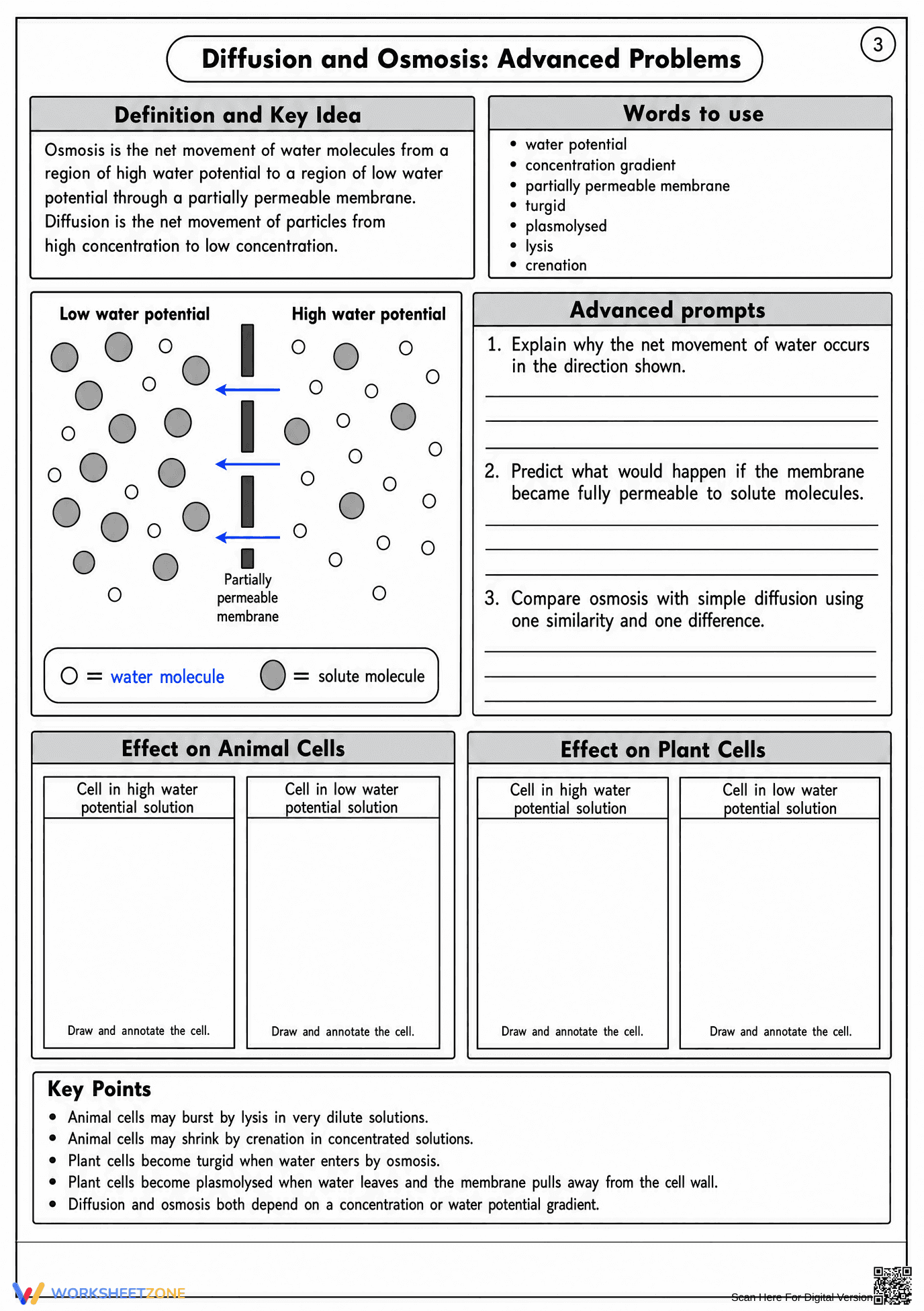

Grade 10 Osmosis & Diffusion — Printable No-Prep Worksheet

Paste this activity's link or code into your existing LMS (Google Classroom, Canvas, Teams, Schoology, Moodle, etc.).
Students can open and work on the activity right away, with no student login required.
You'll still be able to track student progress and results from your teacher account.
This high school biology worksheet challenges students to apply their understanding of cellular transport mechanisms. By analyzing diagrams and predicting outcomes, students will master the concepts of diffusion and osmosis. The structured format ensures learners can confidently explain water potential and its effects on both plant and animal cells.
At a Glance
- Grade: 10 · Subject: Biology
- Standard:
HS-LS1-2— Model cell parts and their specific functions- Skill Focus: Analyzing diffusion and osmosis
- Format: 1 page · 7 problems · Answer key included · PDF
- Best For: Independent practice or review
- Time: 20–30 minutes
A clear definition section grounds students in core concepts. The page includes a detailed diagram of molecules moving across a partially permeable membrane, followed by three advanced short-answer prompts. Students also draw and annotate four cellular scenarios to demonstrate the effects of high and low water potential on animal and plant cells. A targeted word bank provides essential scaffolding.
Experience an efficient zero-prep workflow.
- Print (1 minute): The single-page layout is optimized for quick, high-quality black-and-white printing.
- Distribute (1 minute): Hand out the copies at the start of class or leave them in a designated folder for a substitute teacher.
- Review (5 minutes): Use the included comprehensive answer key to quickly grade submissions or project it on the board for whole-class self-correction.
Total teacher preparation time is under two minutes, making this an ideal sub plan.
This activity is aligned to the Next Generation Science Standard HS-LS1-2: Develop and use a model to illustrate the hierarchical organization of interacting systems that provide specific functions within multicellular organisms. It specifically targets the function of the cell membrane in maintaining homeostasis through passive transport. Both standard codes can be copied directly into lesson plans, IEP goals, or district curriculum mapping tools.
Deploy this worksheet during the independent practice phase of a cell biology unit, immediately following direct instruction on passive transport. It serves as an excellent formative assessment tool; as students draw and annotate the plant and animal cells, teachers can circulate to observe whether they correctly illustrate plasmolysis, turgidity, and lysis. Expect students to complete the reading, diagram analysis, and drawing tasks within a 20 to 30-minute timeframe.
This resource is tailored for high school biology students in grades 9 through 12. The built-in word bank and explicit definitions offer necessary differentiation for English Language Learners or students needing vocabulary support, while the advanced prompts challenge higher-level thinkers to compare and predict outcomes. It pairs perfectly with a hands-on gummy bear or potato slice osmosis lab, bridging the gap between physical experiments and theoretical models.
Mastering cellular transport requires students to move beyond rote memorization and actively model biological processes. This worksheet aligns with HS-LS1-2 by asking students to model cell parts and their specific functions, specifically focusing on how the cell membrane regulates water potential. According to EdReports 2024, science instructional materials that integrate visual modeling with targeted vocabulary practice significantly improve student retention of complex abstract concepts like passive transport. By requiring learners to draw and annotate the physical changes in plant and animal cells—such as crenation, lysis, or becoming turgid—this resource bridges the gap between macroscopic laboratory observations and microscopic cellular mechanisms. The strategic combination of visual diagram analysis, structured writing prompts, and explicit vocabulary reinforcement ensures that students build a robust, enduring understanding of fundamental diffusion and osmosis principles.


