




























Views
Downloads

Diffusion and Osmosis Worksheet | Printable Grade 7 Science

Paste this activity's link or code into your existing LMS (Google Classroom, Canvas, Teams, Schoology, Moodle, etc.).
Students can open and work on the activity right away, with no student login required.
You'll still be able to track student progress and results from your teacher account.
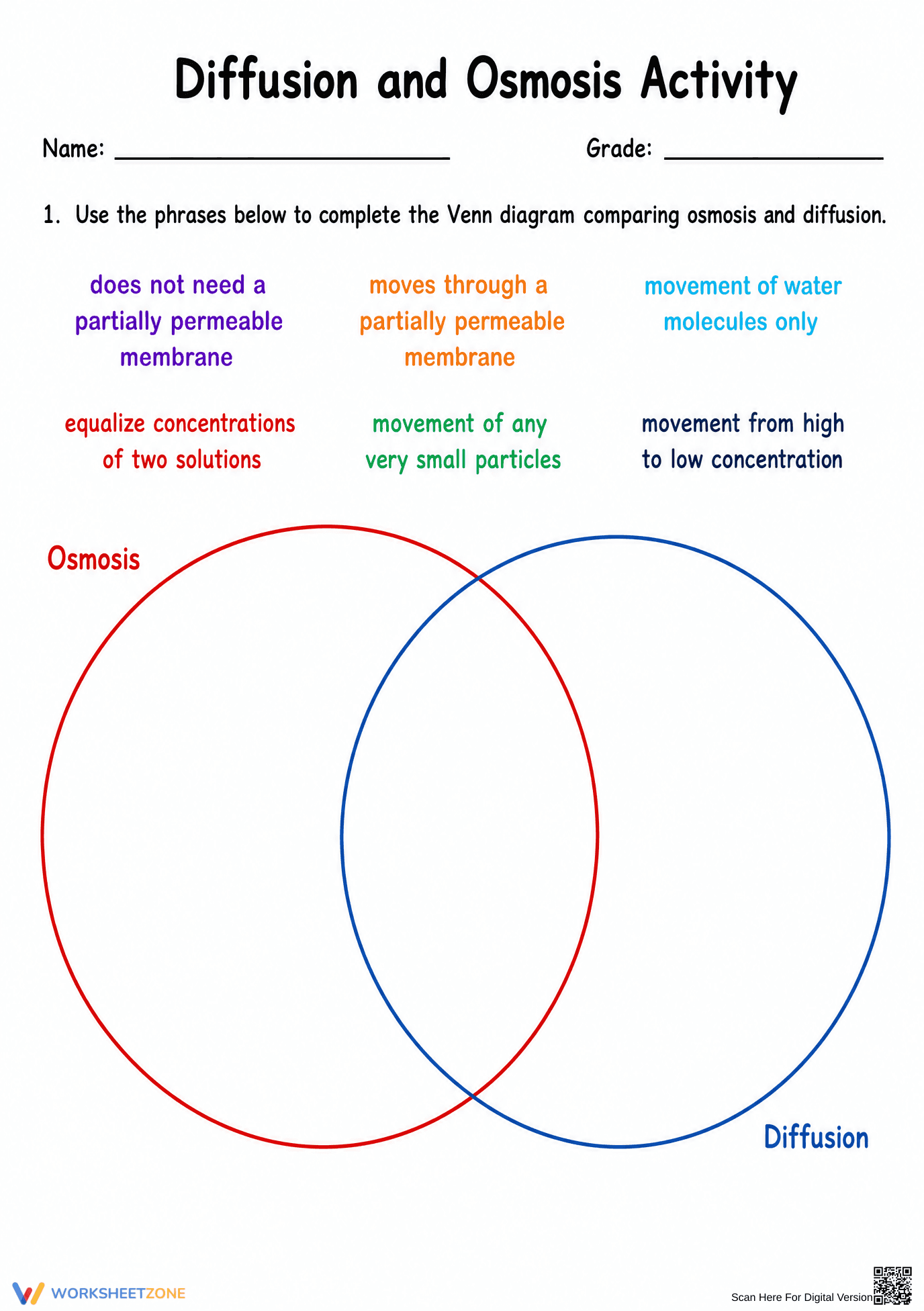
This middle school biology worksheet helps students distinguish between passive transport mechanisms through a structured Venn diagram. By categorizing specific characteristics of molecular movement, learners develop a clear conceptual model of how substances enter and exit cells. It provides an ideal formative assessment for life science units.
At a Glance
- Grade: 7 · Subject: Biology
- Standard:
MS-LS1-2— Model the function of a cell and its parts- Skill Focus: Comparing Diffusion and Osmosis
- Format: 1 page · 6 tasks · Answer key included · PDF
- Best For: Quick check for understanding
- Time: 10–15 minutes
The resource features a clean, one-page layout centered on a large Venn diagram. Students are provided with a word bank of six specific phrases, such as "movement of water molecules only" and "moves through a partially permeable membrane." The task requires students to analyze each phrase and determine if it applies to osmosis, diffusion, or both, facilitating high-level comparison of cellular processes. A complete answer key is included for quick grading.
This activity is designed for immediate classroom implementation. Print: Generating copies for a standard class takes under one minute. Distribute: Hand out the single-page PDF as a bell ringer or exit ticket as students enter or leave the room. Review: Going over the answers as a whole group takes approximately five minutes. Total teacher prep time is under two minutes, making it an efficient tool for busy educators or emergency sub plans.
This worksheet aligns directly with MS-LS1-2, which requires students to develop and use a model to describe the function of a cell as a whole and ways parts of cells contribute to the function. By identifying the specific conditions required for osmosis versus general diffusion, students demonstrate an understanding of how the cell membrane regulates internal environments. Both standard codes can be copied directly into lesson plans, IEP goals, or district curriculum mapping tools.
Use this worksheet during the Explain phase of a 5E lesson cycle after students have observed a demonstration of food coloring in water. It serves as a concrete way to formalize their observations. Alternatively, assign it as an independent homework task to reinforce vocabulary. For a formative assessment, walk around and observe if students correctly place the "water molecules only" phrase, which is a common point of confusion in cellular transport. Expected completion time is 10 to 15 minutes.
This resource is tailored for middle school life science students and introductory high school biology learners. It provides excellent support for visual learners who benefit from graphic organizers to structure their thinking. It pairs naturally with a microscope lab or a teacher-led presentation on the phospholipid bilayer and passive transport mechanisms.
According to the RAND AIRS 2024 report on science literacy, the use of graphic organizers like Venn diagrams significantly improves the retention of complex biological processes by reducing cognitive load. This worksheet targets the MS-LS1-2 standard by requiring students to model the function of a cell and its parts, specifically focusing on the differences between diffusion and osmosis, a fundamental concept in understanding cellular homeostasis. By isolating six critical attributes of molecular movement, the activity ensures that students focus on the most scientifically relevant distinctions. This printable resource provides a structured environment for students to practice these distinctions, ensuring they can accurately describe how cells interact with their environment. It is a reliable tool for any secondary science curriculum focused on evidence-based instructional strategies and efficient classroom workflows.


