




























Views
Downloads
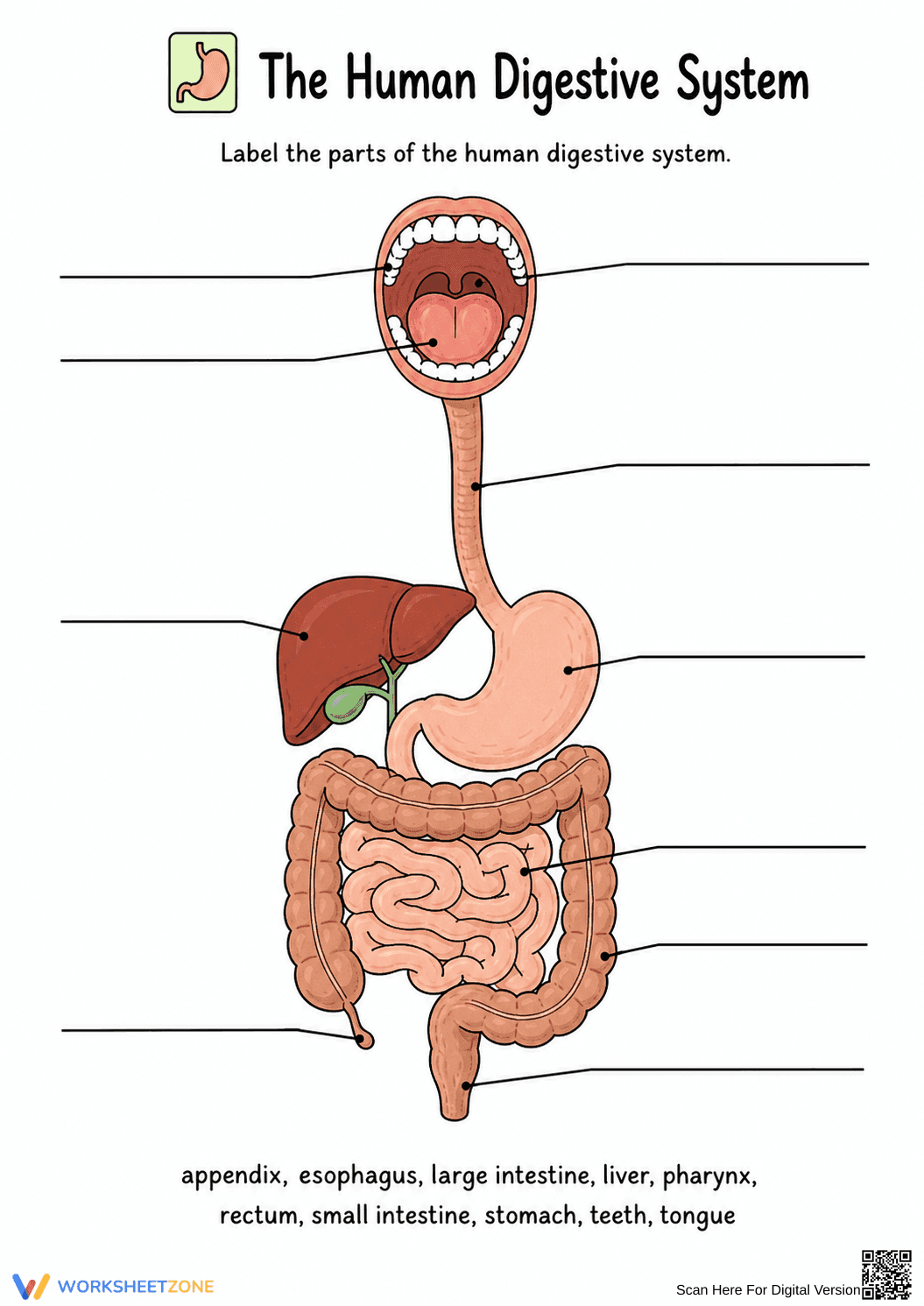

Grade 7 Digestive System — Printable No-Prep Worksheet

Paste this activity's link or code into your existing LMS (Google Classroom, Canvas, Teams, Schoology, Moodle, etc.).
Students can open and work on the activity right away, with no student login required.
You'll still be able to track student progress and results from your teacher account.
This Grade 7 biology worksheet provides a clear, visual method for students to identify and label the major organs of the human digestive system. By connecting anatomical terms to their correct locations, learners build foundational knowledge of how the body processes food and nutrients.
At a Glance
- Grade: 7 · Subject: Science
- Standard:
MS-LS1-3— Identify and describe interacting body system components- Skill Focus: Labeling digestive anatomy
- Format: 1 page · 10 problems · Answer key included · PDF
- Best For: Independent practice or review
- Time: 10–15 minutes
What's Inside
This single-page resource features a high-quality, full-color illustration of the human digestive tract. Students are tasked with completing 10 labeling problems using a provided word bank that includes key structures such as the esophagus, stomach, liver, small intestine, and large intestine. The clear layout minimizes confusion, while the included answer key ensures accurate grading and immediate feedback.
Zero-Prep Workflow
- Print (1 minute): Simply print the PDF and copy a class set. No special materials or cutting required.
- Distribute (1 minute): Hand out the worksheet as a warm-up, exit ticket, or independent practice activity.
- Review (3 minutes): Quickly check student responses using the provided answer key or project it on the board for self-grading.
Total teacher prep time is under two minutes, making this an ideal, stress-free addition to any life science unit or emergency sub plan.
Standards Alignment
Aligned to MS-LS1-3: Use argument supported by evidence for how the body is a system of interacting subsystems composed of groups of cells. This activity specifically supports the foundational step of identifying the macroscopic organs that make up the digestive subsystem. Both standard codes can be copied directly into lesson plans, IEP goals, or district curriculum mapping tools.
How to Use It
Use this worksheet immediately following direct instruction on the digestive system to reinforce organ identification. Alternatively, assign it as a quick formative assessment at the beginning of a class to check for prior knowledge before discussing chemical and mechanical digestion. Teachers can easily observe which students struggle to differentiate between the small and large intestines, allowing for targeted reteaching. Expected completion time is 10 to 15 minutes.
Who It's For
This resource is designed for middle school life science students, particularly those in Grade 7. The inclusion of a word bank provides built-in scaffolding, making it accessible for English Language Learners and students needing additional vocabulary support. It pairs perfectly with a 3D anatomical model demonstration or a digital interactive lesson on human body systems.
Integrating visual diagrams with targeted vocabulary practice is a highly effective instructional strategy for teaching complex biological systems in middle school science classrooms. According to ScienceDirect TpT Analysis, students who engage in active labeling tasks demonstrate significantly improved long-term retention of anatomical structures compared to those who rely on passive reading alone. By aligning directly with the MS-LS1-3 standard, this worksheet ensures learners can accurately identify and describe interacting body system components, which is a critical prerequisite for understanding broader physiological processes. The structured format, complete with a supportive word bank, intentionally reduces extraneous cognitive load. This allows students to focus entirely on mastering the spatial relationships and specific terminology associated with the organs in the digestive tract, ultimately fostering a deeper, more resilient comprehension of human anatomy.


