


























Views
Plays

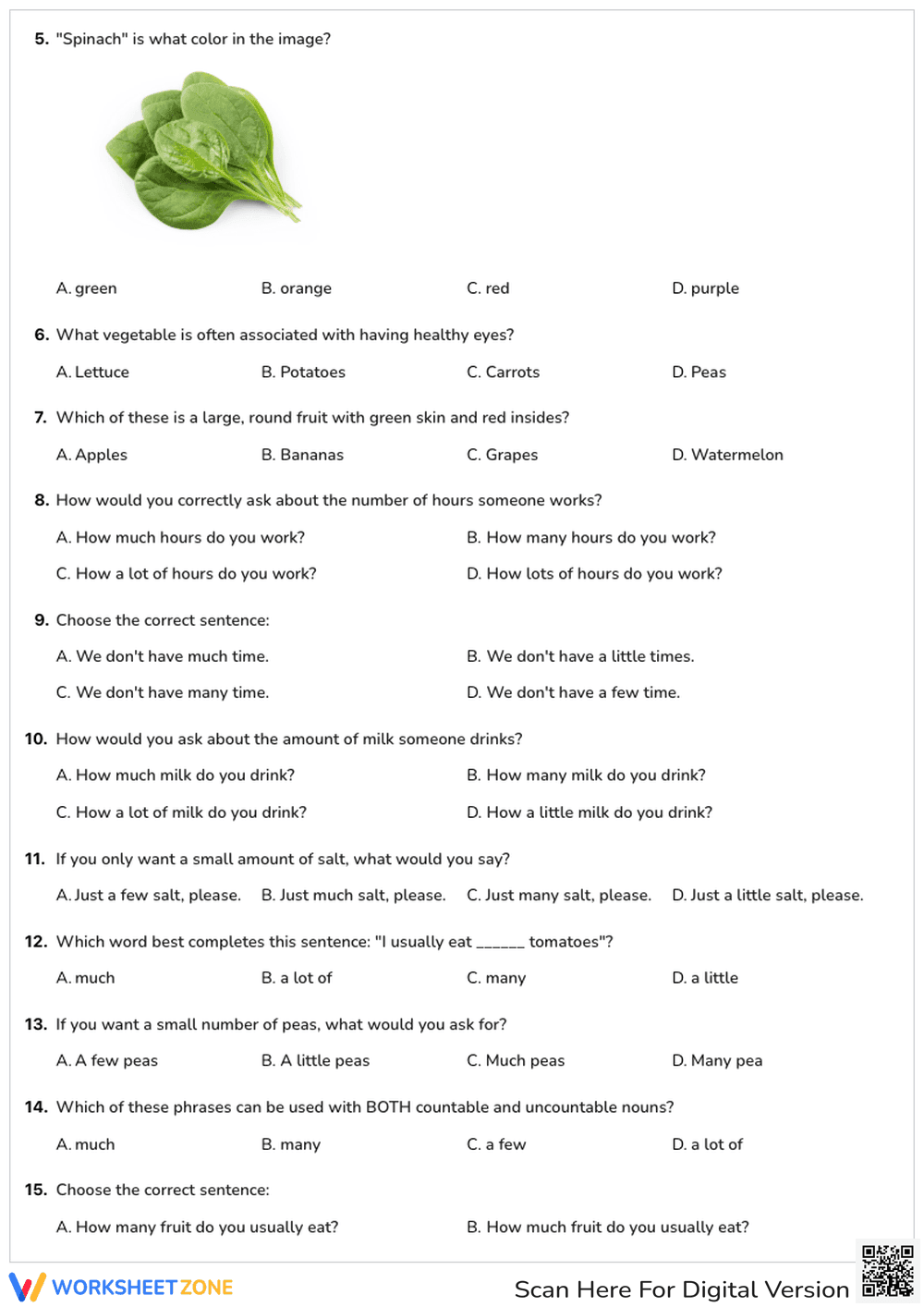
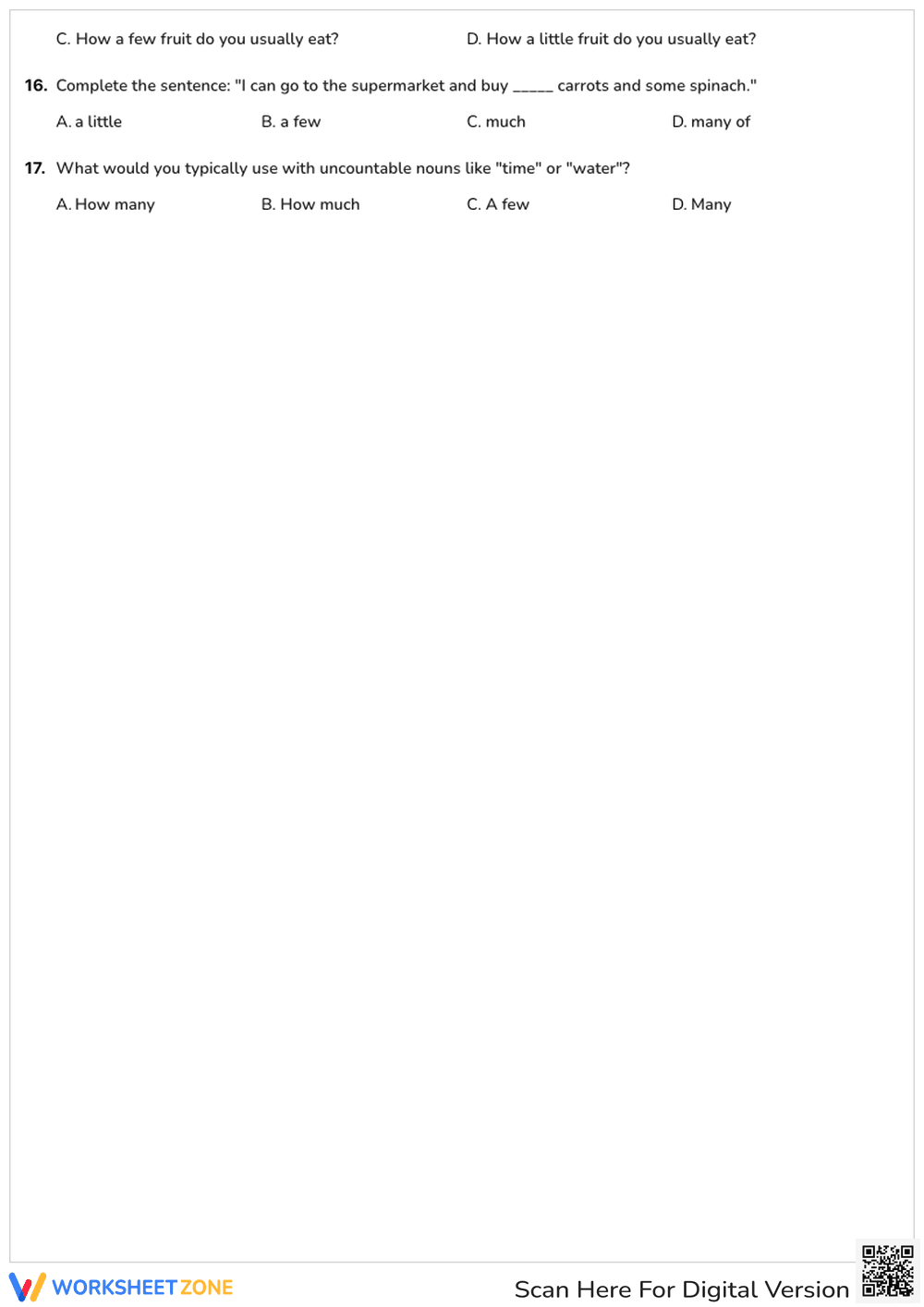

Grade 4-5 Food & Quantifiers — Essential Grammar Worksheet
Paste this activity's link or code into your existing LMS (Google Classroom, Canvas, Teams, Schoology, Moodle, etc.).
Students can open and work on the activity right away, with no student login required.
You'll still be able to track student progress and results from your teacher account.
This Grade 4-5 grammar worksheet focuses on the critical distinction between countable and uncountable nouns through the lens of food and nutrition. Students practice identifying specific produce while mastering the application of quantifiers like "how much" and "a few." It provides immediate practice to ensure students can communicate accurately about quantities in everyday contexts.
At a Glance
- Grade: 4-5 · Subject: ELA Grammar
- Standard:
CCSS.ELA-LITERACY.L.4.1— Demonstrate command of the conventions of standard English grammar and usage- Skill Focus: Quantifiers and Food Vocabulary
- Format: 3 pages · 17 problems · Answer key included · PDF
- Best For: Quick assessment or sub plans
- Time: 15–20 minutes
The resource contains 17 multiple-choice questions spread across three pages. The first section utilizes high-quality visual aids to help students identify vegetables like carrots and aubergines, while the latter half transitions into abstract grammar application. It includes a clear layout with ample white space, making it accessible for English Language Learners (ELL) and students requiring visual support during independent work.
This worksheet is designed for a zero-prep classroom environment. Teachers can print the three-page PDF in under 30 seconds. Distribution takes less than a minute, and because the questions are multiple-choice, the review process is streamlined. Total teacher preparation time is approximately 2 minutes, making it an ideal choice for emergency sub plans, morning work, or end-of-unit reviews where time is at a premium.
Aligned primarily to `CCSS.ELA-LITERACY.L.4.1`, this resource requires students to demonstrate command of standard English grammar. Specifically, it targets the nuance of count versus non-count nouns (e.g., "many carrots" vs "much milk"). Both standard codes can be copied directly into lesson plans, IEP goals, or district curriculum mapping tools to ensure compliance with state and national frameworks.
Use this as a formative assessment after a lesson on nouns and quantifiers. Observe if students struggle more with the vocabulary or the grammatical rules for "a little" versus "a few." It also serves as an excellent warm-up activity to activate prior knowledge before a writing task. Expected completion time is 15 to 20 minutes depending on student reading speed and language proficiency.
This is tailored for Grade 4 and 5 students, particularly those in ESL or ELL programs at an A1 proficiency level. It pairs naturally with a nutrition unit or a lesson on grocery shopping. It works well alongside a visual anchor chart detailing common countable and uncountable kitchen items or a direct instruction lesson on pluralization rules.
According to the RAND AIRS 2024 report on instructional materials, high-quality visual scaffolding in grammar assessments significantly improves retention for intermediate elementary learners. This worksheet applies those findings by pairing produce imagery with quantifier selection. By focusing on CCSS.ELA-LITERACY.L.4.1, the material ensures that students move beyond rote memorization toward functional language use. The 17-question format provides enough data points for teachers to identify specific misconceptions regarding "how much" and "how many" without overwhelming the learner. This balance of vocabulary and mechanics supports the gradual release of responsibility, moving from image identification to complex sentence completion. Such structured practice is essential for building the linguistic foundation required for more advanced middle-school composition and verbal communication tasks in diverse educational settings.


