


























Views
Downloads

Essential Vocabulary Definition Worksheet | Grade 3-12 Ready
Paste this activity's link or code into your existing LMS (Google Classroom, Canvas, Teams, Schoology, Moodle, etc.).
Students can open and work on the activity right away, with no student login required.
You'll still be able to track student progress and results from your teacher account.
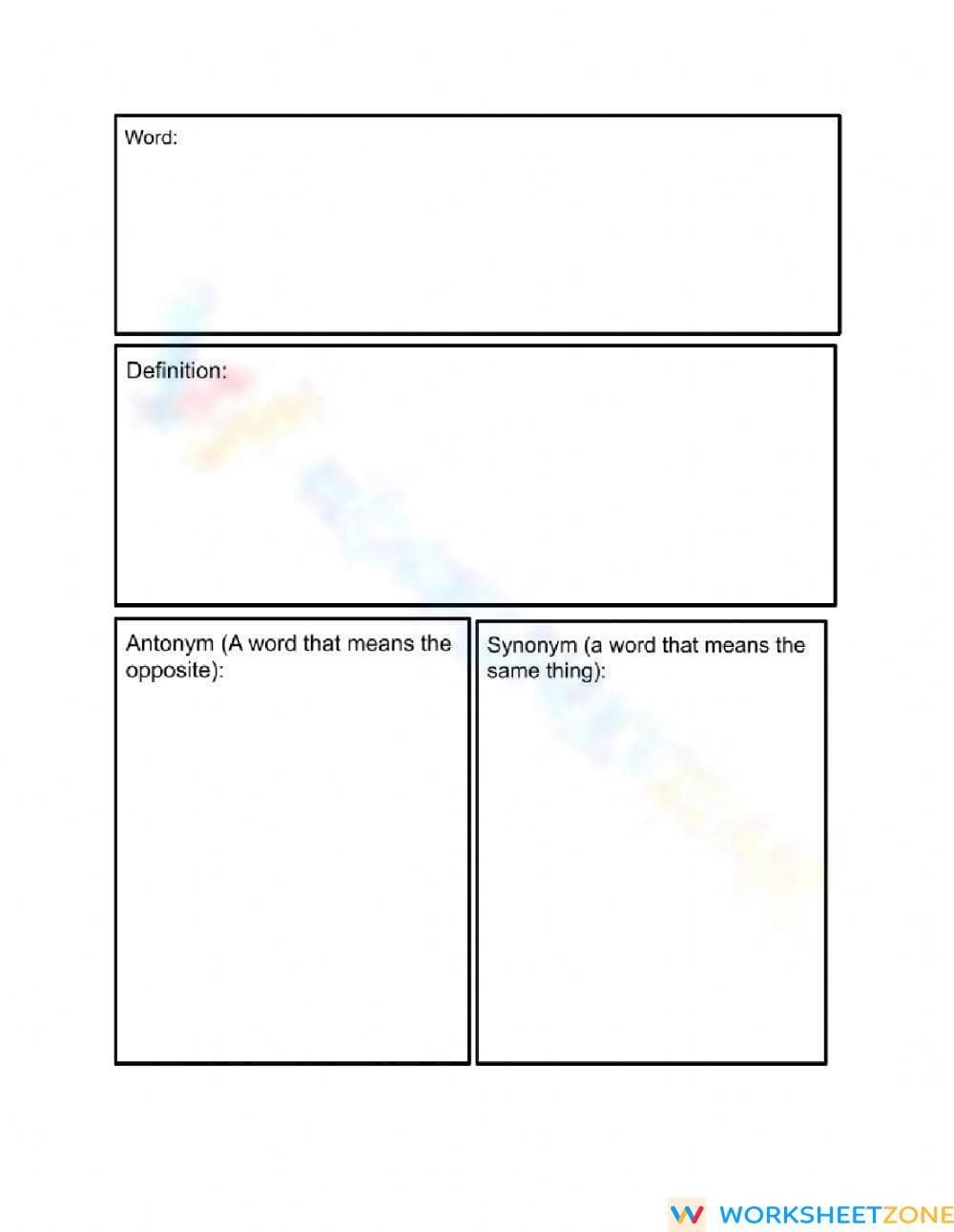
This versatile ELA worksheet provides a structured graphic organizer for students to master new vocabulary words. By connecting a word to its definition, antonyms, and synonyms, learners build deep semantic connections. This printable resource ensures students can independently explore word relationships and expand their lexicon effectively in any subject area.
At a Glance
- Grade: 3–12 · Subject: English Language Arts
- Standard:
CCSS.ELA-LITERACY.L.5.5.C— Use synonyms and antonyms to better understand word relationships- Skill Focus: Vocabulary Definition & Semantic Mapping
- Format: 1 page · 1 task · Template-style · PDF
- Best For: Vocabulary warm-ups and independent word study
- Time: 5–10 minutes
This single-page PDF features a clean, four-quadrant layout designed for maximum clarity. The worksheet includes dedicated sections for the target word, its formal definition, a box for antonyms (opposite meanings), and a box for synonyms (similar meanings). Its minimalist design makes it perfect for repeated use without overwhelming students with unnecessary visual clutter.
Zero-Prep Workflow
Teachers can implement this resource in under two minutes with three simple steps. First, print the required number of copies for the class or individual students. Second, distribute the worksheet alongside any reading passage or vocabulary list. Third, review the student-generated definitions and word pairs to check for conceptual understanding. This template is an ideal addition to sub plans or morning work folders because it requires no teacher setup or specialized materials.
Standards Alignment
This resource is primarily aligned to CCSS.ELA-LITERACY.L.5.5.C, which requires students to use the relationship between particular words (e.g., synonyms, antonyms) to better understand each of the words. It also supports broader vocabulary acquisition goals across middle and high school grades. Both standard codes can be copied directly into lesson plans, IEP goals, or district curriculum mapping tools.
How to Use It
Use this worksheet as a formative assessment tool during the "during reading" phase of a lesson. When students encounter an unfamiliar Tier 2 or Tier 3 word, have them pause to complete the organizer. Alternatively, use it as a weekly "Word of the Day" activity to build a consistent classroom routine. Teachers should look for students who struggle to find antonyms, as this often indicates a shallow understanding of the word's nuanced meaning. Completion typically takes 5 to 10 minutes depending on word complexity.
Who It's For
This resource is designed for students in grades 3 through 12, as well as adult learners and ESL/ELL students who need a structured approach to word study. It pairs naturally with any informational text, literary passage, or content-area textbook. The open-ended nature of the template allows for easy differentiation based on the specific vocabulary words selected by the teacher or student.
Effective vocabulary instruction must move beyond simple rote memorization to explore semantic relationships. As noted by Fisher & Frey (2014), students who engage with synonyms and antonyms develop a more robust mental lexicon, allowing them to retrieve and apply words more accurately in their own writing and speech. This graphic organizer facilitates that process by requiring students to categorize words according to their relational meanings. By mapping the "Word:", "Definition:", "Antonym:", and "Synonym:" in a single visual field, the worksheet reduces cognitive load while maximizing retention of the target term. Research from RAND AIRS 2024 suggests that consistent use of semantic mapping tools significantly improves reading comprehension scores across diverse student populations. This Grade 3-12 ELA worksheet provides the essential scaffolding needed to align with CCSS.ELA-LITERACY.L.5.5.C and promote long-term vocabulary mastery through active student engagement and structured linguistic exploration.


