


























Views
Downloads
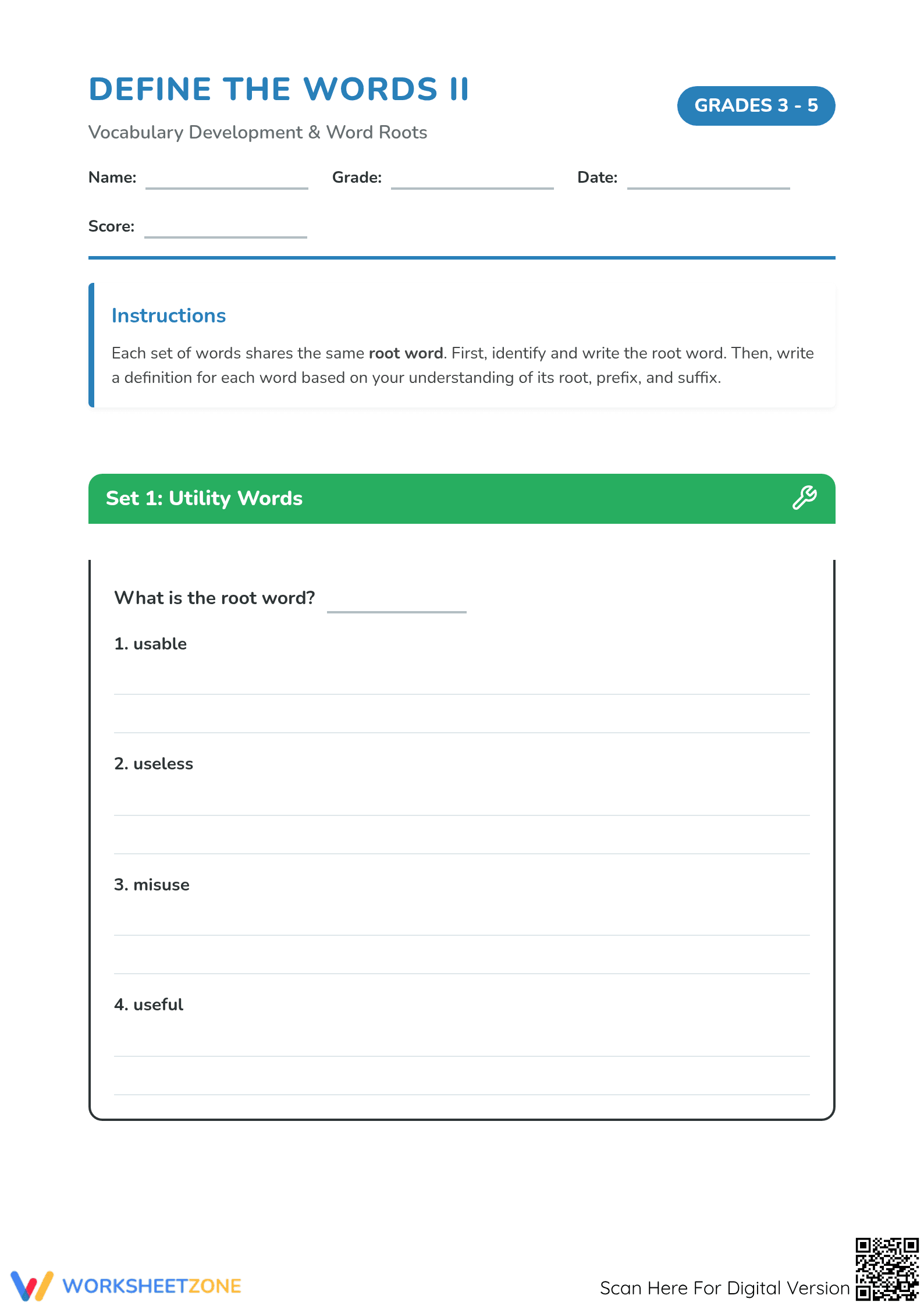


Root Word and Affixes Practice Worksheet | Printable Grade 4
Paste this activity's link or code into your existing LMS (Google Classroom, Canvas, Teams, Schoology, Moodle, etc.).
Students can open and work on the activity right away, with no student login required.
You'll still be able to track student progress and results from your teacher account.
This vocabulary-building worksheet empowers students to decode complex words by analyzing their internal structures. By focusing on the relationship between root words and common affixes, learners develop the morphological awareness necessary to determine meanings independently. Students isolate the central root before defining four related variations, reinforcing how prefixes and suffixes alter word functions.
At a Glance
- Grade: 3–5 · Subject: English Language Arts
- Standard:
CCSS.ELA-LITERACY.L.4.4.b— Use common grade-appropriate roots and affixes as clues to word meaning- Skill Focus: Root Words, Prefixes, and Suffixes
- Format: 4 pages · 20 tasks · Answer key included · PDF
- Best For: Independent vocabulary centers and morning work
- Time: 20–30 minutes
This 4-page PDF contains four distinct "Word Sets" grouped by thematic categories: Utility, Construction, Affection, and Character Traits. Each set presents words derived from a shared root, such as "use" or "build." Students identify the root word and provide definitions for four different forms. The layout includes a dedicated notes section on each page for student examples.
Skill Progression
- Guided Identification: Students isolate the core root word, building foundational awareness of word construction.
- Supported Analysis: Definition tasks provide a scaffolded environment where students apply knowledge of common affixes to the identified root.
- Independent Application: Final sections require students to synthesize understanding of both roots and affixes to create original definitions.
This progression facilitates a gradual release of responsibility, moving from basic recognition to complex semantic application.
Standards Alignment
The primary alignment is CCSS.ELA-LITERACY.L.4.4.b, requiring students to use grade-appropriate roots and affixes as clues to word meaning. By analyzing words like "misuse" and "kindness," students also meet CCSS.ELA-LITERACY.L.3.4.b. Both standard codes can be copied directly into lesson plans, IEP goals, or district curriculum mapping tools to track student growth.
How to Use It
Use this resource during independent practice after a direct instruction lesson on morphology. Assign one word set as a formative assessment to gauge understanding of specific prefix and suffix meanings. These pages also serve as excellent "morning work" or "fast finisher" activities. Expect students to complete the 4-page set in approximately 25 minutes.
Who It's For
This worksheet is designed for upper elementary students in grades 3 through 5 needing support with multisyllabic decoding or vocabulary expansion. It is highly effective for English Language Learners (ELLs) who benefit from seeing patterns in English word formation. Pair this with a root word anchor chart for students needing lexical support.
Morphological instruction is a critical component of literacy development, as noted in the RAND AIRS 2024 report on elementary reading strategies. Research indicates that students who explicitly study the internal structure of words show greater gains in reading comprehension than those using rote memorization. This Grade 4 ELA worksheet supports the CCSS.ELA-LITERACY.L.4.4.b standard by requiring students to isolate roots and apply affix meanings to define 16 terms. By engaging in 20 tasks across 4 pages, learners transition from basic recognition to active morphological synthesis. The inclusion of an answer key ensures that both teachers and parents can provide immediate, accurate feedback, which is essential for correcting misconceptions about affix functionality. This printable resource offers a reliable framework for building the linguistic agility needed for high-stakes testing and academic success.


