


























Views
Downloads

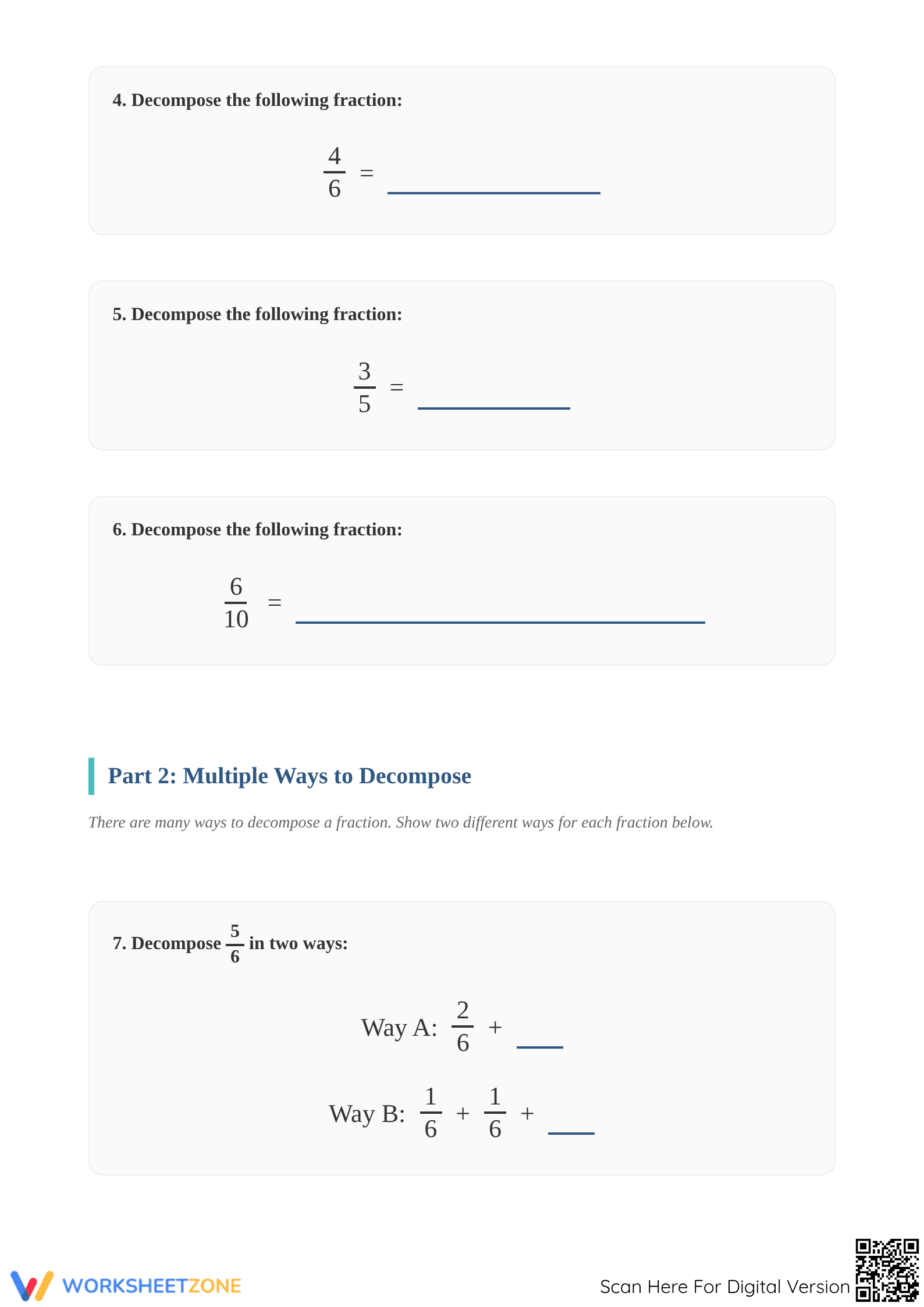



Essential Decompose Fractions Worksheet | Grade 4 Math
Paste this activity's link or code into your existing LMS (Google Classroom, Canvas, Teams, Schoology, Moodle, etc.).
Students can open and work on the activity right away, with no student login required.
You'll still be able to track student progress and results from your teacher account.
This Grade 4 decomposing fractions worksheet helps students visualize how larger fractions are built from smaller parts. By breaking down non-unit fractions into sums, learners develop a deep understanding of fraction composition, which is a prerequisite for advanced operations. Students will successfully record decompositions using standard equations and demonstrate their fluency with fractional addition.
At a Glance
- Grade: 4 · Subject: Math
- Standard:
CCSS.MATH.CONTENT.4.NF.B.3.B— Decompose a fraction into a sum of fractions with the same denominator- Skill Focus: Unit Fraction Decomposition
- Format: 5 pages · 50 problems · Answer key included · PDF
- Best For: Independent practice and formative assessment
- Time: 25–40 minutes
What's Inside
This comprehensive 5-page packet includes 50 distinct problems designed to build confidence. Each page focuses on a specific aspect of the skill, ranging from simple unit fraction sums to complex decompositions into two or more parts. The layout is clean and spacious, providing ample room for students to write their equations. A full answer key is provided at the end of the document for efficient grading or student self-checking.
Skill Progression
- Guided practice: The first two pages provide 20 problems focused on decomposing fractions into unit fractions, establishing the foundational concept that the numerator represents the count of parts.
- Supported practice: Page 3 introduces multiple ways to decompose the same fraction, encouraging students to think flexibly about how numbers can be partitioned.
- Independent practice: The final pages require students to generate equations from scratch, moving from scaffolded blanks to independent mathematical expression.
This sequence follows a gradual-release model, ensuring students master basic partitioning before moving to abstract representations, mirroring the 'I Do, We Do, You Do' instructional framework.
Standards Alignment
This resource is strictly aligned to `CCSS.MATH.CONTENT.4.NF.B.3.B`, which requires students to decompose a fraction into a sum of fractions with the same denominator in more than one way, recording each decomposition by an equation. The tasks directly address the conceptual requirement of understanding fractions as sums of their parts. This standard code can be copied directly into lesson plans, IEP goals, or district curriculum mapping tools.
How to Use It
Use this packet during the middle of your fraction unit after students have been introduced to the concept of the unit fraction (1/n). It serves as an excellent formative assessment tool; observe if students correctly maintain the denominator while summing the numerators. Expected completion time is roughly 30 minutes, making it an ideal choice for a quiet work block or as a homework assignment to reinforce classroom instruction.
Who It's For
This resource is designed primarily for fourth-grade students as part of their core curriculum. It is also suitable for third-grade enrichment or as a remediation tool for fifth graders who require additional support with fractional fluency. Teachers can pair this worksheet with a visual fraction wall or number line anchor chart to provide additional scaffolds for learners who struggle with abstract number concepts.
Educational research highlights fraction decomposition as a critical bridge to fractional multiplication and addition. Mastering CCSS.MATH.CONTENT.4.NF.B.3.B helps students internalize the additive nature of fractions, reducing cognitive load for unlike denominators. This worksheet offers high-quality practice to build conceptual understanding and procedural fluency. With 50 tasks, teachers can tailor intervention or ensure comprehensive mastery. Its structured layout supports focus on mathematical logic, aligning with evidence-based pedagogical recommendations for long-term retention.


