


























Views
Downloads
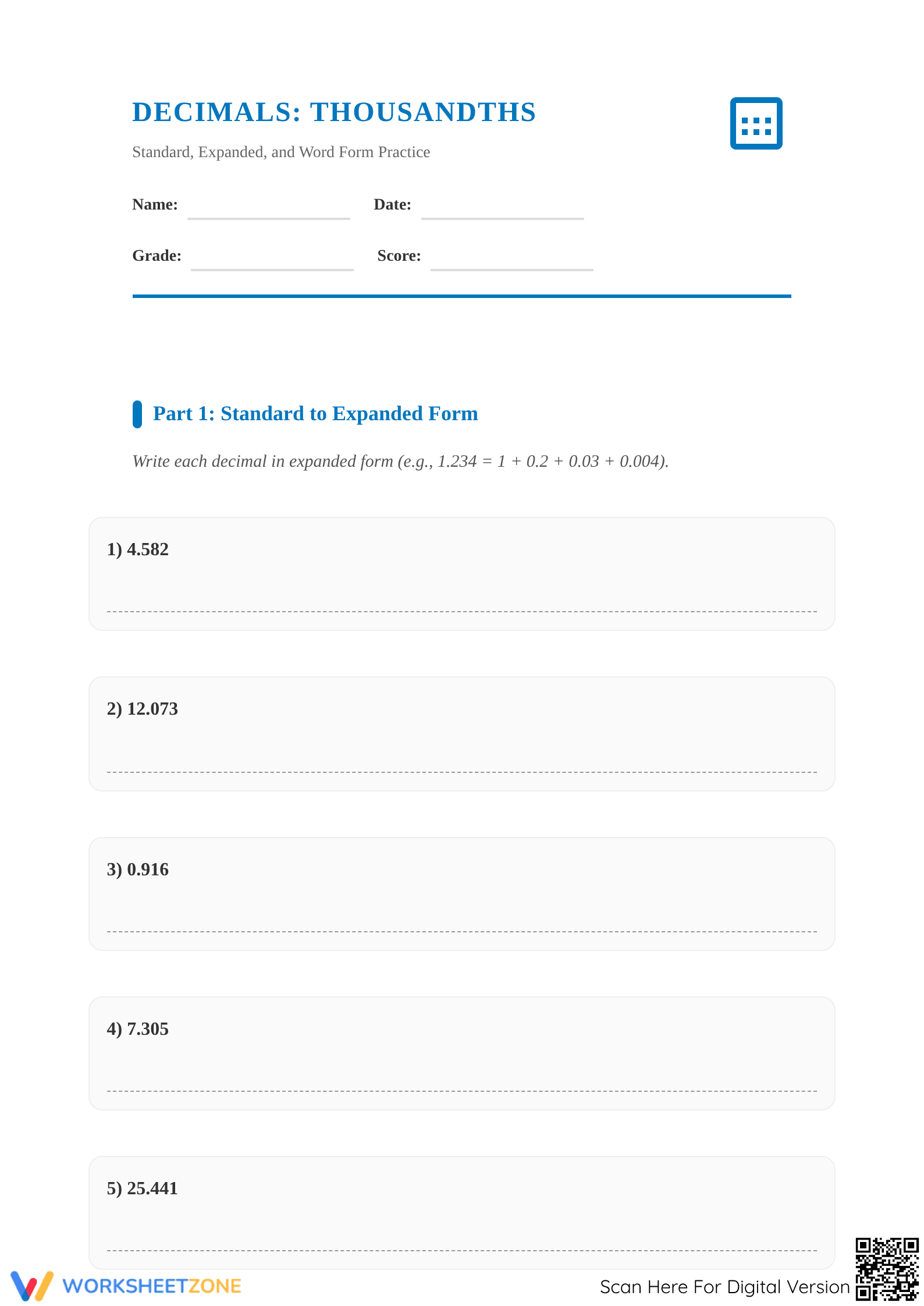



Essential Decimals to Thousandths Worksheet | Grade 4
Paste this activity's link or code into your existing LMS (Google Classroom, Canvas, Teams, Schoology, Moodle, etc.).
Students can open and work on the activity right away, with no student login required.
You'll still be able to track student progress and results from your teacher account.
Mastering decimal notation is a critical milestone for upper elementary students. This comprehensive five-page worksheet provides targeted practice in converting decimals to thousandths across standard, expanded, and word forms. By completing these 50 structured exercises, learners build the fluency and conceptual understanding required for advanced place value mastery and mathematical communication.
At a Glance
At a Glance
- Grade: 4 · Subject: Math
- Standard:
5.NBT.A.3.A— Read and write decimals to thousandths using base-ten numerals, number names, and expanded form- Skill Focus: Decimal place value notation
- Format: 5 pages · 50 problems · Answer key included · PDF
- Best For: Independent practice or homework
- Time: 25–40 minutes
What's Inside
This set contains five identical formatted pages, each offering ten unique problems. Students are presented with one form of a decimal (such as standard form "0.125") and must correctly provide the corresponding expanded form and word form. The layout is clean and organized, featuring a three-column table that minimizes visual distraction. A full answer key is included for rapid grading or student self-correction.
Zero-Prep Workflow
Our zero-prep workflow saves teachers valuable time. First, print the desired number of practice pages based on current student needs. Second, distribute the worksheets as a warm-up, main lesson activity, or exit ticket. Finally, use the included answer key for immediate feedback. Total teacher preparation time is under two minutes, making this set ideal for substitute teacher folders.
Standards Alignment
The primary alignment for this resource is 5.NBT.A.3.A, which requires students to read and write decimals to thousandths using base-ten numerals, number names, and expanded form. While thousandths are typically introduced in fifth grade, this resource serves as an excellent challenge for fourth-grade students who have mastered hundredths. Both standard codes can be copied directly into lesson plans, IEP goals, or district curriculum mapping tools.
How to Use It
Use this resource during the independent practice phase of a lesson on decimal place value. It is particularly effective after students have worked with place value disks to visualize thousandths. For a formative assessment tip, observe students as they write the word forms; errors in hyphenation or the placement of the word "and" often signal underlying confusion about the decimal point's location.
Who It's For
This worksheet is designed for fourth and fifth-grade students. It is particularly helpful for learners who need repetitive, structured practice to internalize the relationship between different numerical representations. It pairs naturally with a decimal place value anchor chart or a short introductory video on place value positions to reinforce the multi-modal learning experience.
Research from Fisher & Frey (2014) emphasizes the importance of the gradual release of responsibility, particularly when students are navigating abstract mathematical notations like decimals to thousandths. This worksheet facilitates that transition by providing high-volume, low-stakes practice that stabilizes a student's mental model of base-ten systems. By requiring conversion between standard, expanded, and word forms (aligned to standard 5.NBT.A.3.A), students engage in dual-coding, which has been shown to improve long-term retention of place value concepts. According to a 2024 ScienceDirect analysis of effective supplemental materials, structured tables that isolate specific conversion tasks help reduce cognitive load, allowing students to focus entirely on the linguistic and numerical rules of the thousandths place. This five-page, 50-problem set ensures that the procedural knowledge of decimal writing becomes second nature, providing a stable foundation for later operations involving addition and subtraction of decimals in complex real-world contexts.


