


























Views
Downloads

Essential Day and Night Worksheet | Grade 4 Science
Paste this activity's link or code into your existing LMS (Google Classroom, Canvas, Teams, Schoology, Moodle, etc.).
Students can open and work on the activity right away, with no student login required.
You'll still be able to track student progress and results from your teacher account.
This worksheet clarifies how Earth's rotation creates the daily cycle of day and night. Students explore the mechanics of planetary spinning to understand sunlight distribution across the globe. By connecting abstract concepts to visual models, this resource ensures learners master the primary cause of light and dark transitions within a 24-hour period.
At a Glance
- Grade: 4 · Subject: Science
- Standard:
4-ESS1-1— Describe predictable patterns of the sun's appearance and the day-night cycle- Skill Focus: Earth's Rotation and Day/Night Cycles
- Format: 1 page · 2 problems · Answer key included · PDF
- Best For: Earth science introduction and formative assessment
- Time: 15–20 minutes
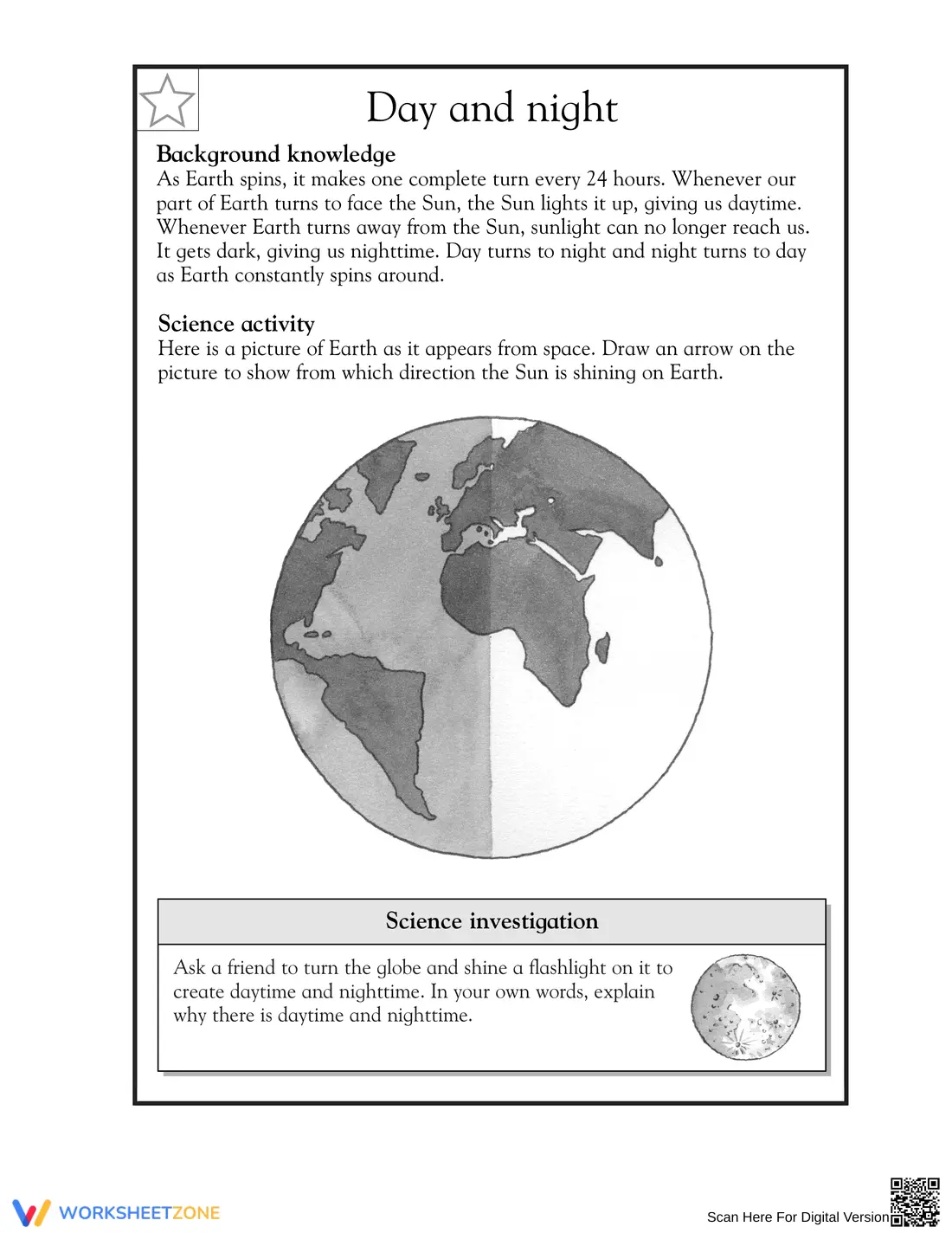
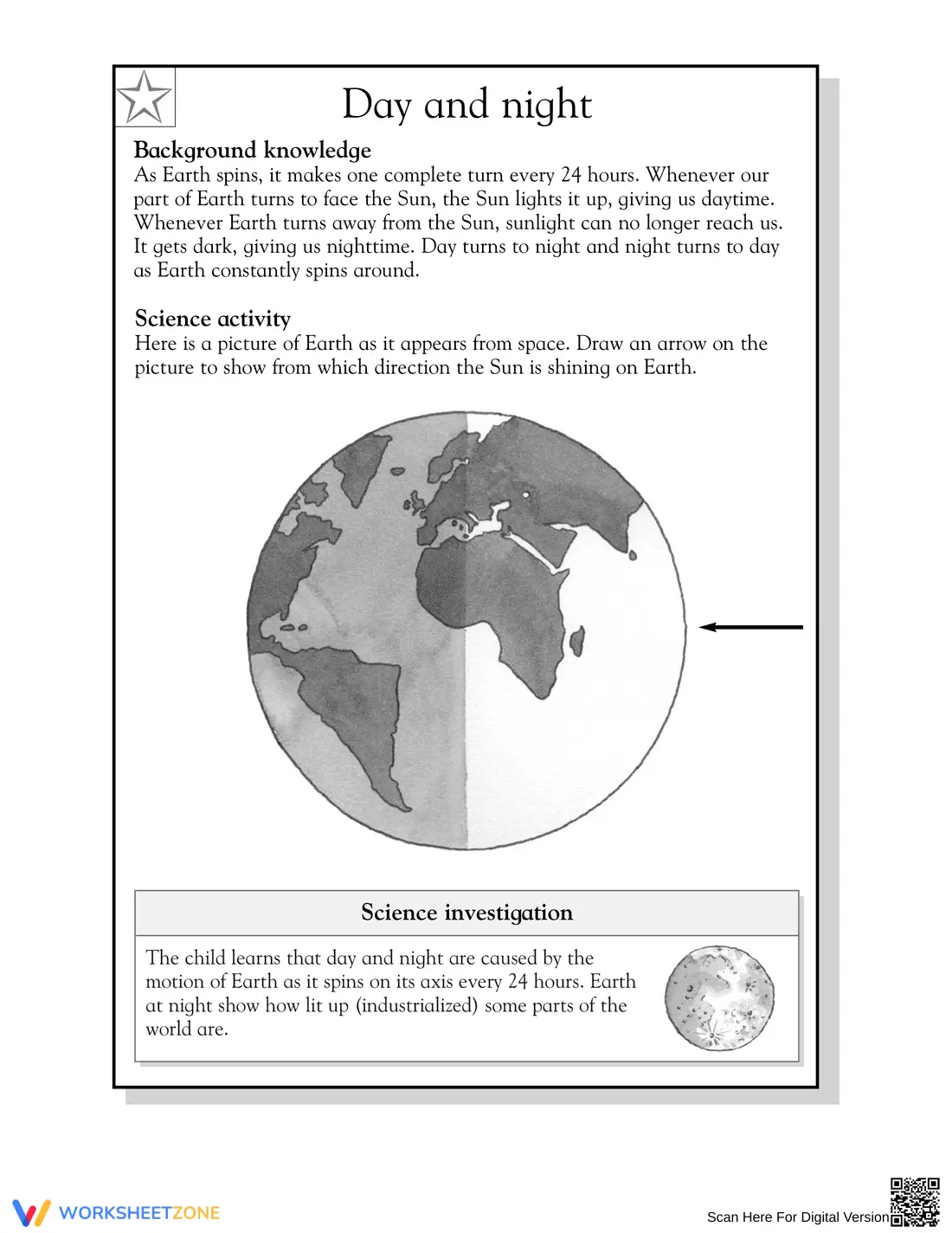
This single-page science resource features a comprehensive "What's Inside" section including background knowledge defining the 24-hour rotation. The worksheet provides a primary activity requiring students to draw solar direction on a globe diagram, followed by a hands-on flashlight investigation. A teacher guide version is also included to streamline the review process.
Zero-Prep Workflow
Educators can implement this lesson with minimal overhead. The process involves printing the PDF (30 seconds), distributing handouts for independent reading (1 minute), and a quick class review of the sun-direction arrow (2 minutes). Total teacher preparation time is under two minutes, making it ideal for substitute plans or emergency science blocks.
Standards Alignment
The content is primary aligned to 4-ESS1-1, focusing on using patterns to explain Earth's changes. Specifically, it addresses the predictable 24-hour pattern of light and dark caused by Earth's constant spin. Both standard codes can be copied directly into lesson plans, IEP goals, or district curriculum mapping tools.
How to Use It
Assign this during the "Explain" phase of a science lesson. Teachers should observe students as they draw the sunlight arrow; if a student places the arrow on the dark side of the globe, it provides an immediate formative assessment opportunity to correct orientation misconceptions. Completion typically takes 15 minutes.
Who It's For
This resource is for Grade 3 and Grade 4 students studying Earth and space systems. It is particularly effective for visual learners who benefit from mapping light onto a 3D representation of the globe. Pair this handout with a classroom globe and a flashlight to maximize the impact of the investigation section.
This Earth science resource addresses the fundamental mechanics of planetary rotation and its direct relationship to the solar illumination patterns observed from the surface. According to the RAND AIRS 2024 analysis of instructional materials, scaffolded science worksheets that integrate background knowledge with active modeling tasks significantly improve conceptual retention of celestial mechanics in upper elementary students. By requiring learners to visualize the Sun's position relative to a rotating Earth, the activity bridges the gap between static diagrams and dynamic orbital realities. This dual-approach method—combining a reading comprehension component with a directional drawing task—allows educators to quickly identify misconceptions regarding why the sun appears to move across the sky. Aligned to the 4-ESS1-1 standard, the worksheet focuses on the predictable pattern of the day-night cycle. It provides a robust foundation for future studies in seasonal changes and lunar phases, ensuring students grasp the 24-hour rotational period as the primary driver of daily light transitions.


