


























Views
Downloads


Essential Day and Night Cycle Worksheet | Grade 1 Science
Paste this activity's link or code into your existing LMS (Google Classroom, Canvas, Teams, Schoology, Moodle, etc.).
Students can open and work on the activity right away, with no student login required.
You'll still be able to track student progress and results from your teacher account.
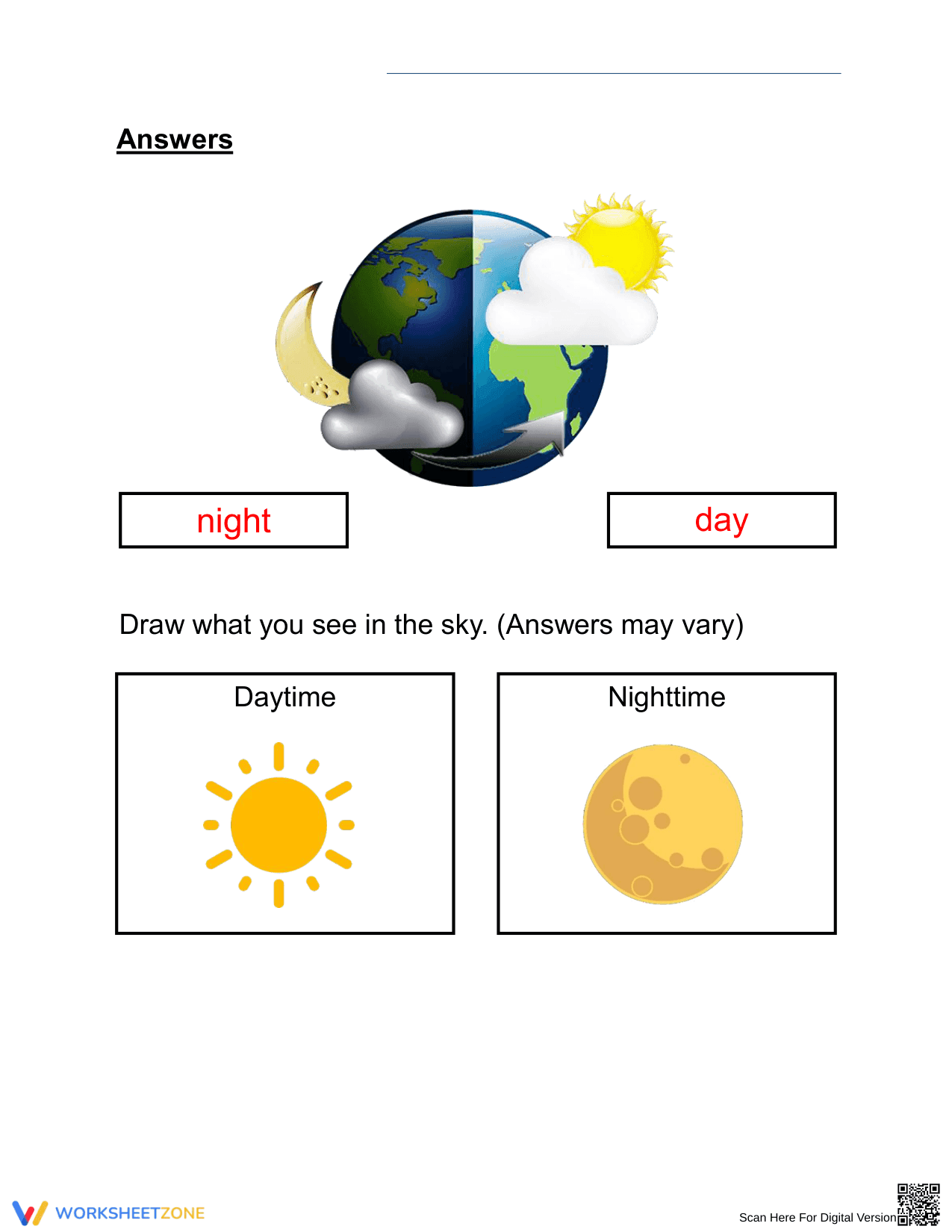
Students identify the relationship between the Earth's position and the presence of sunlight in this introductory science resource. By labeling the globe and illustrating celestial observations, learners build a foundational understanding of how rotation creates our daily cycle. This activity provides a clear visual model for young scientists to grasp complex astronomical concepts through direct observation.
At a Glance
- Grade: 1 · Subject: Science
- Standard:
1-ESS1-1— Use observations of the sun and moon to describe predictable patterns- Skill Focus: Identifying and labeling Earth's day and night cycles and observing sky objects
- Format: 1 page · 4 problems · Answer key included · PDF
- Best For: First-grade Earth science introductory lessons, formative assessments, or independent classroom science centers
- Time: 15–20 minutes
This single-page PDF features a high-quality graphic of the Earth showing distinct light and dark hemispheres. It includes two labeling boxes for students to distinguish between daytime and nighttime based on the sun's position. Below the globe, two structured drawing frames prompt students to illustrate the specific objects they see in the sky during different parts of the cycle, reinforcing critical observational skills.
This zero-prep resource is designed for a fast classroom workflow that takes under 2 minutes of total teacher time:
- Print: Generate copies in 30 seconds for immediate use.
- Distribute: Hand out to students in 30 seconds with no extra materials.
- Review: Grade or peer-check in 1 minute using the provided answer key.
The self-explanatory layout and clear visual cues make this worksheet highly suitable for emergency sub plans or as a quick morning work activity during your Earth and Space unit.
This resource is primary aligned to `1-ESS1-1`: "Use observations of the sun, moon, and stars to describe patterns that can be predicted." It also supports the base conceptual knowledge required for `1-ESS1-2` regarding daylight patterns. Both standard codes can be copied directly into lesson plans, IEP goals, or district curriculum mapping tools to ensure instructional compliance with modern science frameworks.
Introduce this worksheet during the "Explain" phase of a lesson after a class discussion about what students notice when they wake up or go to bed. For a formative-assessment observation, watch if students correctly place the sun in their "Daytime" drawing and the moon or stars in the "Nighttime" section. The activity typically requires 15 to 20 minutes to complete depending on the detail of student drawings.
This activity is designed for first-grade students but serves as an effective review for second graders. It is particularly helpful for English Language Learners due to the heavy reliance on visual models. Pair this resource with a physical globe and a flashlight to demonstrate Earth's rotation before students begin their independent work.
The Day and Night cycle worksheet adheres to best practices for early childhood science education by connecting abstract planetary motion to concrete, observable phenomena. According to Fisher & Frey (2014), the use of visual modeling and structured drawing tasks helps primary students internalize the 1-ESS1-1 standard by bridging the gap between what they see in the sky and the scientific explanation of Earth's rotation. By requiring students to both label a diagram and generate their own illustrations, the worksheet engages multiple cognitive pathways, ensuring a higher retention of Earth science concepts. This specific instructional design aligns with NAEP findings that emphasize the importance of early exposure to spatial reasoning and celestial patterns. Educators can confidently use this tool as a benchmark for student mastery of predictable astronomical cycles, providing a clear artifact for portfolios or standards-based grading systems that require evidence of direct observational analysis in the classroom environment.


