


























Views
Downloads
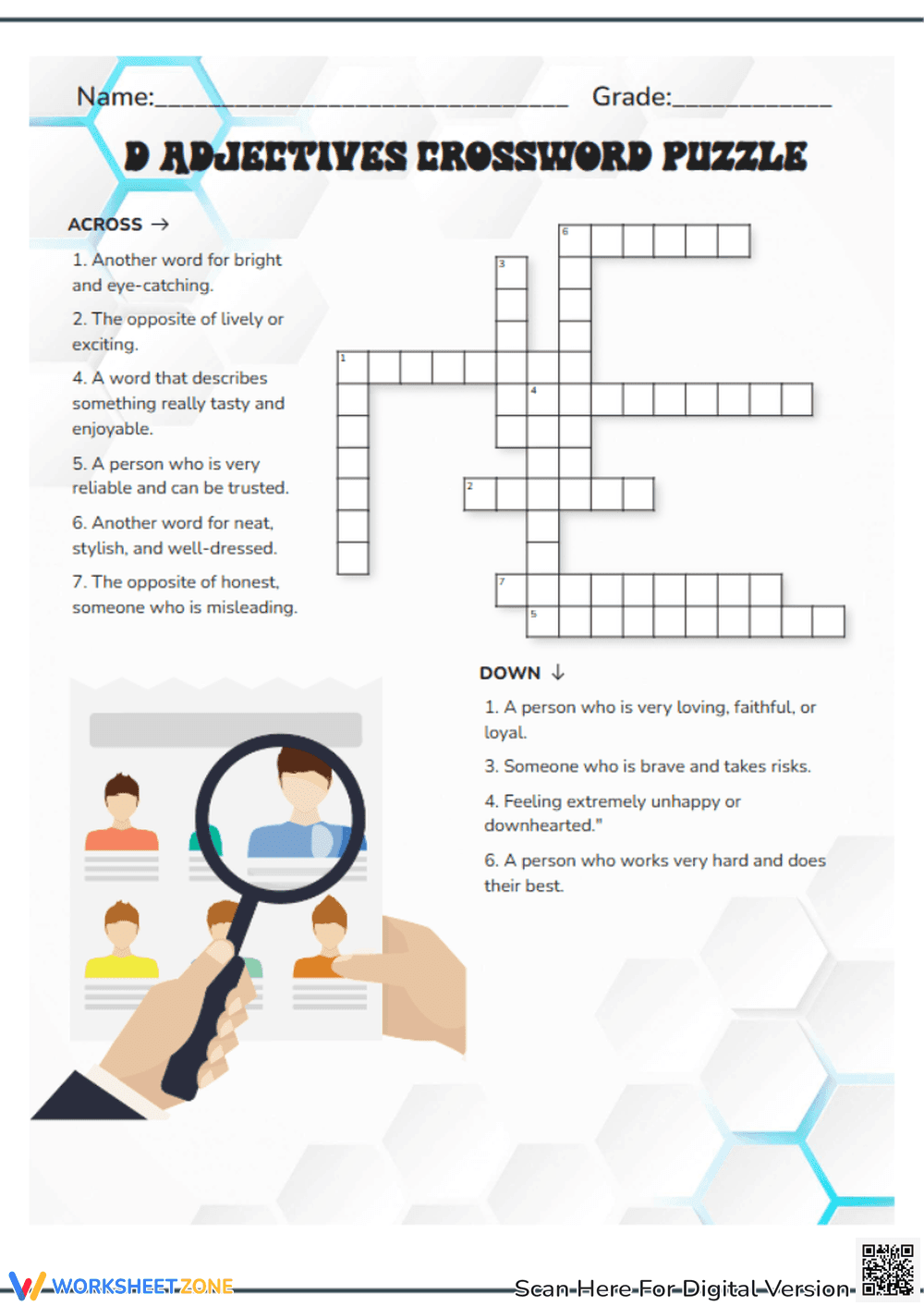

Grade 3 Adjectives — Printable No-Prep Worksheet
Paste this activity's link or code into your existing LMS (Google Classroom, Canvas, Teams, Schoology, Moodle, etc.).
Students can open and work on the activity right away, with no student login required.
You'll still be able to track student progress and results from your teacher account.
This vocabulary-building crossword puzzle helps students master descriptive language by identifying specific adjectives that begin with the letter D. By reading context clues, learners actively recall targeted vocabulary words, strengthening reading comprehension and expressive writing capabilities in a highly engaging format.
At a Glance
- Grade: 3 · Subject: ELA
- Standard:
CCSS.ELA-LITERACY.L.3.1— Explain the function of adjectives in general and specific sentences- Skill Focus: Vocabulary and Adjectives
- Format: 1 page · 10 problems · Answer key included · PDF
- Best For: Independent practice and morning work
- Time: 15–20 minutes
This single-page resource features a classic crossword puzzle layout containing ten distinct clues. Students read descriptive phrases and determine the matching adjective starting with D. The worksheet includes clear across and down sections, a structured grid for spelling practice, and a complete answer key to facilitate quick grading.
Designed for immediate classroom implementation, this activity requires minimal teacher preparation:
- Print (1 minute): Download the PDF and print a class set.
- Distribute (1 minute): Hand out the puzzle during transitions. No additional materials required.
- Review (3 minutes): Display the included answer key on the smartboard for rapid self-correction.
With a total teacher prep time of under two minutes, this worksheet serves as an ideal emergency sub plan.
This activity aligns directly with CCSS.ELA-LITERACY.L.3.1, requiring students to demonstrate command of the conventions of standard English grammar and usage when writing or speaking. It also supports vocabulary acquisition standards by prompting learners to use context clues to determine word meanings. Both standard codes can be copied directly into lesson plans, IEP goals, or district curriculum mapping tools.
Deploy this crossword puzzle as an engaging morning work assignment to settle students into the literacy block. Alternatively, use it as an anchor activity for early finishers during independent reading time. As a formative assessment observation tip, circulate while students work and note which learners struggle to connect the definition clues to the target vocabulary; this indicates a need for explicit synonym instruction. Expected completion time ranges from fifteen to twenty minutes depending on reading fluency.
This resource is primarily designed for third and fourth-grade students developing their descriptive writing skills. It provides excellent reinforcement for English Language Learners who benefit from matching definitions to specific vocabulary words in a structured format. Pair this puzzle with a direct instruction lesson on using vivid adjectives or an anchor chart displaying common synonyms to maximize student success.
Effective vocabulary instruction requires multiple exposures to target words in varied contexts. This worksheet supports CCSS.ELA-LITERACY.L.3.1 by having students explain the function of adjectives in general and specific sentences through active recall. According to a recent ScienceDirect TpT Analysis, integrating puzzle-based learning into literacy routines significantly increases student engagement and retention of domain-specific vocabulary compared to traditional rote memorization drills. By challenging learners to decode context clues and spell the corresponding adjectives accurately, this resource bridges the gap between passive recognition and active application. The crossword format inherently provides immediate feedback through intersecting letters, allowing students to self-monitor their spelling and comprehension. This targeted practice ensures that foundational grammar concepts are solidified, ultimately contributing to more expressive and precise student writing across all academic disciplines.


