


























Views
Downloads
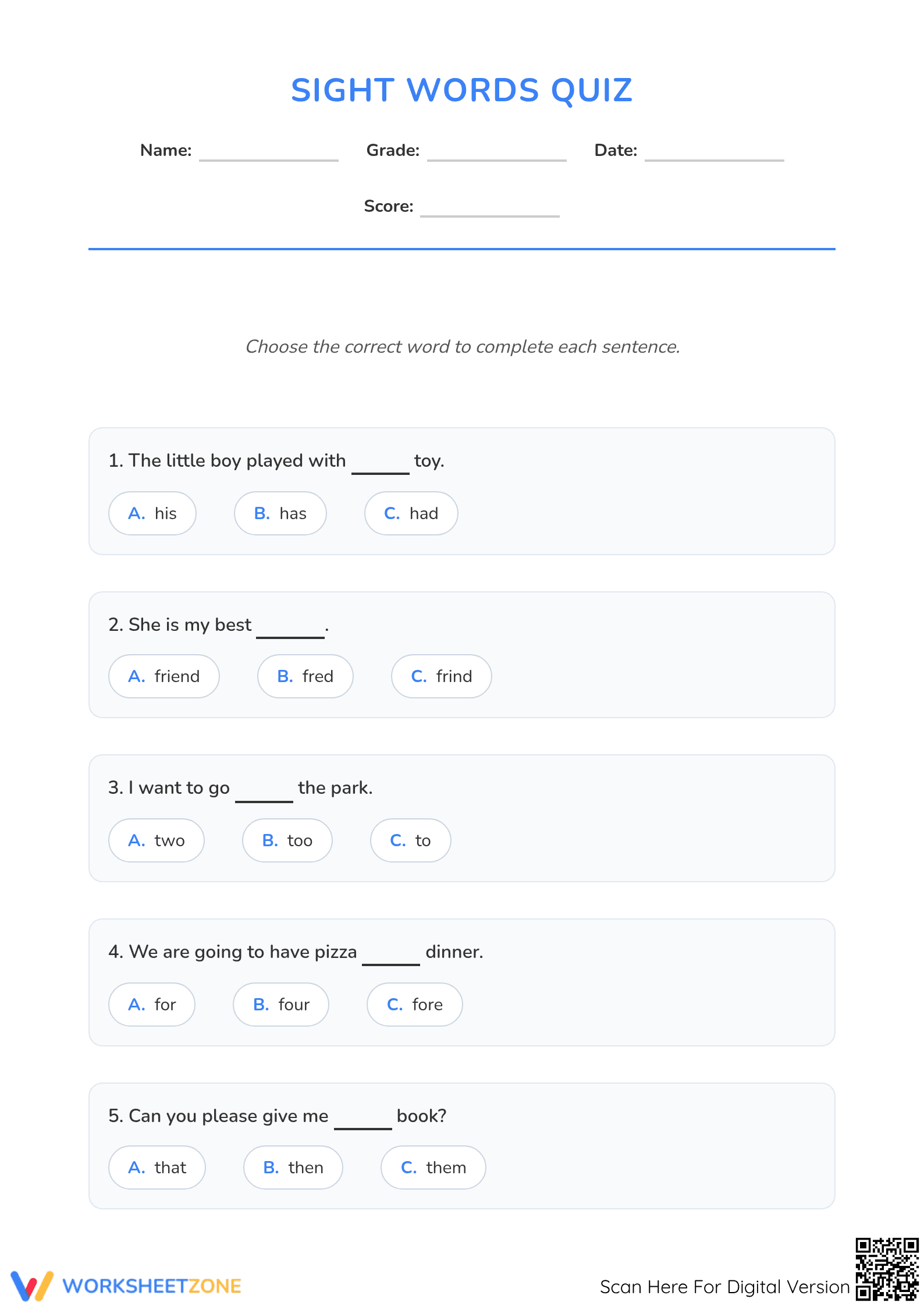


Essential Sight Words Quiz | Grade 2-3 Printable Worksheet
Paste this activity's link or code into your existing LMS (Google Classroom, Canvas, Teams, Schoology, Moodle, etc.).
Students can open and work on the activity right away, with no student login required.
You'll still be able to track student progress and results from your teacher account.
This comprehensive Sight Words Quiz for Grade 2 and Grade 3 students strengthens high-frequency word recognition and sentence-level comprehension. By selecting the correct word to complete various contexts, learners build the reading fluency necessary for advanced literacy. This resource ensures students can distinguish between similar-looking words and apply them accurately in written English.
At a Glance
- Grade: 2–3 · Subject: English Language Arts
- Standard:
CCSS.ELA-LITERACY.RF.2.3.f— Recognize and read grade-appropriate irregularly spelled words in sentences- Skill Focus: High-frequency sight word recognition
- Format: 4 pages · 25 problems · Answer key included · PDF
- Best For: Weekly assessments and literacy center rotations
- Time: 15–20 minutes
What's Inside
This printable packet contains four dedicated pages of assessment material designed for young learners. Each page presents a series of multiple-choice questions where students must evaluate three word options to complete a sentence. The layout is clean and distraction-free, featuring 25 total tasks and a full answer key for rapid grading.
Skill Progression
- Guided Practice: Initial tasks provide high-frequency words in simple subject-verb-object constructions to establish confidence and baseline recognition.
- Supported Practice: Middle sections introduce sentences with more complex grammatical structures and distractors that challenge common spelling errors or phonetic confusion.
- Independent Practice: The final set of questions requires independent application of context clues to identify the correct irregular word without external scaffolding or hints.
This progression mirrors the gradual release of responsibility model, moving students from basic identification to critical evaluation of vocabulary in context.
Standards Alignment
The primary focus of this worksheet is `CCSS.ELA-LITERACY.RF.2.3.f`, which requires students to recognize and read grade-appropriate irregularly spelled words. This foundational skill is critical for achieving reading proficiency in early elementary grades. Additionally, the activity supports the development of standard English conventions and syntactic awareness. Standard codes can be copied directly into lesson plans, IEP goals, or district curriculum mapping tools.
How to Use It
Deploy this quiz as a summative assessment at the end of a sight word unit to measure student retention and mastery. Alternatively, use it during small-group rotations to observe how students process context clues in real-time. For a quick formative check, review the first five questions as a class to model the process of elimination. This activity typically takes 15 to 20 minutes for most Grade 2 or Grade 3 students to complete.
Who It's For
This resource is tailored for second and third-grade students working on foundational reading skills and spelling. It is also an excellent tool for English Language Learners (ELL) who need extra practice with high-frequency vocabulary and sentence syntax. Pair this worksheet with a sight word anchor chart or a decodable reader to provide a complete instructional loop for students requiring additional intervention or support.
This worksheet applies the gradual release of responsibility model, scaffolding cognitive load for Grade 2 and Grade 3 students by requiring them to analyze `CCSS.ELA-LITERACY.RF.2.3.f` irregular words within full sentences, moving beyond rote memorization to authentic application. Mastery of high-frequency words is a strong predictor of reading comprehension. Educators can use these 25 focused tasks to identify phonetic gaps and tailor literacy instruction for effective, fluent reading and writing.


