




























Views
Downloads
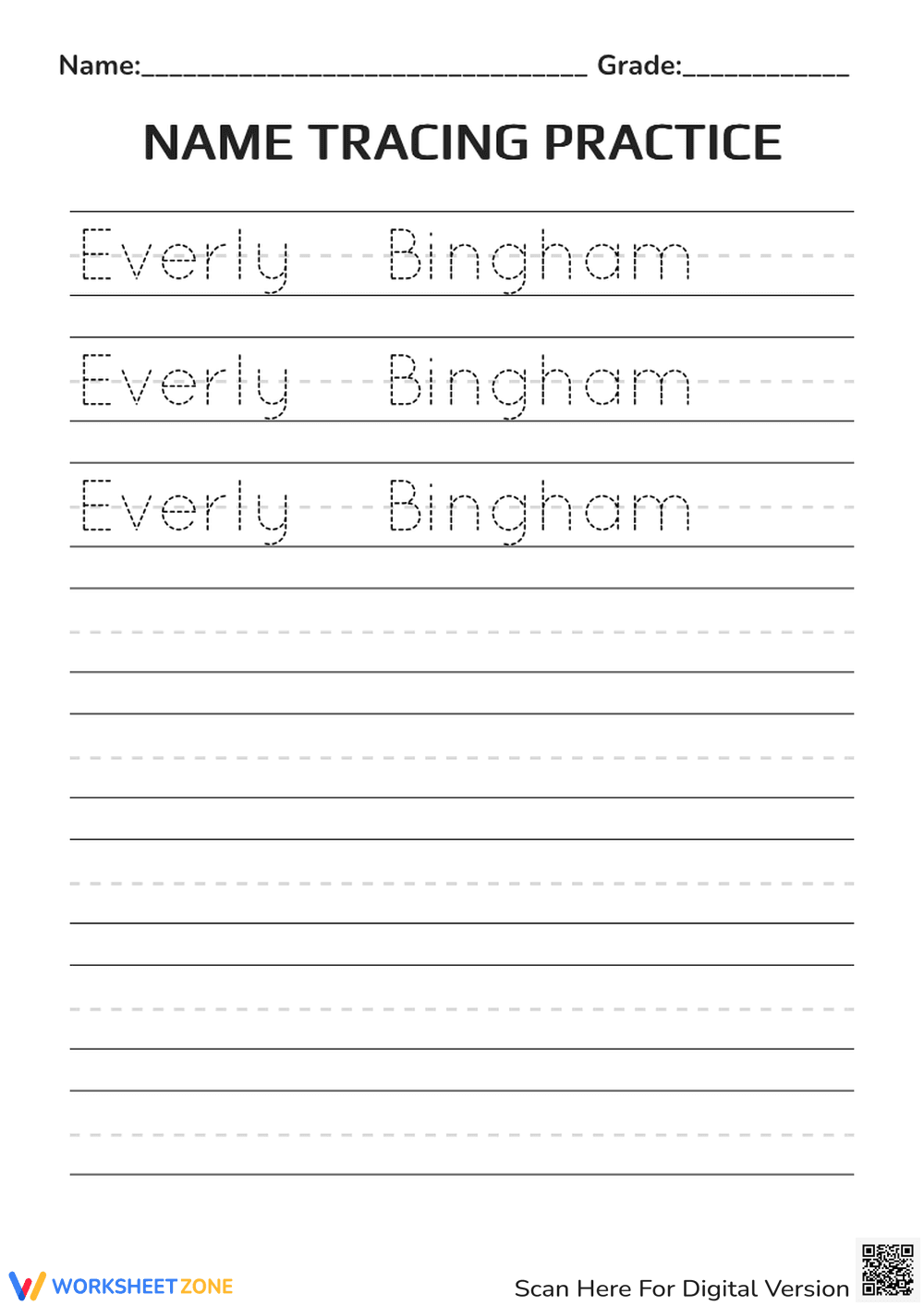

Printable Name Tracing Worksheet | Kindergarten Ready

Paste this activity's link or code into your existing LMS (Google Classroom, Canvas, Teams, Schoology, Moodle, etc.).
Students can open and work on the activity right away, with no student login required.
You'll still be able to track student progress and results from your teacher account.
This Kindergarten name tracing worksheet provides early learners with a structured path to mastering their own name through repetitive letter formation. By combining guided tracing with independent writing lines, students build the muscle memory necessary for legible penmanship. It is an essential tool for developing fine motor control and personal identity in the classroom.
At a Glance
- Grade: Kindergarten · Subject: Handwriting
- Standard:
CCSS.ELA-LITERACY.L.K.1.A— Print many upper- and lowercase letters with proper form- Skill Focus: Name tracing and letter formation
- Format: 1 page · 10 lines · No answer key needed · PDF
- Best For: Morning work and daily warm-ups
- Time: 5–10 minutes
The worksheet features a clean, distraction-free layout designed for young eyes. It includes one full page with three rows of pre-populated dashed-line text for guided tracing, followed by seven empty primary-ruled lines for independent practice. The generous spacing and standard dashed midlines help students understand letter height and placement without feeling overwhelmed by complex instructions.
This resource is designed for a zero-prep workflow to save teacher time. First, print the PDF directly from your browser (30 seconds). Second, distribute the sheets during morning arrival or as a transition activity (1 minute). Finally, review student progress by checking for proper pencil grip and stroke direction as they work (ongoing). Total teacher preparation time is under 2 minutes, making it an ideal sub plan addition.
This activity aligns with `CCSS.ELA-LITERACY.L.K.1.A`, which requires students to print many upper- and lowercase letters. By focusing on a personal name, the worksheet makes the standard relevant and engaging. This standard code can be copied directly into lesson plans, IEP goals, or district curriculum mapping tools to document foundational literacy progress.
Use this worksheet as a consistent "Morning Tub" activity to settle students as they enter the room. It also serves as an excellent formative assessment tool; observe if students start letters from the top or bottom to identify who needs additional direct instruction. Completion typically takes 5 to 10 minutes depending on the student's fine motor development and attention span.
This resource is ideal for Kindergarten and Grade 1 students, as well as English Language Learners (ELLs) who are becoming familiar with the Latin alphabet. It pairs naturally with an alphabet anchor chart or a name-recognition game. For students struggling with grip, consider pairing this with a triangular pencil or a rubber grip stabilizer to improve comfort.
Research by Fisher & Frey (2014) emphasizes the importance of the gradual release of responsibility, moving from highly scaffolded tasks to independent application. This worksheet mirrors that pedagogical shift by providing three lines of guided tracing before requiring the student to produce the letters on blank primary lines. According to the RAND AIRS 2024 report, repetitive motor tasks in early childhood are foundational for cognitive offloading, allowing students to eventually focus on composition rather than the mechanics of writing. The use of `CCSS.ELA-LITERACY.L.K.1.A` ensures that this practice is not merely busy work but a targeted intervention for letter formation mastery. By practicing a high-frequency word like their own name, students increase their orthographic mapping speed. This printable resource provides the high-repetition, low-stakes environment necessary for young learners to gain confidence in their handwriting abilities before moving to complex sentence construction.


