


























Views
Downloads
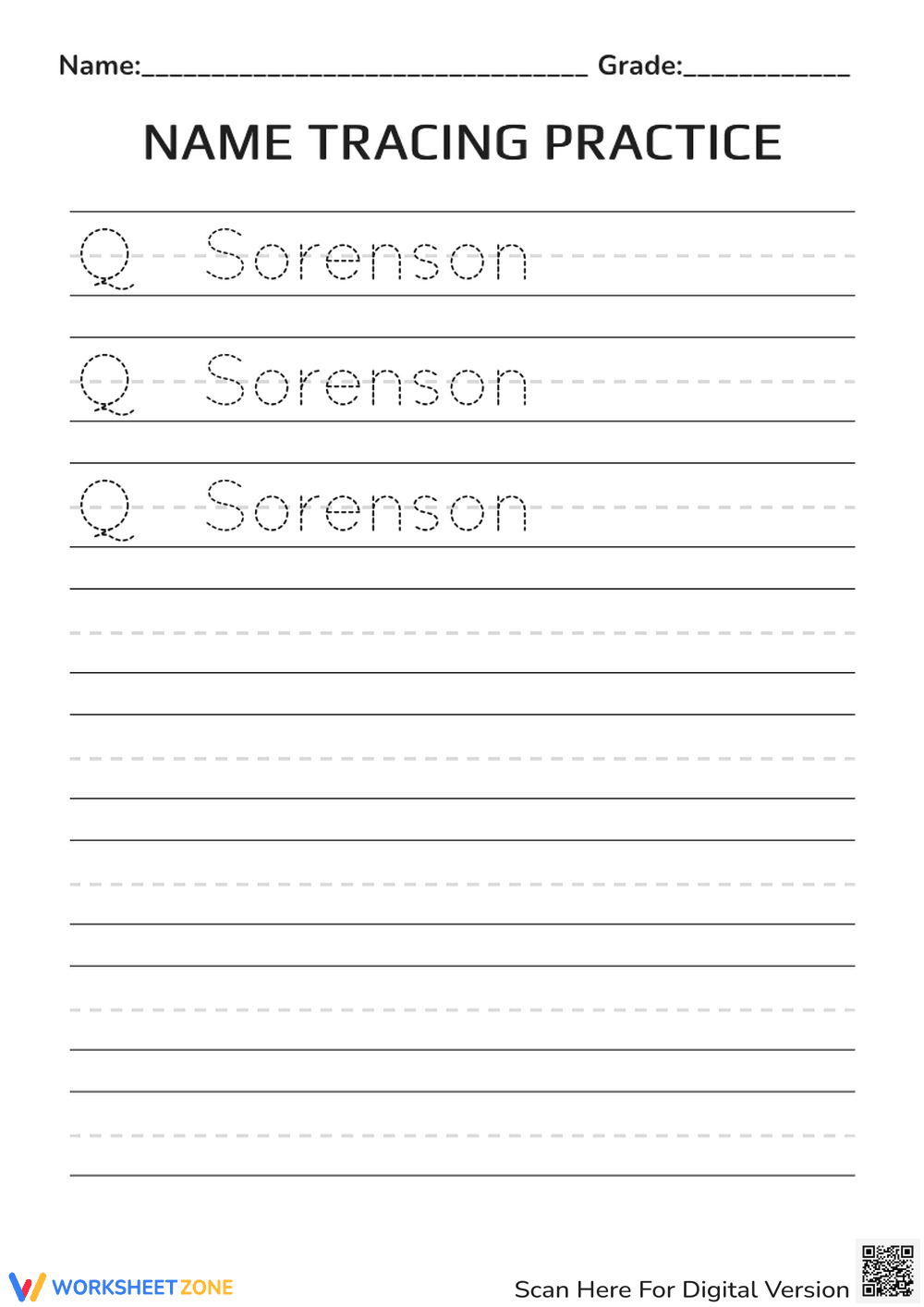

Name Tracing Practice | Grade K-1 Printable Worksheet
Paste this activity's link or code into your existing LMS (Google Classroom, Canvas, Teams, Schoology, Moodle, etc.).
Students can open and work on the activity right away, with no student login required.
You'll still be able to track student progress and results from your teacher account.
This Kindergarten and Grade 1 name tracing worksheet helps students master the essential skill of writing their own names through guided repetition. By providing structured dotted lines, the resource ensures students develop proper letter height and spacing. It is a foundational tool for early literacy and fine motor development in any primary classroom.
At a Glance
- Grade: K-1 · Subject: Handwriting
- Standard:
CCSS.ELA-LITERACY.L.K.1.A— Print many upper- and lowercase letters correctly- Skill Focus: Name tracing and letter formation
- Format: 1 page · 10 lines · No answer key needed · PDF
- Best For: Morning work or daily writing practice
- Time: 5–10 minutes
This single-page PDF features a clean, distraction-free layout designed for young learners. It includes three rows of large, dotted-line text for guided tracing, followed by seven additional sets of primary lines for independent practice. The generous spacing helps children who are still refining their grip and stroke control during early writing stages.
The workflow for this resource is designed for maximum efficiency. Teachers can print the master copy in under 30 seconds, distribute it to the entire class in 1 minute, and provide immediate verbal feedback as students work. Total preparation time is less than 2 minutes, making it an ideal choice for emergency sub plans or transition periods between lessons.
The primary focus is `CCSS.ELA-LITERACY.L.K.1.A`, which requires students to print many upper- and lowercase letters. This worksheet specifically targets the application of this skill within the high-frequency context of a student's own name. This standard code can be copied directly into lesson plans, IEP goals, or district curriculum mapping tools.
Use this worksheet during the first ten minutes of the school day as a "settling in" activity. It serves as an excellent formative assessment tool; observe the student's pencil grip and stroke direction (top-to-bottom) during the 5-10 minute session. It can also be laminated for use in a dry-erase writing center for repeated daily practice.
This resource is tailored for Kindergarteners and first graders who are transitioning from letter recognition to active production. It is particularly helpful for students requiring occupational therapy support or those who need extra repetition to build muscle memory. Pair this with an alphabet anchor chart for visual reference during the writing process.
According to research by Fisher & Frey (2014), the gradual release of responsibility is vital in early childhood writing instruction. This worksheet embodies that principle by moving from highly scaffolded tracing to independent production on the same page. Mastery of letter formation at the Kindergarten level is a significant predictor of later reading fluency and written expression. By focusing on the student's name, the task increases engagement and personal relevance, which aligns with NAEP findings regarding student motivation in literacy tasks. The CCSS.ELA-LITERACY.L.K.1.A standard ensures that students are building the mechanical foundations necessary for more complex composition in later grades. This printable resource provides the 10 lines of practice required to begin establishing the neural pathways for automaticity in handwriting, allowing cognitive resources to eventually shift toward content creation rather than just letter formation.


