


























Views
Plays
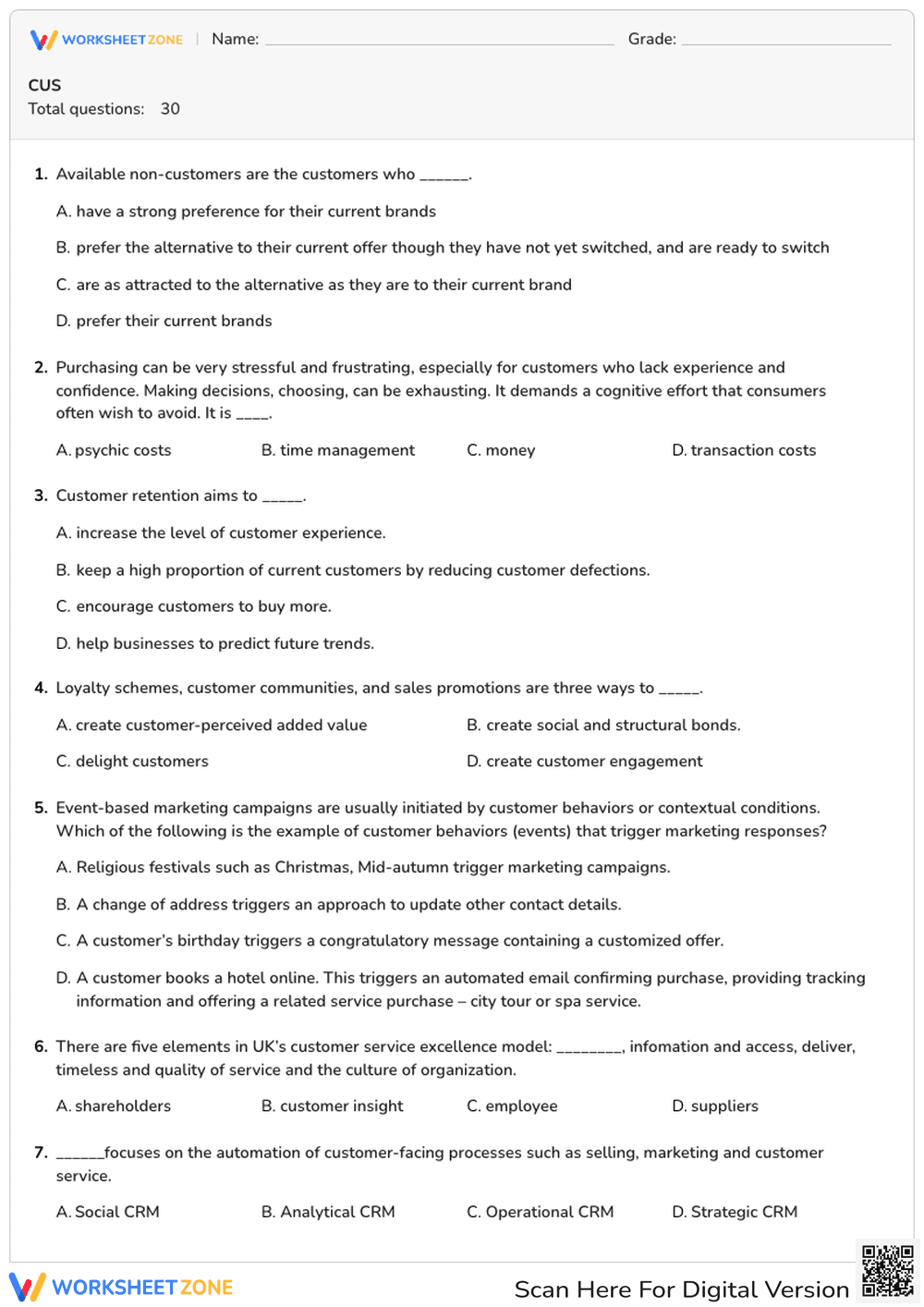


CRM and Marketing Strategy Quiz | Grade 12 Essential
Paste this activity's link or code into your existing LMS (Google Classroom, Canvas, Teams, Schoology, Moodle, etc.).
Students can open and work on the activity right away, with no student login required.
You'll still be able to track student progress and results from your teacher account.
This worksheet assesses student mastery of Customer Relationship Management (CRM) and marketing principles through 30 rigorous multiple-choice questions. Students will identify key models like IDIC and McKinsey/GE while analyzing customer behaviors and retention strategies. It provides a comprehensive evaluation of technical marketing vocabulary and strategic application for upper-level students.
At a Glance
- Grade: 11-12 · Subject: Marketing
- Standard:
CCSS.ELA-LITERACY.RI.11-12.4— Determine the meaning of domain-specific words and phrases in a technical context- Skill Focus: CRM Models & Marketing Strategy
- Format: 4 pages · 30 problems · Answer key included · PDF
- Best For: Summative assessment or exam review
- Time: 40–50 minutes
What's Inside
This 4-page PDF contains 30 multiple-choice questions designed to challenge high school and college-level learners. The content covers a broad spectrum of marketing topics, including CRM types (Operational, Analytical, Social), customer segmentation, the IDIC model, and B2B relationship dynamics. The layout is clean and professional, ensuring that students can focus on the technical nuances of each question without distraction.
Zero-Prep Workflow
- Print: Select "Print All" for the 4-page set to provide a complete assessment for each student (30 seconds).
- Distribute: Hand out to students as a quiet individual assessment or a collaborative open-note review (1 minute).
- Review: Use the included answer key for rapid grading or to facilitate a whole-class discussion on difficult concepts (5 minutes).
Total teacher prep time is under 2 minutes, making this an ideal emergency sub plan or an end-of-unit check for understanding.
Standards Alignment
This resource aligns with CCSS.ELA-LITERACY.RI.11-12.4: "Determine the meaning of symbols, key terms, and other domain-specific words and phrases as they are used in a specific scientific or technical context." This worksheet specifically targets the technical lexicon of the marketing industry, requiring students to differentiate between complex business frameworks. Both standard codes can be copied directly into lesson plans, IEP goals, or district curriculum mapping tools.
How to Use It
Use this as a summative assessment after completing a unit on Customer Relationship Management. It is also effective as a diagnostic tool at the start of a college-level marketing course to gauge prior knowledge. Formative tip: Observe which models, such as the McKinsey/GE matrix, students struggle with most to target your next review session. Expected completion time is approximately 45 minutes.
Who It's For
This resource is designed for Grade 11-12 business students and undergraduate marketing majors. It supports learners who need practice with technical terminology and strategic frameworks. It pairs naturally with a CRM anchor chart or a case study on customer loyalty programs to provide a well-rounded instructional experience.
According to the RAND AIRS 2024 report, structured assessments that focus on domain-specific vocabulary are critical for college and career readiness in technical fields like marketing. This worksheet aligns with CCSS.ELA-LITERACY.RI.11-12.4 by requiring students to differentiate between complex business concepts such as Operational vs. Analytical CRM and the nuances of customer engagement. By engaging with 30 targeted questions, students build the cognitive stamina required for professional certification exams. Research from Fisher & Frey (2014) emphasizes that multiple-choice assessments, when used as part of a gradual release of responsibility, help solidify the "You Do" phase of learning by forcing students to discriminate between closely related technical definitions. This resource provides the necessary rigor for high school seniors and college freshmen to master the foundational language of customer-centric business strategy, ensuring they can navigate the professional terminology used in modern corporate environments.


