




























Views
Downloads

Halloween Cursive Writing Worksheet | Grade 2 Printable

Paste this activity's link or code into your existing LMS (Google Classroom, Canvas, Teams, Schoology, Moodle, etc.).
Students can open and work on the activity right away, with no student login required.
You'll still be able to track student progress and results from your teacher account.
This Grade 2 cursive writing worksheet provides immediate handwriting practice by focusing on a festive, high-interest sentence about Halloween. Students develop fine motor control and letter-linking fluency while learning a factual statement. By tracing the specific date of the holiday, learners reinforce both their penmanship and their understanding of calendar events in a structured format.
At a Glance
- Grade: 2 · Subject: Cursive
- Standard:
CCSS.ELA-LITERACY.L.2.1— Demonstrate command of the conventions of standard English grammar and usage when writing- Skill Focus: Cursive sentence tracing
- Format: 1 page · 2 tasks · No answer key · PDF
- Best For: Seasonal handwriting practice and morning work
- Time: 5–10 minutes
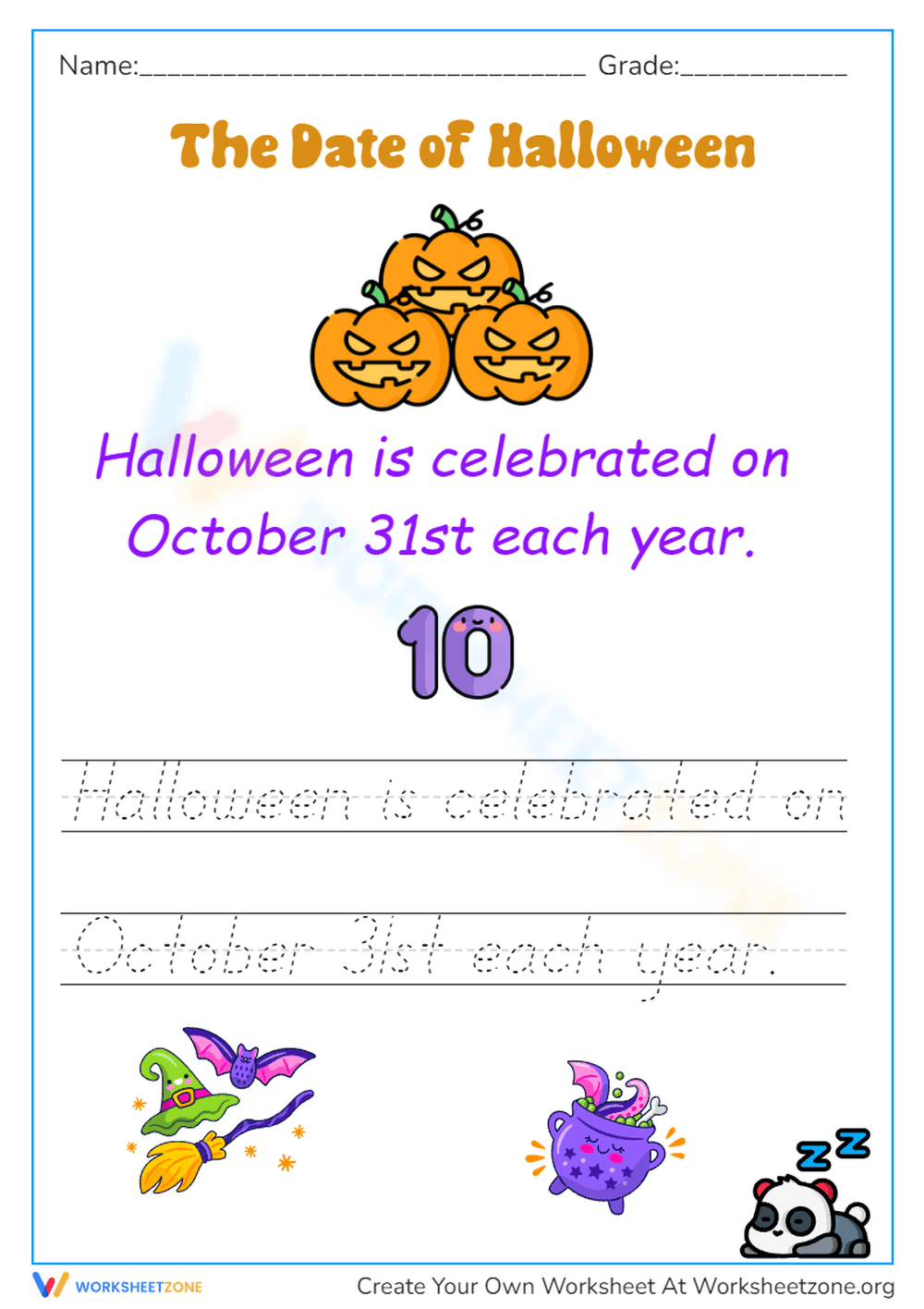
The worksheet features a single page containing a clear, cursive model of the sentence "Halloween is celebrated on October 31st each year." Below the model, two dedicated tracing lines with dotted guides allow students to practice the flow of cursive connections. The page is decorated with engaging Halloween-themed illustrations, including pumpkins, bats, and a witch's hat, to maintain student interest during the writing task.
Zero-Prep Workflow
- Print: Generate the single-page PDF for your entire class in under 30 seconds.
- Distribute: Hand out the sheets as a festive bell-ringer or transition activity.
- Review: Monitor student progress and letter slant with zero additional teacher preparation time.
This resource is designed for immediate use with no teacher setup, ideal for substitute folders or seasonal literacy centers.
Standards Alignment
The primary standard is `CCSS.ELA-LITERACY.L.2.1`, which requires students to demonstrate command of the conventions of standard English grammar and usage when writing. While cursive is often a state-level requirement, this worksheet supports the broader goal of legible handwriting and sentence structure. Both standard codes can be copied directly into lesson plans, IEP goals, or district curriculum mapping tools.
How to Use It
Use this worksheet during the last week of October as a calming morning work activity. It serves as an excellent formative assessment tool; teachers can observe pencil grip and the fluid motion of letter transitions as students trace the sentence. Expect students to complete the tracing in approximately 5 to 10 minutes, depending on their familiarity with cursive forms.
Who It's For
This resource is tailored for first and second-grade students who are beginning their transition from manuscript to cursive writing. It is particularly effective for learners who benefit from visual anchors and holiday-themed motivation. Pair this with a Halloween reading passage or a cursive anchor chart for a comprehensive literacy experience.
Handwriting remains a foundational literacy skill, even in a digital age. According to Fisher & Frey (2014), the physical act of writing letters by hand, particularly in a connected script like cursive, activates neural pathways associated with memory and language processing that typing does not. This worksheet addresses CCSS.ELA-LITERACY.L.2.1 by providing the repetition necessary for motor memory development. Research from the NAEP suggests that students who develop fluent handwriting can devote more cognitive resources to higher-order composition tasks. By integrating seasonal themes with 2 specific tracing tasks, this resource ensures that handwriting practice is both meaningful and engaging. The inclusion of dotted guides supports the gradual release of responsibility, allowing students to internalize the proportions and slants of cursive characters. This 1-page tool is a practical application of evidence-based handwriting instruction for early elementary classrooms, helping students master the complex motor patterns required for fluent cursive writing.


