


























Views
Downloads
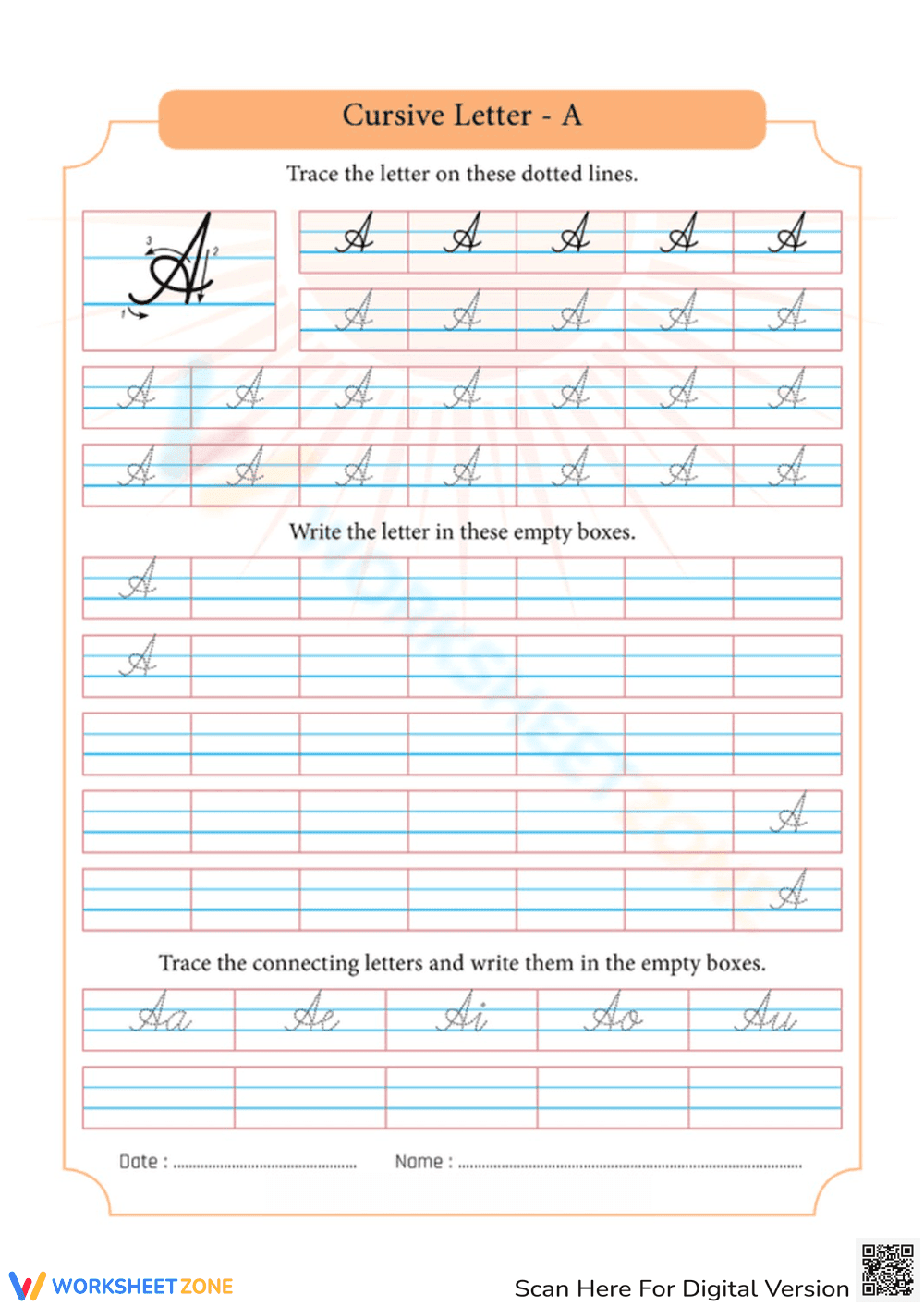

Printable Cursive Letter A Worksheet | Grade 3
Paste this activity's link or code into your existing LMS (Google Classroom, Canvas, Teams, Schoology, Moodle, etc.).
Students can open and work on the activity right away, with no student login required.
You'll still be able to track student progress and results from your teacher account.
This printable cursive handwriting worksheet helps third and fourth-grade students master the uppercase letter A. By providing clear directional arrows and structured practice lines, the resource ensures learners develop proper stroke mechanics. Students transition from guided tracing to independent writing, building essential penmanship skills for fluent communication.
At a Glance
- Grade: 3 · Subject: Handwriting
- Standard:
CCSS.ELA-LITERACY.L.3.1— Write legibly using standard English conventions- Skill Focus: Cursive Letter A
- Format: 1 page · 50 problems · No answer key needed · PDF
- Best For: Morning work or literacy centers
- Time: 10–15 minutes
Inside this single-page PDF, educators will find a highly structured progression of handwriting tasks. The page opens with a numbered instructional model showing the exact stroke order for the cursive capital A. This is followed by 15 dotted tracing boxes, 25 independent writing boxes, and a final section dedicated to connecting the uppercase A to lowercase vowels. The clean layout minimizes visual clutter.
This resource is designed for a seamless, zero-prep classroom workflow:
- Print (1 minute): Use the ink-friendly black-and-white PDF for the whole class.
- Distribute (1 minute): Hand out during morning routines; visual instructions let students begin immediately.
- Review (1 minute): Scan quickly for proper slant and stroke direction.
With under two minutes of total teacher prep time, this worksheet is ideal for sub plans or literacy stations.
This practice aligns with CCSS.ELA-LITERACY.L.3.1, supporting students as they demonstrate command of standard English conventions when writing. Mastering fluid letter production reduces cognitive load, allowing students to focus on content. Both standard codes can be copied directly into lesson plans, IEP goals, or district curriculum mapping tools.
Teachers can deploy this worksheet during morning bell work to establish a calm, focused start to the school day. It also serves as an excellent independent activity during guided reading rotations. As a formative assessment tip, observe students while they complete the connecting letters section at the bottom of the page; watch to ensure they are not lifting their pencils between the uppercase A and the subsequent lowercase vowel. Most students will complete this practice sheet within 10 to 15 minutes.
This resource is primarily designed for third and fourth-grade students who are being introduced to cursive or need targeted remediation on specific letterforms. For differentiation, teachers can provide a highlighted baseline for students struggling with spatial awareness, or challenge advanced writers to compose full sentences using the connecting letter pairs on the back of the page. It pairs perfectly with a classroom cursive alphabet anchor chart or a direct instruction mini-lesson on handwriting posture.
Developing automaticity in handwriting is a critical component of early literacy and written expression. This resource targets CCSS.ELA-LITERACY.L.3.1, helping students write legibly using standard English conventions. According to a comprehensive EdReports 2024 analysis of foundational skills, explicit handwriting instruction significantly improves spelling accuracy and overall writing fluency. When students no longer have to consciously think about how to form a cursive letter A, their working memory is freed up to focus on vocabulary selection, sentence structure, and complex idea generation. Structured practice sheets that move from tracing to independent production provide the exact repetition needed to build this essential muscle memory. By integrating targeted penmanship exercises into daily routines, educators can ensure that mechanical writing difficulties do not impede a student's academic communication or creative expression.


