


























Views
Downloads
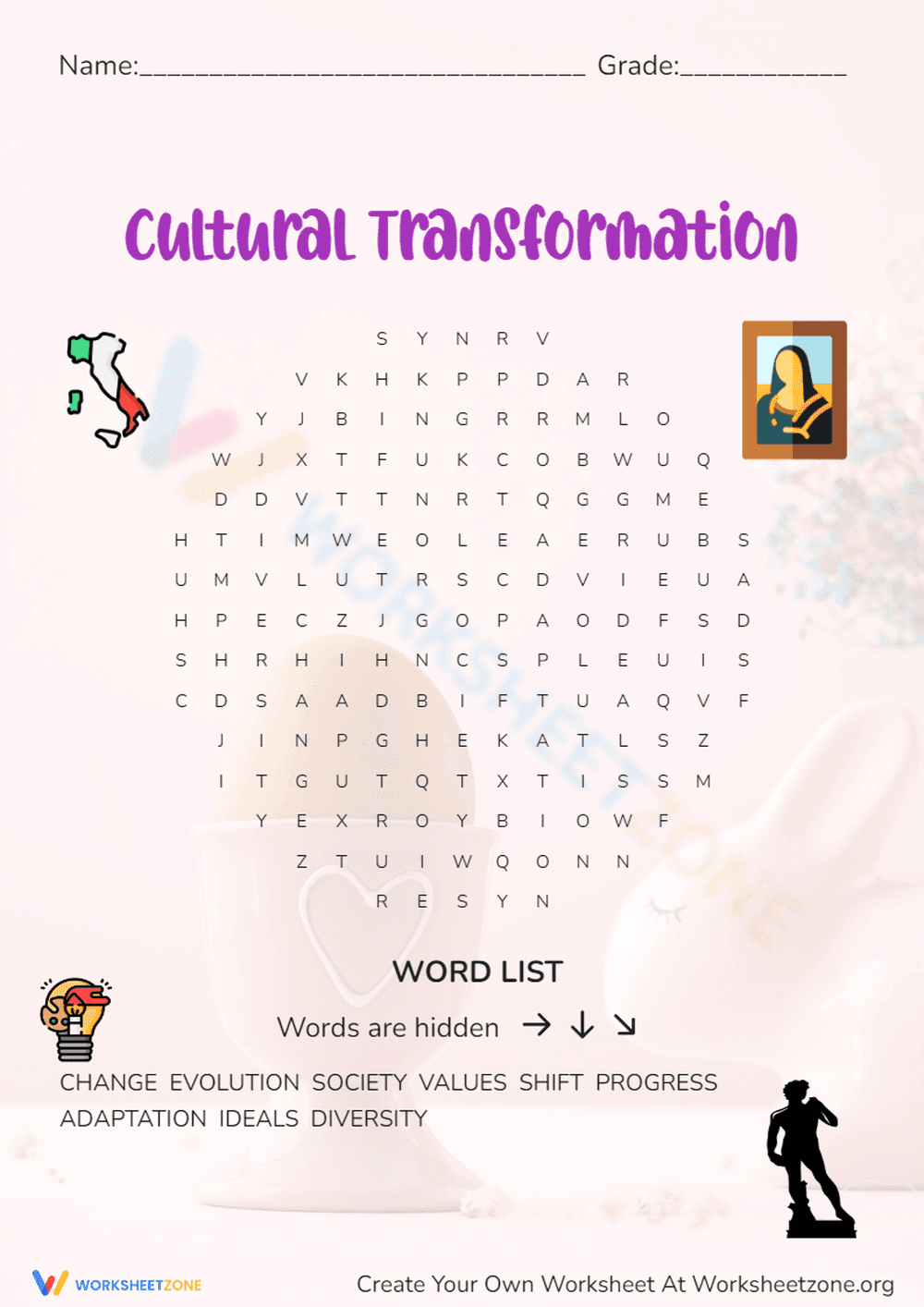

Renaissance Cultural Transformation Word Search | Ready
Paste this activity's link or code into your existing LMS (Google Classroom, Canvas, Teams, Schoology, Moodle, etc.).
Students can open and work on the activity right away, with no student login required.
You'll still be able to track student progress and results from your teacher account.
Overview
This Grade 5 Renaissance worksheet helps students identify and internalize key vocabulary associated with historical cultural shifts. By engaging with terms like evolution, ideals, and society, learners develop a conceptual framework for understanding how the Renaissance reshaped the modern world. It provides a focused, low-stakes environment for domain-specific language acquisition and historical context.
At a Glance
- Grade: 5 · Subject: Social Studies
- Standard:
CCSS.ELA-LITERACY.RI.5.4— Determine the meaning of general academic and domain-specific words and phrases- Skill Focus: Renaissance Vocabulary
- Format: 1 page · 10 problems · Answer key included · PDF
- Best For: Early finishers or vocabulary reinforcement
- Time: 15–20 minutes
What's Inside
This single-page PDF features a high-interest word search puzzle containing 10 essential terms related to the Renaissance period. The word list includes academic vocabulary such as "adaptation," "diversity," and "progress." The layout is clean and visually engaging, featuring iconic imagery like the Mona Lisa and the statue of David to provide immediate historical context. A full answer key is provided for quick grading.
Zero-Prep Workflow
The zero-prep design ensures this resource fits perfectly into a busy classroom schedule. First, print the single-page PDF (30 seconds). Second, distribute the sheets to students as a bell-ringer or transition activity (1 minute). Third, review the definitions of the found words as a whole-class discussion to solidify understanding (5 minutes). Total teacher preparation time is under 2 minutes, making it an ideal sub-plan addition.
Standards Alignment
This resource aligns with `CCSS.ELA-LITERACY.RI.5.4`, which requires students to determine the meaning of general academic and domain-specific words and phrases in a text relevant to a grade 5 topic. By identifying these terms in a puzzle format, students build the lexical stamina needed for complex historical texts. Both standard codes can be copied directly into lesson plans, IEP goals, or district curriculum mapping tools.
How to Use It
Use this worksheet as a formative assessment during a unit on European history. Observe which students quickly identify abstract terms like "ideals" versus concrete ones, providing insight into their conceptual grasp of the era. Alternatively, assign it as a quiet-time activity after direct instruction on the Medici family or Renaissance art to reinforce the day's key themes. Completion typically takes 15 to 20 minutes.
Who It's For
This worksheet is designed for Grade 5 students but is adaptable for Grade 4 or Grade 6 learners needing vocabulary support. It is particularly effective for English Language Learners (ELLs) who benefit from seeing domain-specific words in isolation before encountering them in dense passages. Pair this with an anchor chart depicting Renaissance inventions or a short biography of Leonardo da Vinci for a complete lesson.
The use of word searches in the social studies classroom serves as a valuable tool for lexical retrieval and pattern recognition. According to research in the RAND AIRS 2024 report, providing students with multiple exposures to domain-specific vocabulary in varied formats—such as puzzles, direct instruction, and reading—significantly increases long-term retention of historical concepts. This worksheet targets CCSS.ELA-LITERACY.RI.5.4 by isolating ten high-leverage terms that define the Renaissance era, including "evolution" and "transformation." By engaging with these words outside of a traditional textbook paragraph, students reduce cognitive load while building the foundational "word wealth" necessary for analyzing primary source documents later in the unit. This approach aligns with evidence-based practices for middle-grade literacy, ensuring that students are not just memorizing dates, but are instead mastering the language of historical change and innovation.


