


























Views
Downloads


Essential Cells & Cell Theory Worksheet | Grade 7 Aligned
Paste this activity's link or code into your existing LMS (Google Classroom, Canvas, Teams, Schoology, Moodle, etc.).
Students can open and work on the activity right away, with no student login required.
You'll still be able to track student progress and results from your teacher account.
Comprehensive Cell Biology Study Guide
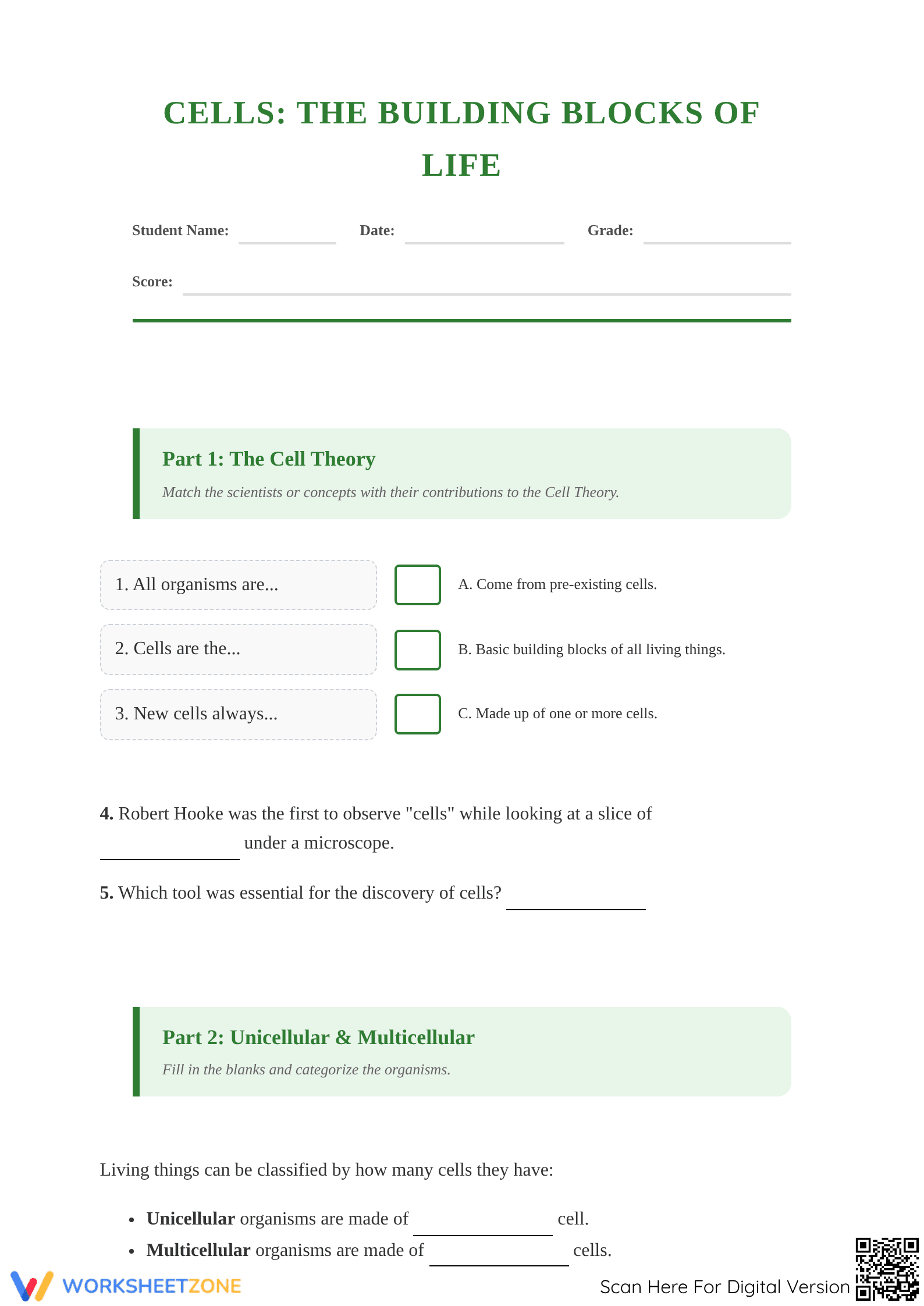
This worksheet helps students identify the components of the cell theory and distinguish between various cell types. Students will analyze diagrams of plant and animal cells to understand structural differences and specific organelle functions. By completing these 26 structured tasks, learners demonstrate mastery of the fundamental building blocks of all living organisms in life science.
At a Glance
- Grade: 7 · Subject: Science
- Standard:
MS-LS1-1— Conduct an investigation to provide evidence that living things are made of cells- Skill Focus: Cell Theory and Organelles
- Format: 4 pages · 26 problems · Answer key included · PDF
- Best For: Comprehensive unit review or formative assessment
- Time: 45–55 minutes
What's Inside
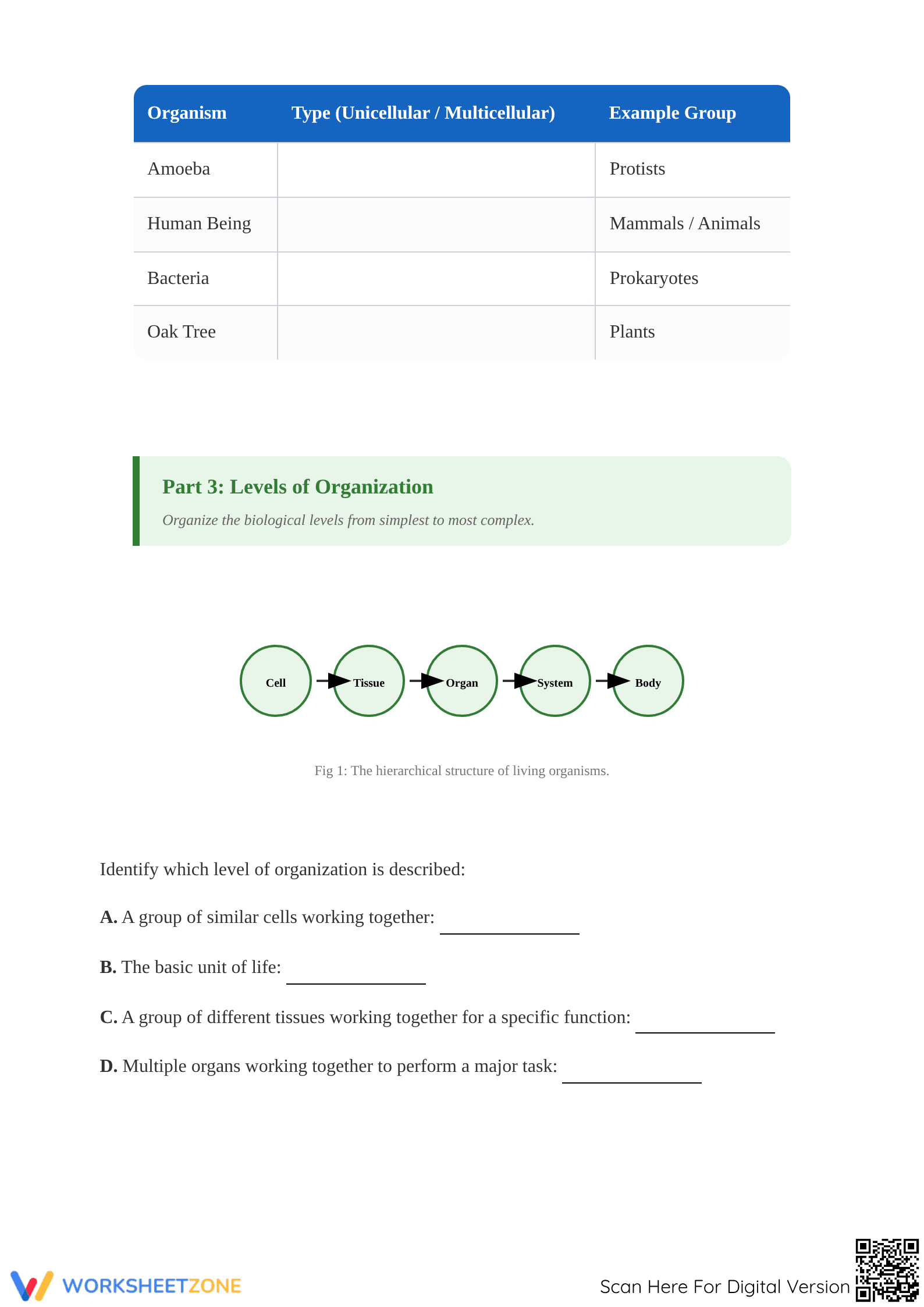
This 4-page comprehensive packet features a variety of task types including matching exercises for the cell theory, fill-in-the-blank categorization for unicellular and multicellular organisms, and a diagram-based analysis of the levels of organization. It includes a dedicated comparison section for prokaryotic versus eukaryotic cells and a detailed organelle function table for plant and animal cells, supported by a full answer key.
Mastery Evidence
The worksheet provides clear evidence of mastery across multiple cognitive levels. Tasks map directly to the core pillars of MS-LS1-1: identifying cells as the basic unit of life, recognizing structural differences in cell types, and understanding how specialized organelles support life processes. Teachers can use the structural organization and organelle matching sections to enter specific sub-skill scores into gradebooks or monitor IEP progress for life science goals.
Standards Alignment
Aligned to MS-LS1-1, which requires students to provide evidence that all living things are made of cells. It also supports MS-LS1-2, focusing on the role of the cell as a whole and its specific parts. Both standard codes can be copied directly into lesson plans, IEP goals, or district curriculum mapping tools to ensure instructional coherence throughout the biology or life science unit.
How to Use It
Use this resource as a summative assessment following direct instruction on cell biology or as a structured review before a unit exam. For a formative approach, observe students during the prokaryotic vs. eukaryotic comparison to identify misconceptions about nucleus presence. The 4-page sequence is designed to be completed in one 50-minute class period, providing a complete data snapshot of student understanding before moving to human body systems.
Who It's For
This worksheet is designed for middle school life science students, with clear headings and visual diagrams that support English Language Learners and students with IEP accommodations. It serves as a natural pairing for microscopic lab observations or as a companion to an introductory cell structures passage, ensuring that students can connect theoretical knowledge with observable biological evidence.
The fundamental importance of cell biology instruction is supported by ScienceDirect TpT Analysis, which emphasizes that visual modeling and hierarchical organization are critical for middle school students to grasp abstract biological concepts. By aligning with MS-LS1-1, this resource ensures that students move beyond rote memorization of organelles toward an evidence-based understanding that all living organisms are composed of cells. Research from EdReports 2024 highlights that standards-aligned materials which integrate cell theory with structural organization, as seen in the levels of biological hierarchy from cell to tissue to organ, significantly improve long-term retention of life science frameworks. This 4-page packet provides the necessary scaffolded practice for Grade 7 learners to master the plain-English skill of identifying cell parts and their functions within the context of the larger biological system. The inclusion of prokaryotic and eukaryotic distinctions further bridges the gap between basic identification and advanced classification required by national science standards.


