


























Views
Downloads

Essential Grade 7 Prep: Create Proportions - 7.RP.A.2 Worksheet
Paste this activity's link or code into your existing LMS (Google Classroom, Canvas, Teams, Schoology, Moodle, etc.).
Students can open and work on the activity right away, with no student login required.
You'll still be able to track student progress and results from your teacher account.
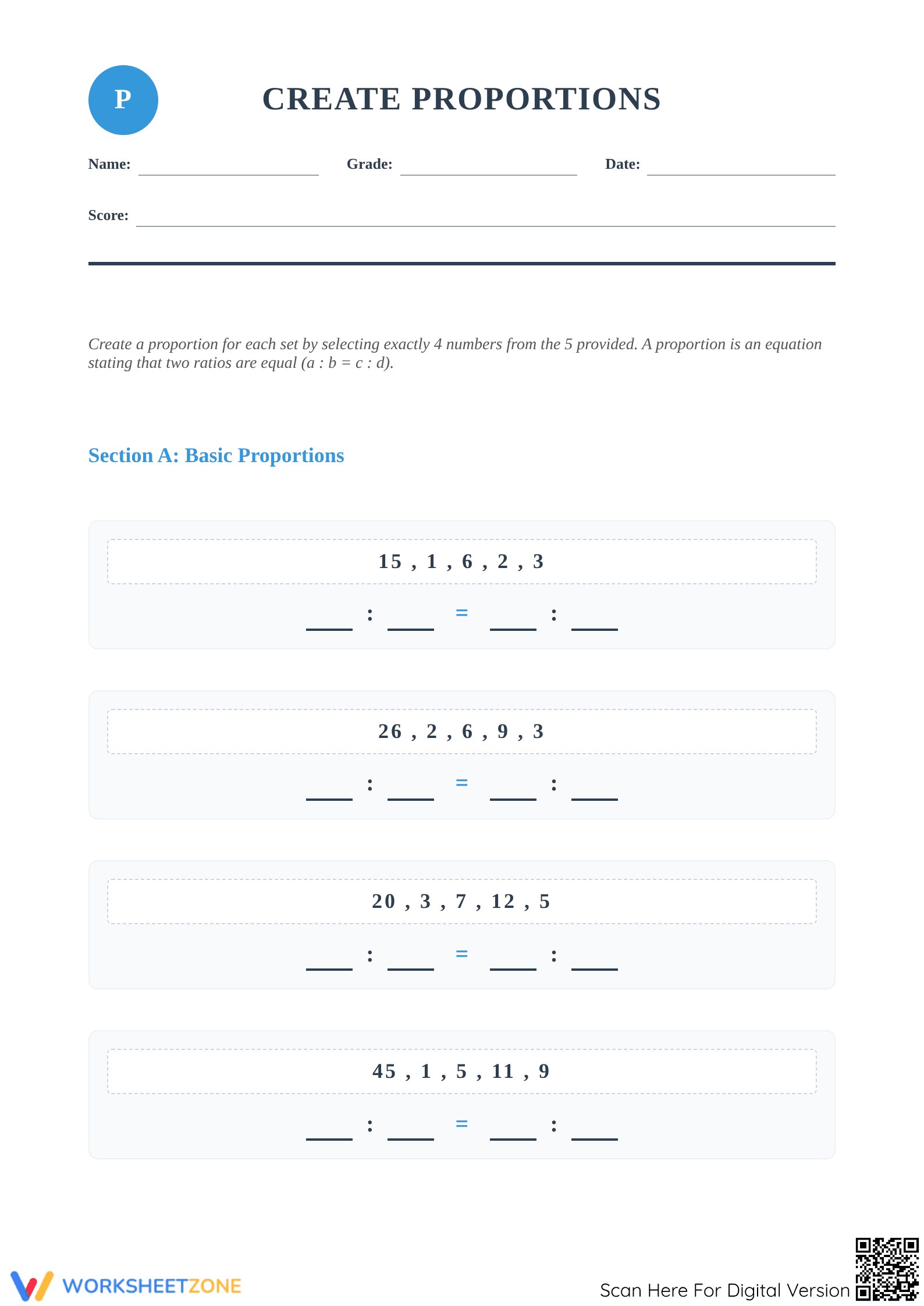
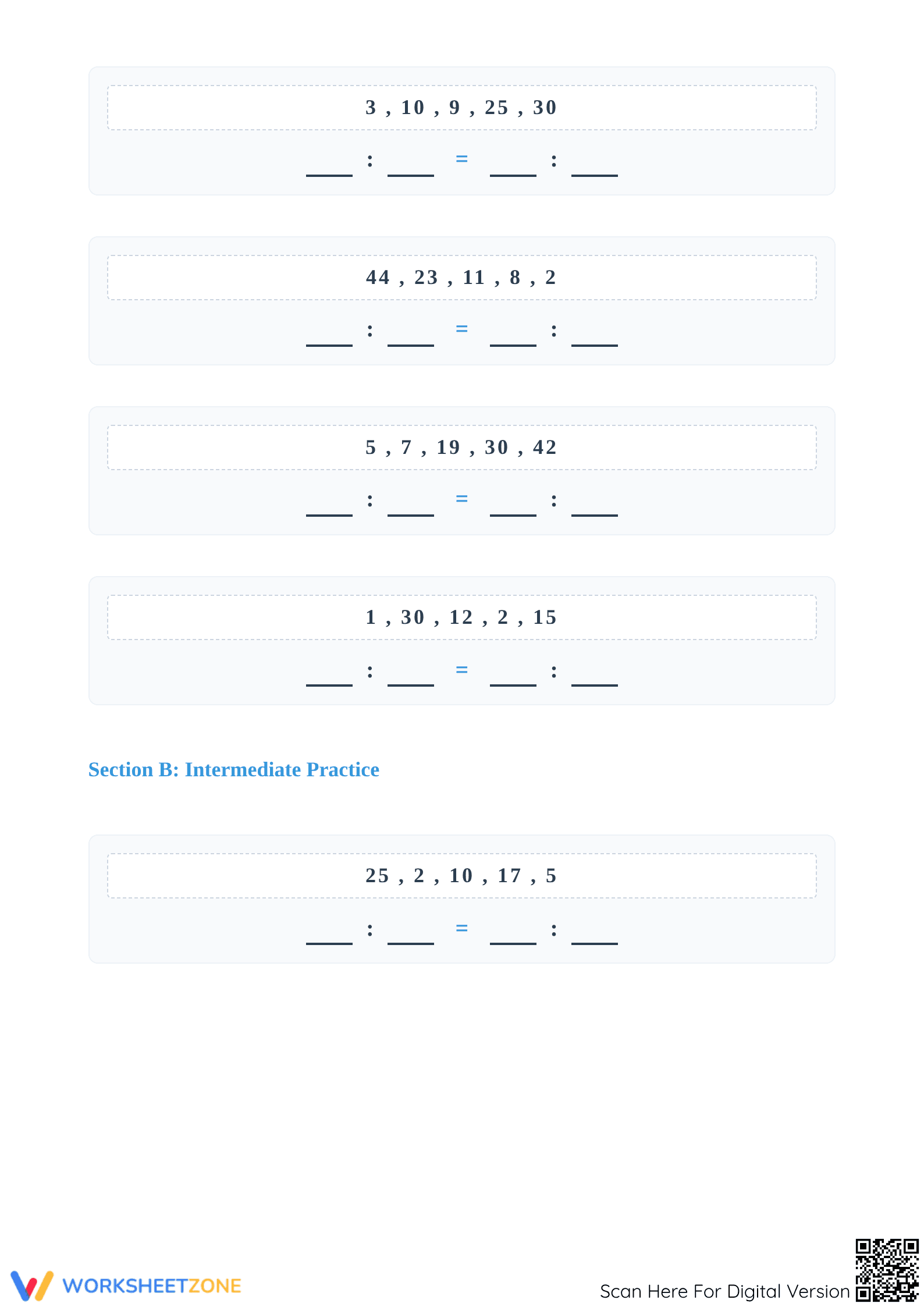
This comprehensive Grade 7 math worksheet helps students master the construction of equivalent ratios through a series of scaffolded exercises. By requiring students to select four numbers from a given set of five to form a valid proportion, the resource reinforces the fundamental mechanics of cross-multiplication and scaling. Students will demonstrate their understanding by creating balanced equations that reflect proportional relationships.
At a Glance
- Grade: 7 · Subject: Math
- Standard:
CCSS.MATH.CONTENT.7.RP.A.2— Recognize and represent proportional relationships between quantities- Skill Focus: Creating proportions from number sets
- Format: 5 pages · 25 problems · Answer key included · PDF
- Best For: Scaffolded practice and formative assessment
- Time: 30–45 minutes
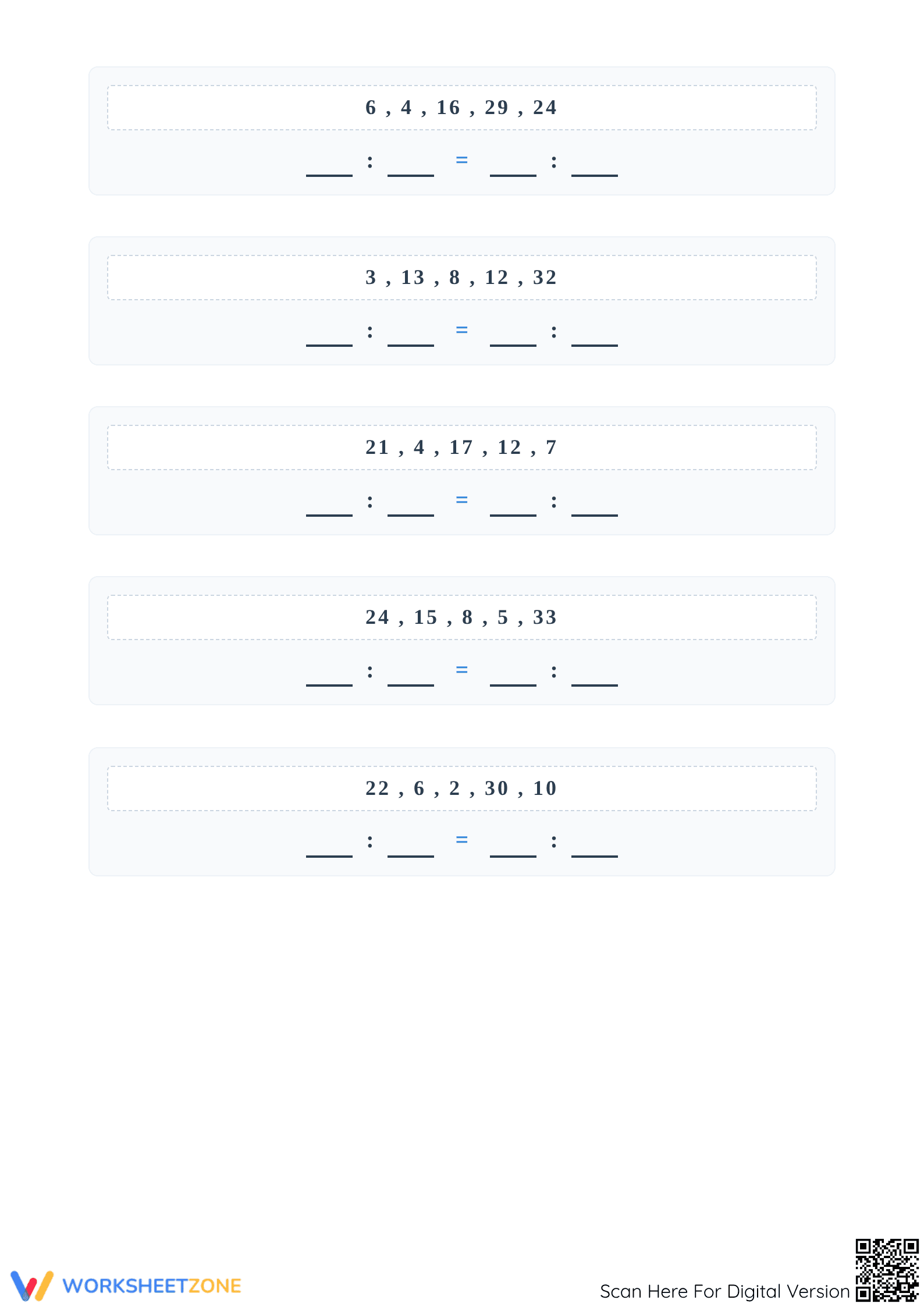
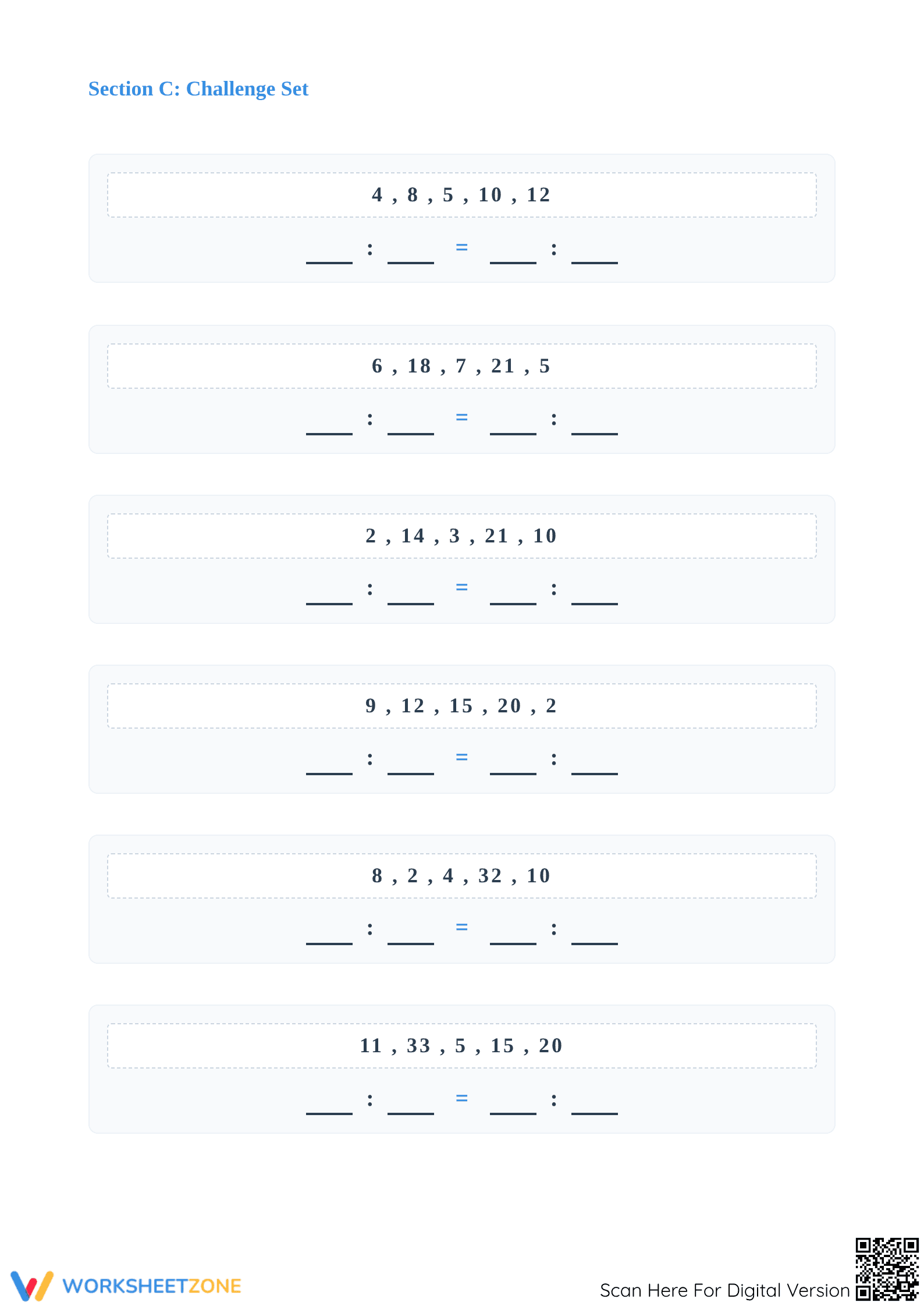
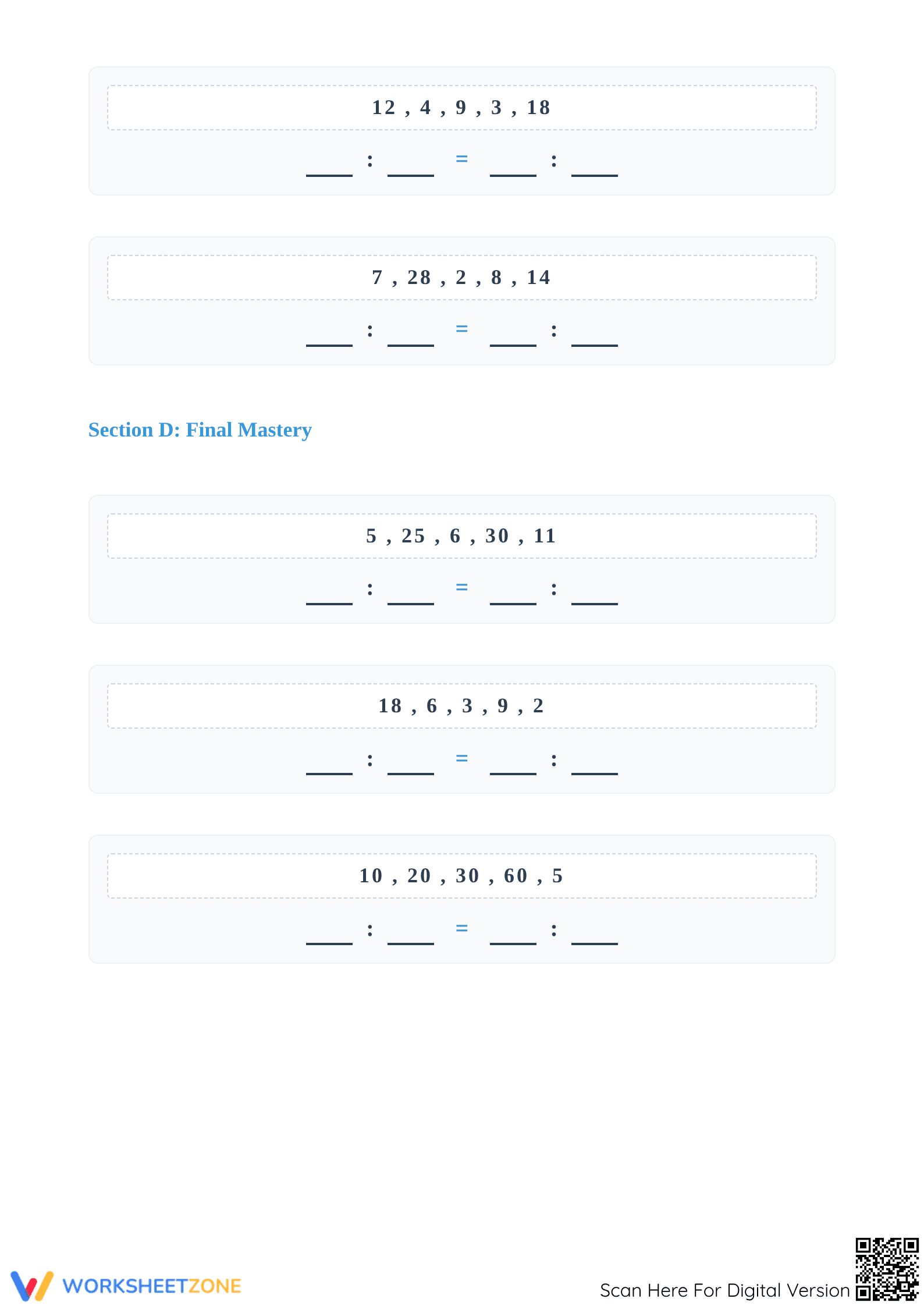
What's Inside: This 5-page PDF contains 25 unique proportion-building tasks distributed across four progressive sections. Each task provides a number bank of five integers, and students must identify the specific four that satisfy the ratio equation a : b = c : d. A complete answer key is included at the end of the collection, allowing for immediate feedback and efficient grading by teachers or parents.
Mastery Evidence: The worksheet is divided into four strategic sections: Basic Proportions, Intermediate Practice, Challenge Set, and Final Mastery. Each of the 25 tasks requires students to evaluate numerical relationships to identify the four values that successfully form a balanced equation. Section A focuses on small integers for fluency, while Section D demands higher-order numerical reasoning. This tiered structure allows teachers to identify the exact point where a student's conceptual understanding of equivalent ratios begins to struggle, facilitating data-driven intervention. Scores can be recorded directly into gradebooks or used to monitor IEP progress for ratios and proportional reasoning goals.
Standards Alignment: The primary focus is CCSS.MATH.CONTENT.7.RP.A.2, which requires students to recognize and represent proportional relationships between quantities. By synthesizing proportions from raw data, students practice the inverse of simplifying ratios. Both standard codes can be copied directly into lesson plans, IEP goals, or district curriculum mapping tools.
How to Use It: This resource is best utilized during the independent practice phase of a lesson on proportional relationships. Teachers can assign the Basic section as an entrance ticket to gauge prior knowledge, then move to the Challenge Set for students who demonstrate early mastery. As a formative assessment tip, observe whether students use division to find unit rates or cross-multiplication to verify their chosen sets. Expected completion time is 35 minutes for most students.
Who It's For: This collection is designed for Grade 7 students working toward proficiency in ratios. It provides natural differentiation through its difficulty sections, making it suitable for both general education classrooms and targeted intervention groups. It pairs perfectly with an anchor chart detailing the cross-product property or a direct instruction lesson on equivalent fractions.
According to the CCSS.MATH.CONTENT.7.RP.A.2 standard, students must develop the ability to recognize and represent proportional relationships between quantities. This worksheet facilitates that development by requiring them to construct proportions, moving beyond simple identification to active synthesis. Research from EdReports (2024) emphasizes that high-quality mathematics instructional materials must provide a clear progression from procedural fluency to conceptual application. By organizing tasks into four distinct sections—Basic, Intermediate, Challenge, and Final Mastery—this resource adheres to the gradual release of responsibility model. Students first practice with foundational number sets before tackling complex relationships that require deeper division and multiplication logic. The inclusion of 25 unique problems ensures sufficient repetitions for mastery, while the explicit requirement to select four out of five numbers prevents guessing and encourages active checking of equivalent ratios. This structured approach is essential for bridging the gap between middle school arithmetic and high school algebraic functions.


