


























Views
Downloads


Printable August Calendar Worksheet for Preschool Math
Paste this activity's link or code into your existing LMS (Google Classroom, Canvas, Teams, Schoology, Moodle, etc.).
Students can open and work on the activity right away, with no student login required.
You'll still be able to track student progress and results from your teacher account.
This interactive August calendar worksheet helps preschoolers master the concept of time while practicing essential numeracy and fine motor skills. By tracing the month and filling in missing dates, students build a concrete understanding of how weeks and months are structured. This colorful resource transforms abstract time concepts into a hands-on learning experience for early learners.
At a Glance
- Grade: Preschool · Subject: Math
- Standard:
K.CC.A.3— Write numbers from 0 to 20 and represent quantities with written numerals- Skill Focus: Calendar structure, counting 1–31, and weather identification
- Format: 3 pages · 3 main tasks · No answer key required · PDF
- Best For: Daily morning meetings and calendar math routines
- Time: 15–20 minutes
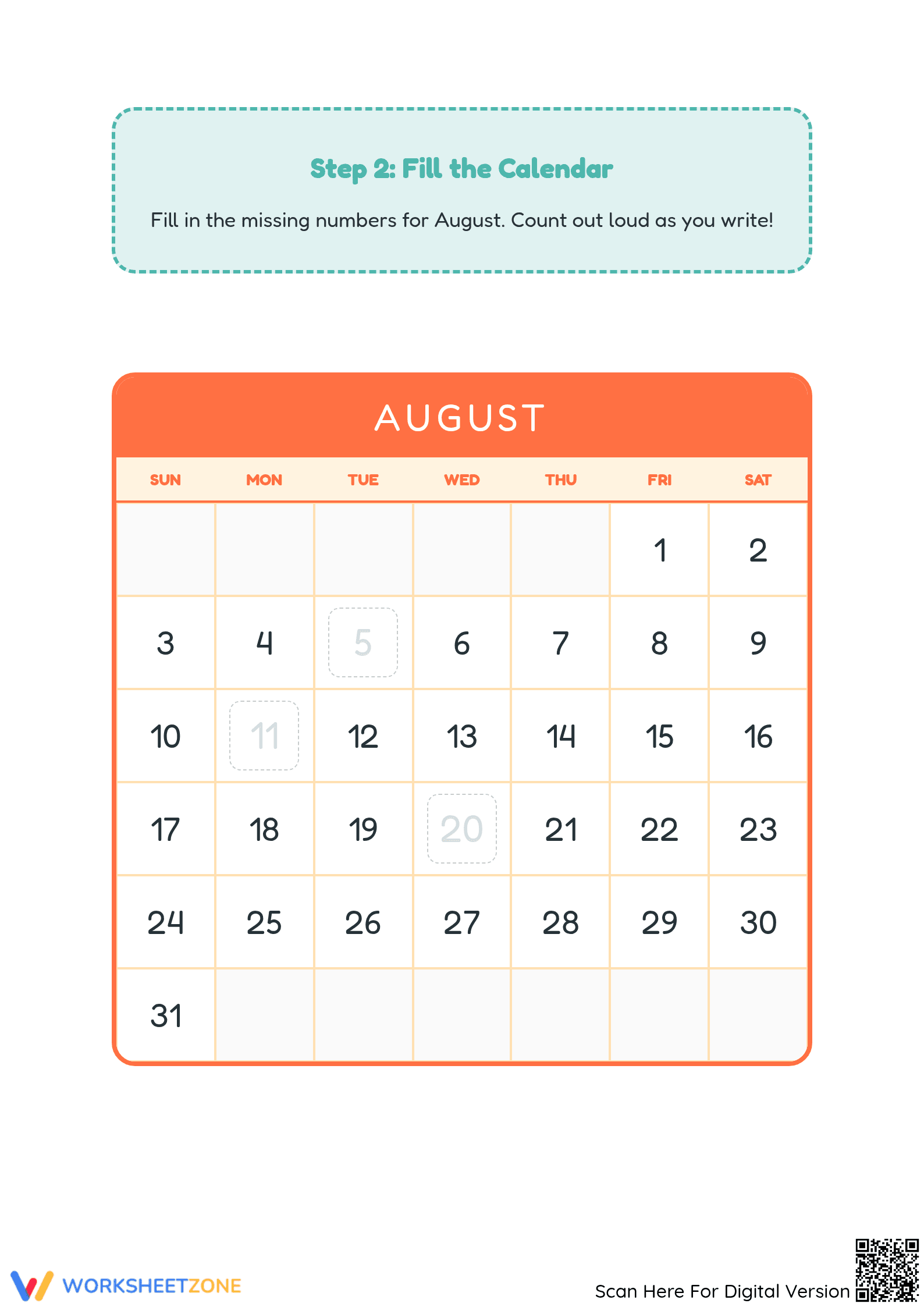
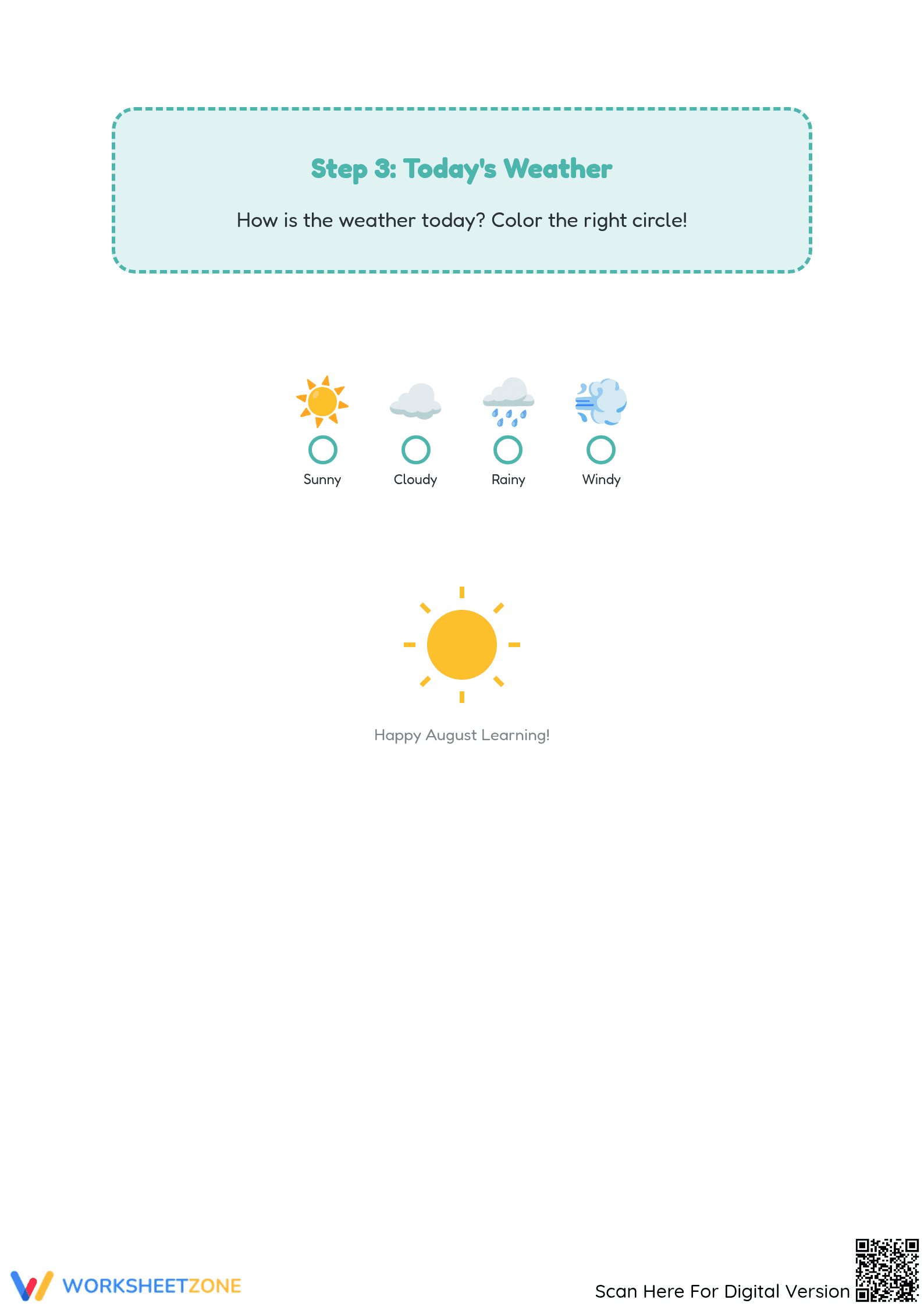
The download consists of three structured pages designed for young learners. Page one features a large, trace-ready "AUGUST" header to reinforce letter formation and month recognition. Page two contains a calendar grid where students fill in missing numbers from 1 to 31, providing targeted practice in number sequencing. The final page includes a weather tracking component, allowing children to observe and record daily environmental conditions through coloring.
Teachers can implement this activity with zero preparation. First, print the three-page set for each student (less than 1 minute). Next, distribute the packets during your morning meeting or math center (30 seconds). Finally, review the completed calendar together to discuss the days of the week and current weather (5 minutes). This streamlined workflow makes it an ideal choice for busy classrooms or emergency sub plans where high-quality instructional materials are needed immediately.
This activity is primarily aligned to `K.CC.A.3`, which requires students to write numbers and understand their relationship to quantities. While the calendar extends to 31, it serves as a natural bridge for preschool students moving toward kindergarten expectations. Additionally, it supports `K.CC.A.1` by encouraging students to count aloud as they write. Both standard codes can be copied directly into lesson plans, IEP goals, or district curriculum mapping tools.
Use this worksheet as a foundational part of your daily "Morning Meeting" routine at the start of August. As students track the passing days, they develop a sense of rhythm and routine. Alternatively, assign it as a centers-based activity where students work in small groups to help each other identify which number comes next in the sequence. Observe how students handle the transition from one week to the next on the grid for a quick formative assessment.
This resource is tailored for preschool and early kindergarten students who are beginning to explore numbers beyond ten. It is particularly effective for visual learners and students who benefit from repetitive, predictable tasks. For further enrichment, pair this worksheet with a physical wall calendar or a weather-themed picture book to deepen the connection between the paper tasks and real-world observations.
Structured calendar activities in early childhood settings provide more than just date-tracking; they serve as a critical scaffolding tool for temporal reasoning and mathematical sequencing. By integrating handwriting, counting, and science observation, this worksheet follows integrated learning models. These activities show students the practical application of numbers, boosting engagement and retention of counting skills. This approach, supported by the 2024 NAEP framework, emphasizes early numeracy for future STEM success.


