


























Views
Downloads
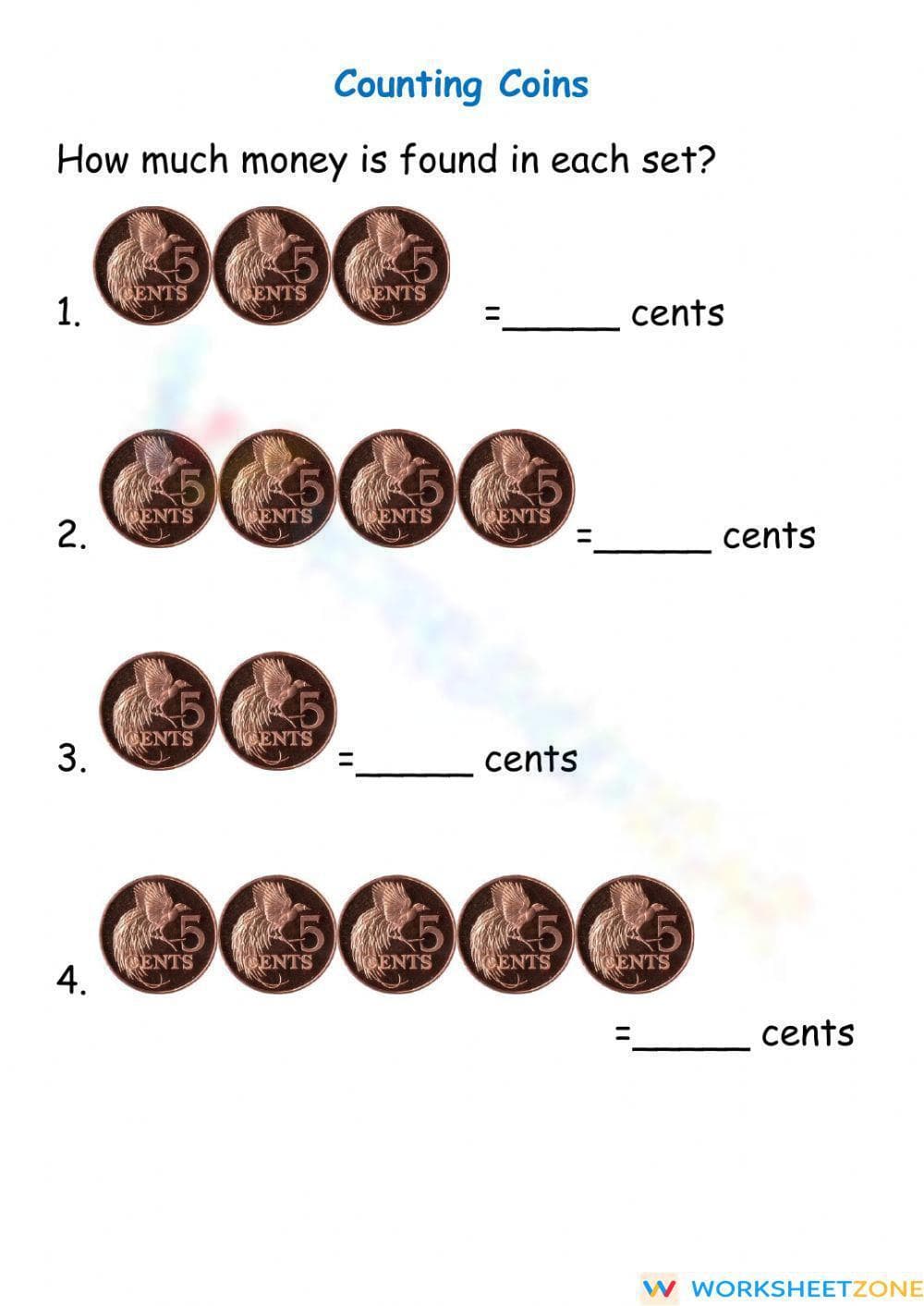

Grade 2 Counting Coins — Printable No-Prep Worksheet
Paste this activity's link or code into your existing LMS (Google Classroom, Canvas, Teams, Schoology, Moodle, etc.).
Students can open and work on the activity right away, with no student login required.
You'll still be able to track student progress and results from your teacher account.
This Grade 2 math worksheet provides focused practice on counting identical coins, specifically skip counting by fives. Students determine the total value of multiple coin sets, reinforcing both foundational money skills and repeated addition concepts. The clear, uncluttered layout ensures young learners can confidently calculate the total cents for each problem.
At a Glance
- Grade: 2 · Subject: Math
- Standard:
CCSS.MATH.CONTENT.2.MD.C.8— Solve problems involving coins and bills- Skill Focus: Counting coins and skip counting
- Format: 1 page · 4 problems · Answer key included · PDF
- Best For: Independent practice and review
- Time: 10–15 minutes
This single-page resource features four distinct visual problems where students count sets of five-cent coins. Each task presents a clear, high-quality image of the coins grouped together, followed by a straightforward equation line where students write the total value in cents. An answer key supports quick grading, making the packet highly functional for daily use.
Zero-Prep Workflow
Designed for immediate implementation:
- Print (1 minute): Simply download the PDF and print the required number of copies.
- Distribute (1 minute): Hand out the sheets during math centers or as a quick warm-up activity.
- Review (3 minutes): Use the included answer key to quickly check student work or project it on the board for whole-class review.
With a total teacher prep time of under two minutes, this worksheet is an excellent addition to any emergency sub plan or last-minute lesson adjustment.
Standards Alignment
This worksheet aligns directly with CCSS.MATH.CONTENT.2.MD.C.8, requiring students to solve word problems involving dollar bills, quarters, dimes, nickels, and pennies, using $ and ¢ symbols appropriately. It also supports foundational skip-counting skills. Both standard codes can be copied directly into lesson plans, IEP goals, or district curriculum mapping tools.
How to Use It
Use this during independent practice. After direct instruction on coin values, students can complete these four problems to demonstrate their understanding of skip counting by fives. Alternatively, use it as a morning work activity to activate prior knowledge before introducing mixed coin counting. As a formative assessment tip, observe whether students physically tap each coin as they count or if they can visually group the coins to find the total. Expected completion time ranges from 10 to 15 minutes.
Who It's For
This resource is primarily designed for first and second-grade students mastering basic currency concepts. The visual coin sets provide built-in scaffolding for visual learners. For differentiation, provide physical manipulatives for students performing below grade level to match the images on the page. Pair this worksheet with a whole-group anchor chart detailing the value of different coins to maximize student success.
Mastering currency calculations, such as those aligned with CCSS.MATH.CONTENT.2.MD.C.8 to solve problems involving coins and bills, requires repeated exposure to visual and concrete models. According to EdReports 2024, integrating visual representations of mathematics concepts significantly improves student retention and procedural fluency in early elementary grades. This worksheet provides exactly that type of targeted practice, allowing students to connect the visual image of a five-cent coin with the abstract concept of skip counting by fives. By isolating this specific skill into four manageable tasks, educators can accurately assess student proficiency without cognitive overload. The straightforward format ensures that the focus remains entirely on the mathematical operation rather than deciphering complex instructions. This makes it an essential tool for building foundational financial literacy, ensuring young learners develop the confidence needed for more advanced money management tasks in the future.


