


























Views
Downloads

Counting Money Worksheet: Printable Grade 2 Math
Paste this activity's link or code into your existing LMS (Google Classroom, Canvas, Teams, Schoology, Moodle, etc.).
Students can open and work on the activity right away, with no student login required.
You'll still be able to track student progress and results from your teacher account.
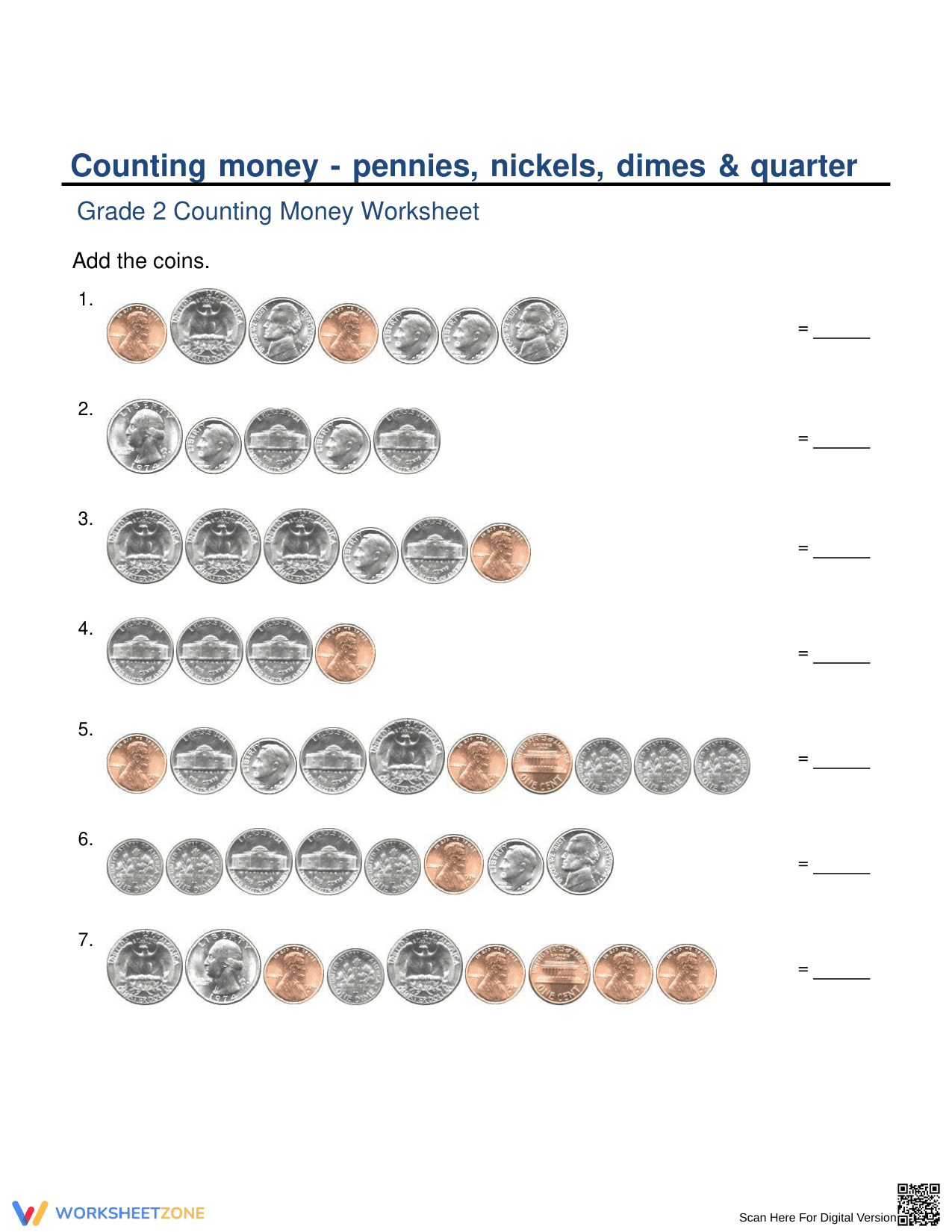
This printable worksheet helps second-grade students master counting mixed coins including pennies, nickels, dimes, and quarters. Students calculate the total monetary value for seven distinct coin groups, writing their answers in standard decimal format. This resource builds essential financial literacy and skip-counting skills.
At a Glance
- Grade: Grade 2 · Subject: Math
- Standard:
CCSS.MATH.CONTENT.2.MD.C.8— Solve word problems involving dollar bills, quarters, dimes, nickels, and pennies- Skill Focus: Counting mixed coins and writing decimal values
- Format: 2 pages · 7 problems · Answer key included · PDF
- Best For: Independent practice or quick homework assignment
- Time: 10–15 minutes
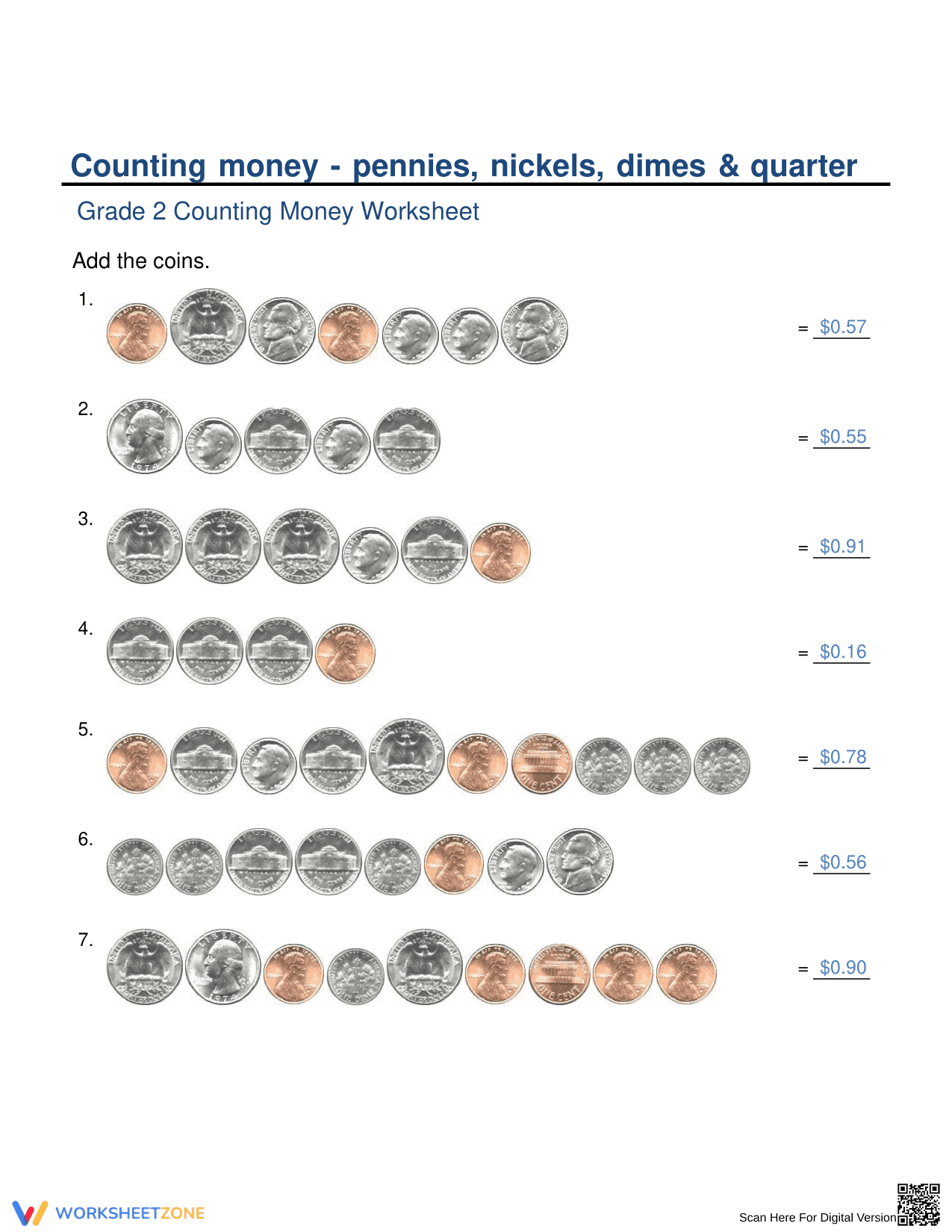
The PDF contains a single-page student worksheet featuring seven horizontal rows of clear, realistic coin illustrations. Each problem presents a unique combination of pennies, nickels, dimes, and quarters in random order to challenge student identification skills. A matching, fully populated answer key page is included to facilitate rapid grading or student self-assessment.
Zero-Prep Workflow
This resource is designed for immediate classroom deployment with minimal teacher effort. First, print the single-page student worksheet, which takes less than one minute. Next, distribute the sheets to your class for a focused ten-minute independent session. Finally, review the answers using the provided key, taking under two minutes to grade the entire class set. This efficient structure makes the worksheet an ideal choice for emergency sub plans, morning work, or transition periods.
Standards Alignment
This activity aligns directly with the Common Core State Standard CCSS.MATH.CONTENT.2.MD.C.8, which requires students to solve word problems and calculate values involving quarters, dimes, nickels, and pennies using appropriate symbols. By practicing with mixed coin groups, students develop the foundational skip-counting and place-value skills necessary for real-world financial transactions. Both standard codes can be copied directly into lesson plans, IEP goals, or district curriculum mapping tools.
How to Use It
Use this worksheet during the independent practice portion of a lesson on money. Alternatively, assign it as a formative assessment exit ticket after direct instruction on coin values. While students work, observe if they sort coins by value before counting or if they struggle to transition between different skip-counting intervals (such as counting by tens then switching to fives). Expect completion within ten to fifteen minutes.
Who It's For
This worksheet is tailored for second-grade students learning to count money, but it also serves as an excellent intervention tool for third graders needing review. Teachers can pair this worksheet with physical plastic coins or an interactive anchor chart displaying coin faces and values to support visual learners who need tactile reinforcement during the counting process.
According to the RAND AIRS 2024 report on elementary mathematics instruction, structured visual aids and repetitive practice with concrete representations, such as realistic coin illustrations, significantly improve conceptual understanding of currency value in early childhood education. This worksheet directly supports these findings by providing clear, high-contrast images of pennies, nickels, dimes, and quarters, allowing students to practice the specific skill of counting mixed coins. By aligning tasks with the standard code CCSS.MATH.CONTENT.2.MD.C.8, the resource ensures that students engage in grade-appropriate mathematical reasoning. The structured layout helps reduce cognitive load, enabling learners to focus on the transition between different coin values. This targeted practice builds the necessary computational fluency required for more complex multi-step money word problems in subsequent grades, making it a valuable addition to any second-grade math curriculum.


