


























Views
Downloads
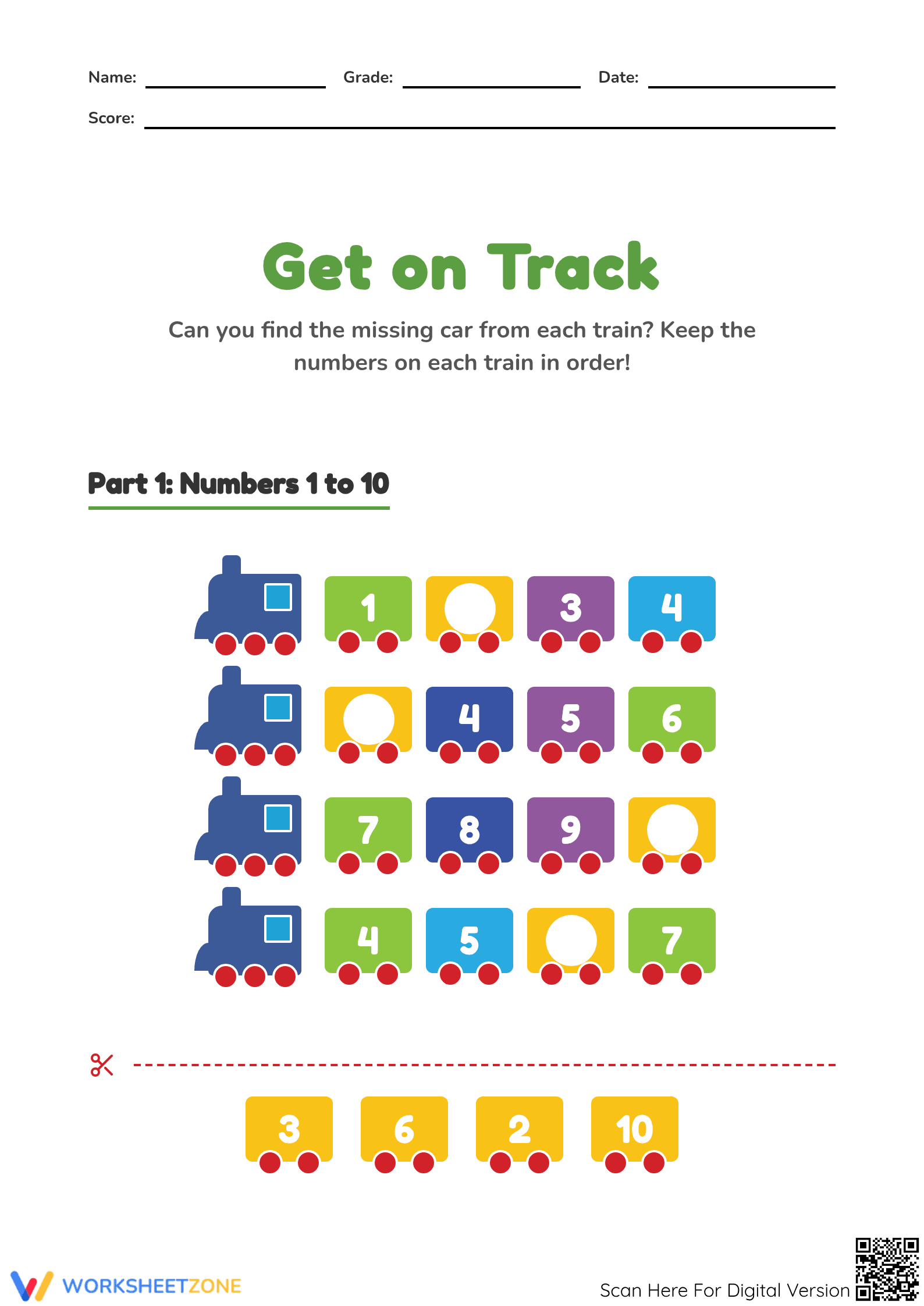


Printable Ordering Numbers 1-20 Train Worksheet | Grade K-1
Paste this activity's link or code into your existing LMS (Google Classroom, Canvas, Teams, Schoology, Moodle, etc.).
Students can open and work on the activity right away, with no student login required.
You'll still be able to track student progress and results from your teacher account.
Mastering number order is a foundational milestone for early mathematicians. This colorful 'Get on Track' worksheet provides an engaging way for students to practice sequencing numbers 1 to 20. By identifying missing numbers in train series, children reinforce numerical continuity and prepare for arithmetic. It is a perfect addition to any math center.
At a Glance
- Grade: Kindergarten · Subject: Math
- Standard:
CCSS.MATH.CONTENT.K.CC.A.2— Count forward beginning from a given number within the known sequence- Skill Focus: Number sequencing and numerical order (1-20)
- Format: 2 pages · 8 problems · Answer key included · PDF
- Best For: Early finishers, math centers, or homework
- Time: 15–20 minutes
This two-part worksheet set features a fun train-themed design. Part 1 focuses on numbers 1-10, while Part 2 extends the challenge to 11-20. Each page contains four train sequences with one missing car. Students can write the missing number or use the cut-and-paste tiles provided at the bottom. The included answer key ensures quick and easy grading for teachers and parents.
Skill Progression
- Guided practice: Trains 1-10 provide significant surrounding context to build student confidence in the basic counting sequence.
- Supported practice: The 11-20 range requires students to apply sequencing skills to challenging 'teen' numbers which often pose difficulty.
- Independent practice: Final trains require recall with fewer anchors, ensuring mental number line mastery without constant visual prompts.
This resource follows a gradual release model, moving students from simple recognition to independent numerical retrieval.
Standards Alignment
This resource aligns with `CCSS.MATH.CONTENT.K.CC.A.2`, which requires students to count forward beginning from any given number within the known sequence. It also supports `CCSS.MATH.CONTENT.K.CC.A.1` by reinforcing the oral counting sequence through visual representation. Both standard codes can be copied directly into lesson plans, IEP goals, or district curriculum mapping tools.
How to Use It
Use this during small-group guided math sessions. Have students 'whisper count' the sequence before identifying the missing car to observe their fluency. Alternatively, place it in a math station for independent work. Provide a number line nearby so students can self-correct their work as they find the missing pieces. Completion typically takes 10 to 20 minutes depending on the student's familiarity with the 11-20 range.
Who It's For
Designed for Kindergarten and Grade 1 students, this worksheet is effective for ELLs and students with IEPs who benefit from visual scaffolds and tactile activities. To extend learning, pair this resource with a physical number line or a counting picture book to provide a multi-sensory instructional experience that bridges the gap between concrete and abstract math.
Developing a strong mental number line is a critical predictor of later mathematical success, as noted in the RAND AIRS 2024 reports on early numeracy. This resource targets the essential skill of number sequencing (CCSS.MATH.CONTENT.K.CC.A.2), helping students move beyond rote counting to understanding the relative position of numbers 1-20. Research from the NAEP highlights that students who can flexibly count from any starting point demonstrate higher proficiency in additive reasoning. By utilizing a familiar 'train' metaphor and providing tactile options, this worksheet reduces cognitive load while increasing engagement. Educators can use these 8 tasks to assess whether students have achieved mastery of the base-ten sequence or require further intervention. This high-utility printable serves as an evidence-based tool for building foundational fluency, ensuring students are ready for the transition to addition and subtraction operations within the primary elementary curriculum.


