




























Views
Downloads

Essential Count & Color Animals Worksheet | Kindergarten

Paste this activity's link or code into your existing LMS (Google Classroom, Canvas, Teams, Schoology, Moodle, etc.).
Students can open and work on the activity right away, with no student login required.
You'll still be able to track student progress and results from your teacher account.
Mastering the relationship between numbers and quantities is a foundational milestone for early learners. This Count & Color Animals worksheet provides a structured environment for students to practice one-to-one correspondence and cardinality through engaging visual tasks. By combining counting with coloring and matching, the resource reinforces numerical recognition while developing essential fine motor skills.
At a Glance
- Grade: Kindergarten · Subject: Math
- Standard:
K.CC.B.4— Connect counting to cardinality and understand number-quantity relationships- Skill Focus: One-to-one correspondence and number matching
- Format: 2 pages · 8 problems · Answer key included · PDF
- Best For: Early morning work or math center rotations
- Time: 15–20 minutes
What's Inside
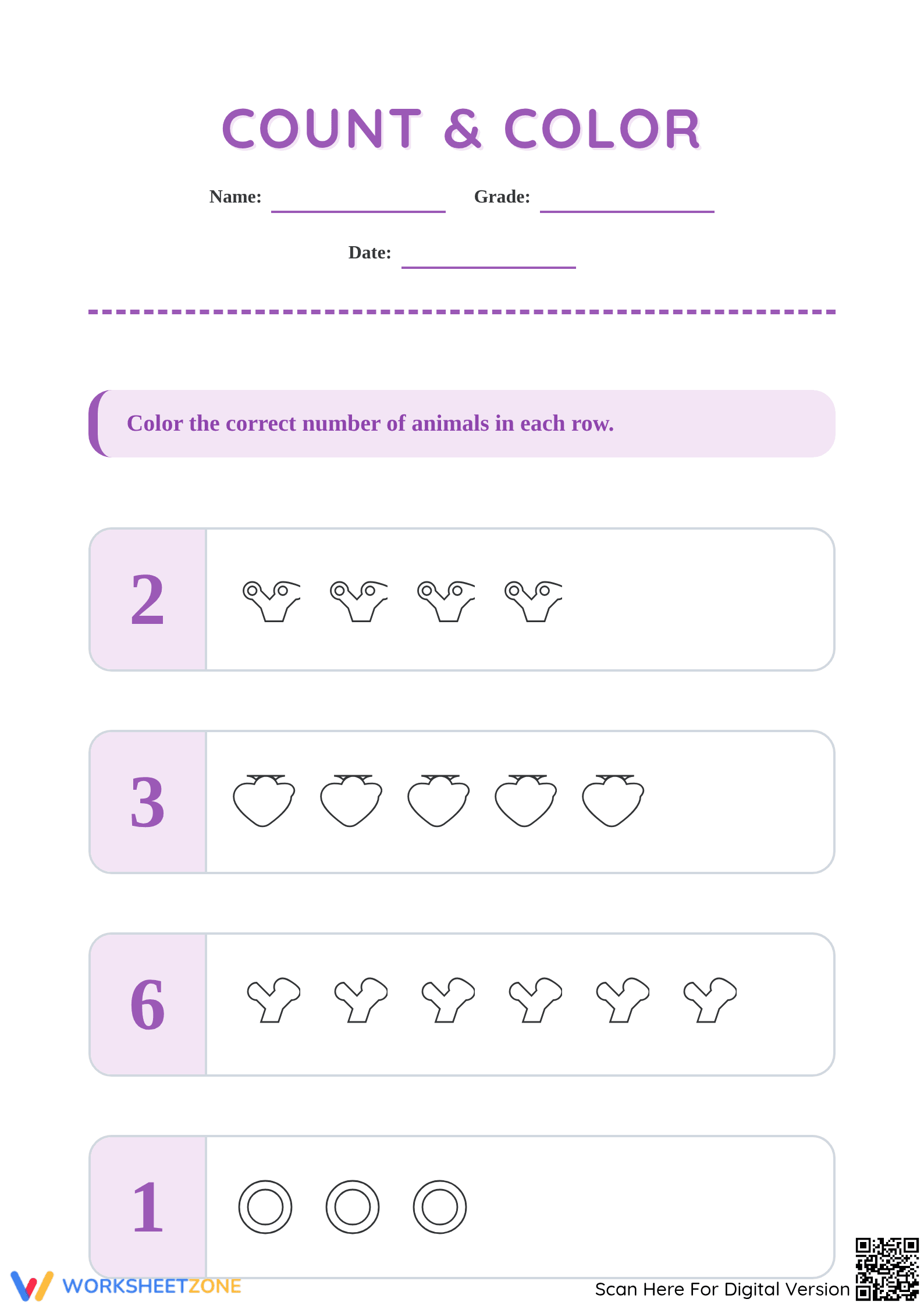
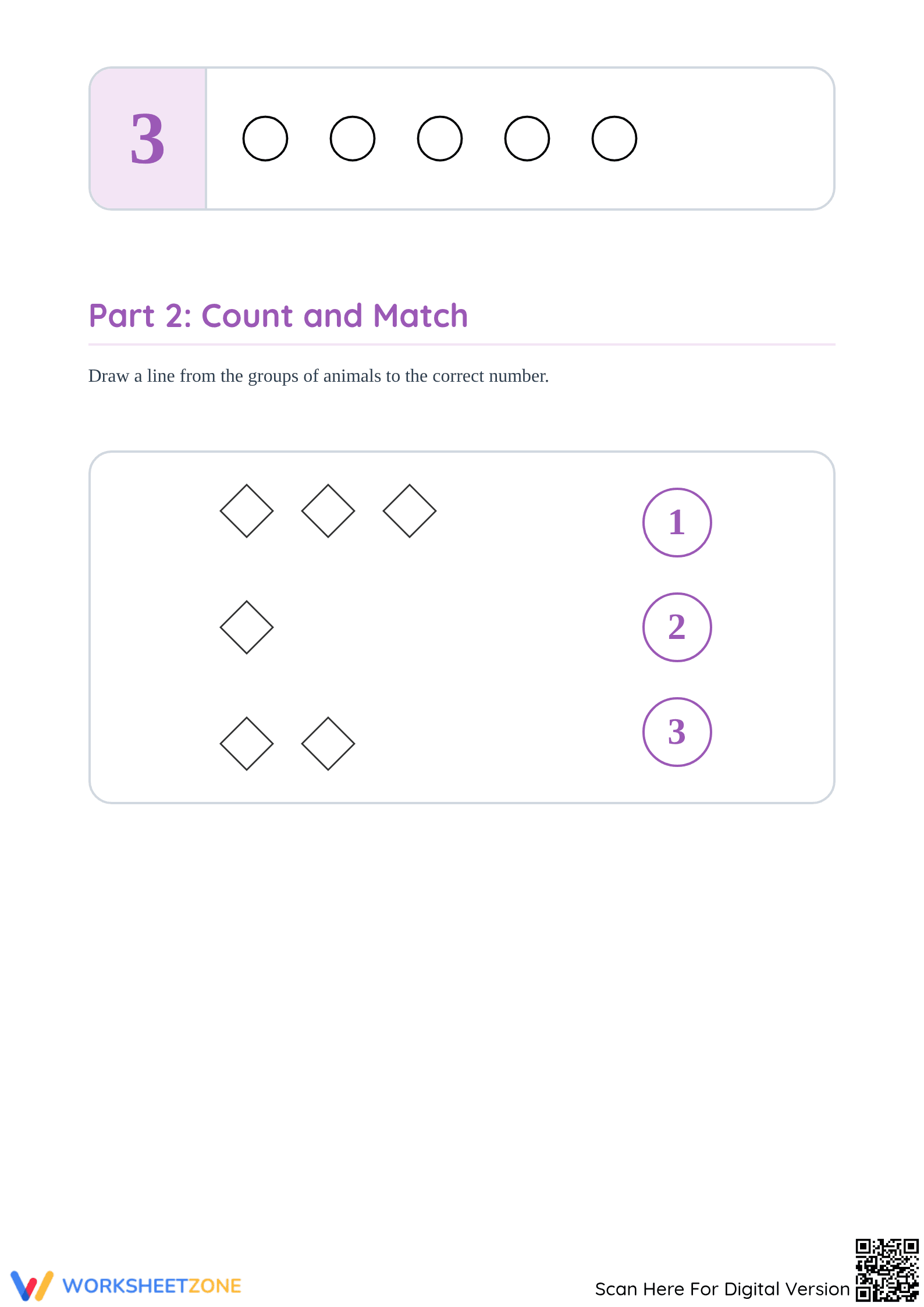
This two-page PDF resource features a clean, high-contrast layout designed specifically for young learners. The first section contains five "Count and Color" rows where students must identify a target number and color the corresponding amount of animal icons. The second section introduces a "Count and Match" activity, challenging students to count groups of shapes and draw lines to the correct numerals. A full answer key is provided for quick grading or student self-correction.
Skill Progression
- Guided Practice: The worksheet begins with small sets of objects presented alongside clear numerals to establish a stable counting rhythm.
- Supported Practice: The middle section increases set sizes, requiring students to maintain focus as they color individual items within a larger group.
- Independent Practice: The final matching section asks students to count pre-arranged groups and independently link them to the correct abstract symbol.
This gradual release model ensures students build confidence with small quantities before moving to higher-order matching and identification tasks.
Standards Alignment
The primary standard addressed is `CCSS.MATH.CONTENT.K.CC.B.4`, which requires students to understand the relationship between numbers and quantities. By requiring students to color a specific number of objects within a larger set, the worksheet specifically targets sub-standard K.CC.B.4.A (pairing one number name with one object) and K.CC.B.4.B (recognizing the total quantity). Both standard codes can be copied directly into lesson plans, IEP goals, or district curriculum mapping tools.
How to Use It
This worksheet is ideal as a formative assessment after an initial lesson on counting. Teachers can use it during small-group rotations to observe students' pointing and counting techniques. Look for finger-tracking behavior as a key indicator that the student is successfully applying one-to-one correspondence. For a quick extension, ask students to count the remaining uncolored items in each row to introduce the concept of "more" and "less" in a concrete way.
Who It's For
This resource is designed for Kindergarten students but is equally effective for Pre-K learners showing readiness for formal math or Grade 1 students needing intervention in basic cardinality. It pairs naturally with physical manipulatives, such as counting bears or blocks, allowing teachers to bridge the gap between concrete objects and semi-concrete pictorial representations during direct instruction.
Drawing on educational research, this worksheet integrates visual-spatial tasks like coloring with numerical recognition to build strong cognitive pathways for early learners. It offers 8 distinct opportunities across two pages, reinforcing cardinality and the "how many" concept in varied visual contexts. The clear, uncluttered design minimizes cognitive load, aligning with best practices for effective early math materials.


