


























Views
Downloads

Grade K Counting Objects — Printable No-Prep Worksheet
Paste this activity's link or code into your existing LMS (Google Classroom, Canvas, Teams, Schoology, Moodle, etc.).
Students can open and work on the activity right away, with no student login required.
You'll still be able to track student progress and results from your teacher account.
This Easter-themed counting worksheet helps Kindergarten students practice one-to-one correspondence and number recognition. By coloring specific quantities and writing numbers to match groups of festive objects, young learners build foundational math skills. The engaging format keeps students focused while reinforcing their ability to accurately count up to ten items.
At a Glance
- Grade: K · Subject: Math
- Standard:
CCSS.MATH.CONTENT.K.CC.B.5— Count to answer how many objects are in a group- Skill Focus: Counting Objects
- Format: 2 pages · 11 problems · Answer key included · PDF
- Best For: Independent practice and morning work
- Time: 10–15 minutes
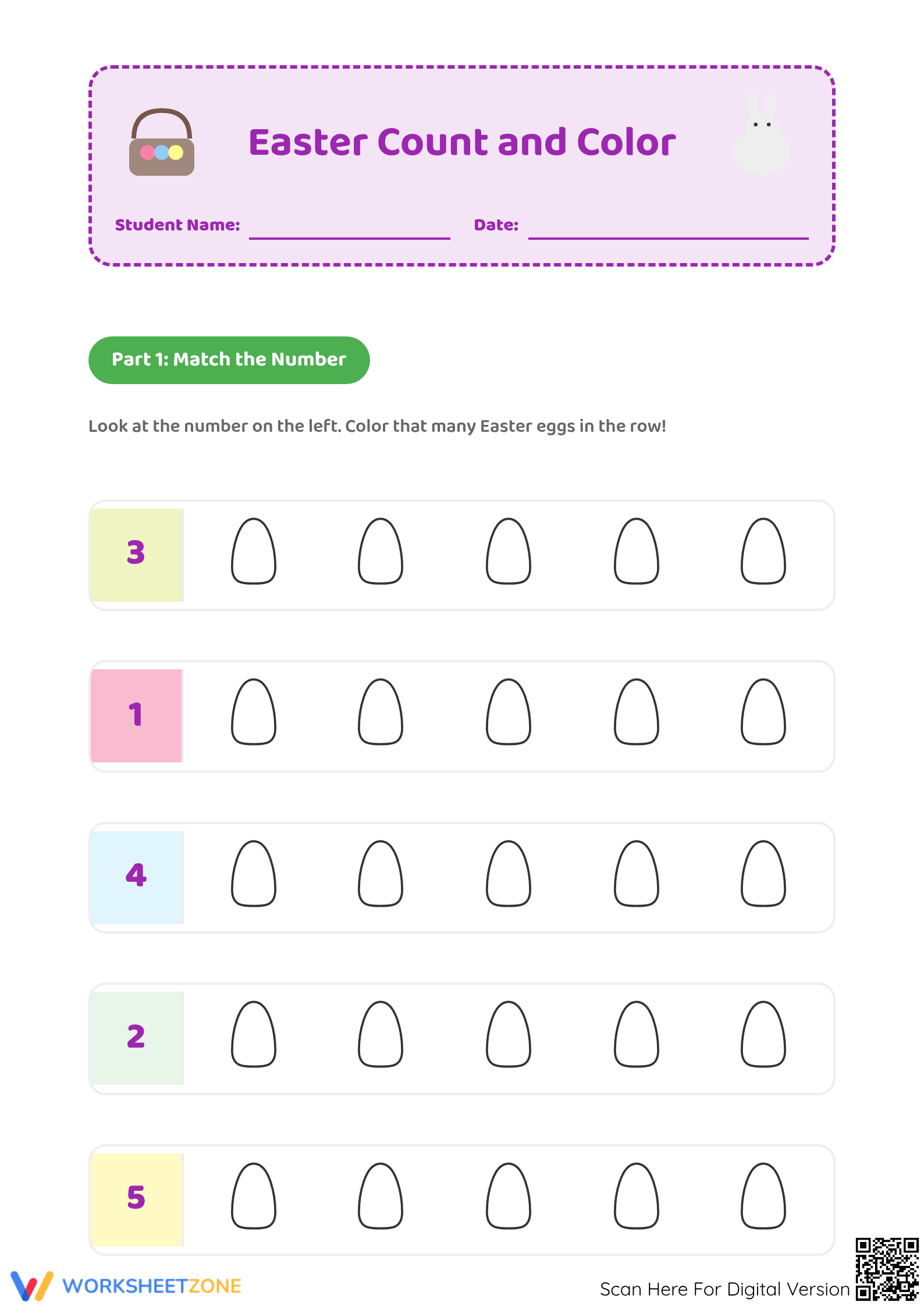
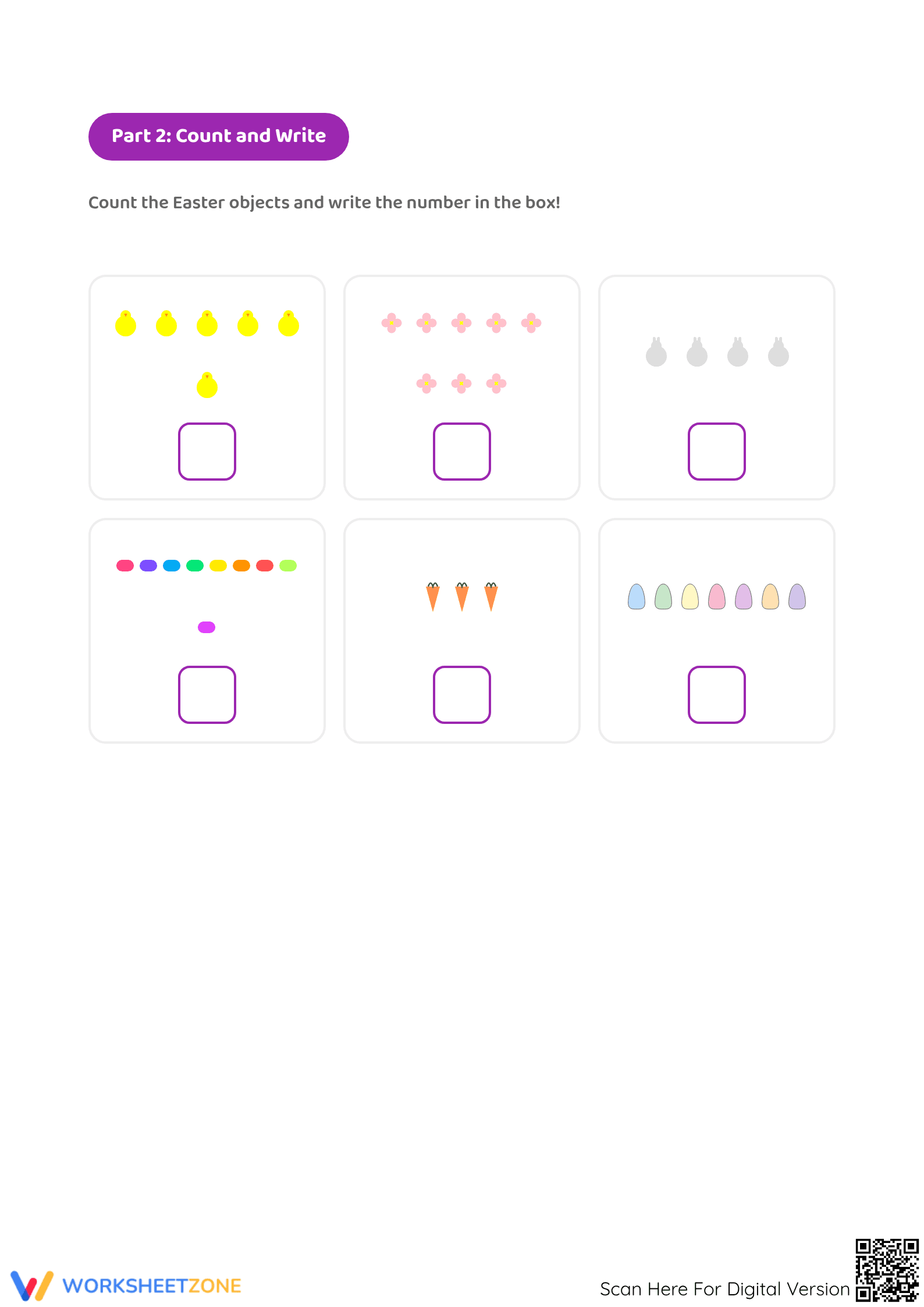
This resource features two distinct activity pages designed to reinforce early numeracy. Part one requires students to read a numeral and color the corresponding number of Easter eggs in a row. Part two prompts learners to count various holiday-themed items—such as chicks, flowers, bunnies, and carrots—and write the correct number in the provided box. A complete answer key is included to ensure quick and accurate grading.
Designed for immediate classroom implementation, this zero-prep resource follows a simple workflow:
- Print (1 minute): Generate the two-page PDF and the accompanying answer key.
- Distribute (1 minute): Hand out the worksheets during morning work, math centers, or as a fast-finisher activity.
- Review (2 minutes): Use the answer key to quickly check student responses or project it for self-correction.
With a total teacher prep time of under two minutes, this activity is highly suitable for emergency sub plans or last-minute schedule changes.
This worksheet is strictly aligned to CCSS.MATH.CONTENT.K.CC.B.5: Count to answer "how many?" questions about as many as 20 things arranged in a line, a rectangular array, or a circle, or as many as 10 things in a scattered configuration. It also supports early number writing and numeral recognition. Both standard codes can be copied directly into lesson plans, IEP goals, or district curriculum mapping tools.
Teachers can utilize this worksheet during independent math centers after direct instruction on counting and cardinality. It serves as an excellent formative assessment tool; while students work, observe whether they are touching each object as they count to ensure one-to-one correspondence. The activity is expected to take most Kindergarten students between 10 and 15 minutes to complete.
This resource is primarily designed for Kindergarten students mastering basic counting skills, but it also serves as a helpful review for first graders needing extra reinforcement. For students requiring additional support, provide physical manipulatives like counting bears or mini erasers to place over the printed objects before coloring or writing. It pairs perfectly with hands-on counting lessons or seasonal anchor charts.
Developing strong foundational numeracy through targeted practice is essential for early childhood education. This resource aligns with CCSS.MATH.CONTENT.K.CC.B.5, focusing on the ability to count to answer how many objects are in a group. According to a recent EdReports 2024 analysis, instructional materials that integrate thematic, visual counting exercises significantly improve student engagement and retention of one-to-one correspondence principles. By combining numeral recognition with physical counting tasks, educators can better assess early mathematical comprehension. Structured worksheets that require both coloring specific quantities and writing numbers provide the dual-modality practice necessary for solidifying these concepts in young learners. This evidence-based approach ensures that students build the cognitive frameworks required for subsequent addition and subtraction skills, making it a vital component of any comprehensive early math curriculum.


